
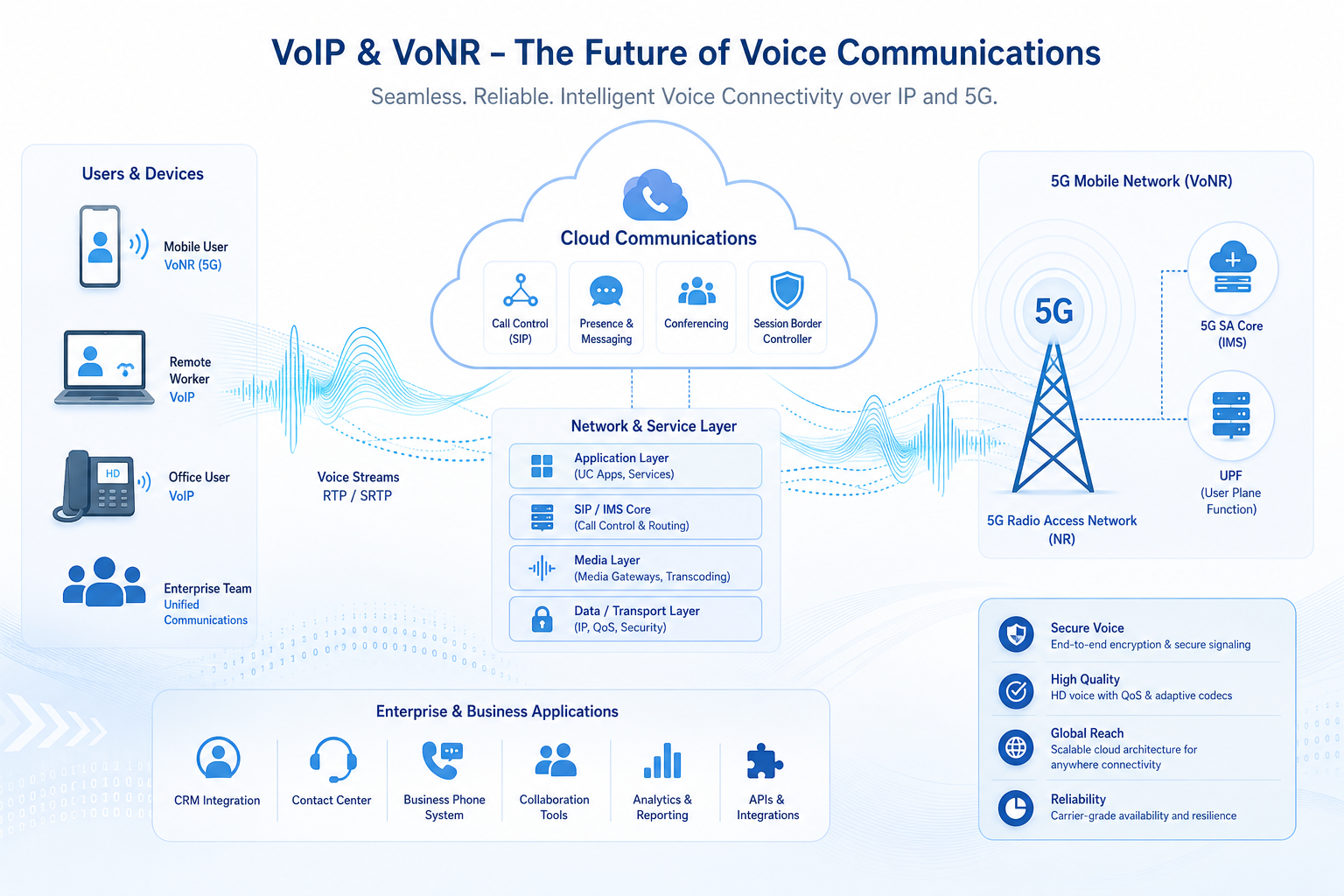
While 5G CPE procurement discussions often center on throughput, spectrum support, and antenna configuration, voice service architecture remains one of the most technically nuanced — and frequently overlooked — evaluation criteria. For operators deploying FWA as a primary broadband service (especially in markets where FWA replaces xDSL and cable), the CPE must deliver carrier-grade voice quality that meets regulatory obligations and subscriber expectations. This guide examines the VoNR and IMS voice architecture considerations that technical buyers should evaluate when sourcing 5G CPE for voice-enabled FWA deployments.
The Voice Evolution in 5G: From CSFB to VoNR
The migration path from circuit-switched voice to fully native 5G voice has been complex. In the 4G era, VoLTE (Voice over LTE) established IMS as the core voice architecture, but early 5G NSA deployments relied on EPS Fallback (EPS-FB) — the CPE temporarily falls back to LTE for voice calls while maintaining the 5G data connection. As standalone (SA) 5G cores proliferate globally, VoNR (Voice over New Radio) is becoming the target architecture, delivering voice calls entirely within the 5G domain with improved call setup times, enhanced codec support, and superior spectral efficiency.
For procurement teams, the critical question is not whether a CPE supports voice — it is which voice architectures are supported, and how seamlessly the transitions are managed:
| Architecture | Call Setup Time | Codec Support | Network Dependency | Maturity |
|---|---|---|---|---|
| EPS Fallback | 1.5-3.0s | AMR-WB (HD Voice), AMR-NB | LTE coverage required | Widely deployed |
| VoNR (5G SA) | 0.8-1.5s | EVS (Super-Wideband), AMR-WB | 5G SA core required | Growing rapidly |
| VoLTE (4G anchor) | 1.0-2.5s | AMR-WB, AMR-NB | LTE coverage | Mature |
IMS Registration and SIP Stack Architecture
At the heart of any voice-capable 5G CPE is the IMS (IP Multimedia Subsystem) client. This embedded software stack handles SIP registration with the operator’s IMS core, manages session establishment and teardown, and enforces QoS policies for voice bearer traffic. Procurement teams should evaluate the IMS implementation across several dimensions:
- SIP stack maturity and interoperability: The CPE’s SIP implementation must interoperate with major IMS core vendors including Ericsson, Nokia, Huawei, and Mavenir. Request interoperability test reports for the specific IMS core versions deployed in target markets.
- IMS APN/DNN configuration: Operators typically dedicate a separate APN (Access Point Name) or DNN (Data Network Name) for IMS traffic, with distinct QoS profiles. The CPE must support concurrent data and IMS PDN connections with proper routing.
- P-CSCF discovery: The CPE should support multiple P-CSCF (Proxy-Call Session Control Function) discovery mechanisms including DHCP options, DNS-based discovery per 3GPP TS 23.228, and manual configuration for fixed-access deployments.
- SIP registration resilience: Support for SIP outbound (RFC 5626) with keep-alive mechanisms, registration refresh timers, and graceful re-registration after network interruptions.
Voice QoS: The 5QI Framework
Voice quality in 5G is governed by the 5G QoS Identifier (5QI) framework, which defines standardized QoS characteristics for different traffic types. For voice services, the critical 5QI values are:
- 5QI 1 (GBR, Conversational Voice): 100ms packet delay budget, 10⁻² packet error rate, guaranteed bit rate. This is the primary QoS class for VoNR bearer traffic and must be supported with true GBR enforcement at the CPE’s modem and application processor.
- 5QI 5 (Non-GBR, IMS Signaling): 100ms packet delay budget, 10⁻⁶ packet error rate. Used for SIP signaling traffic; prioritizes signaling messages to prevent call setup failures under congestion.
The CPE must correctly map these 5QI values to internal packet scheduling queues and enforce appropriate DSCP markings on the LAN side when voice traffic is bridged to an analog telephone adapter (ATA) or IP phone connected to the CPE’s Ethernet port. Failure to properly prioritize voice bearer traffic results in jitter, packet loss, and degraded Mean Opinion Score (MOS) — issues that drive subscriber churn in voice-dependent markets.
Analog Voice Interfaces: FXS Ports and ATA Integration
For FWA deployments that replace traditional fixed-line services, many operators require the CPE to provide FXS (Foreign Exchange Subscriber) ports for connecting existing analog telephones. This is particularly important in markets where subscribers are accustomed to plugging a standard telephone into the wall jack. The CPE’s integrated ATA (Analog Telephone Adapter) function bridges SIP-based IMS voice to analog POTS interfaces.
Key FXS specifications to evaluate:
- Codec transcoding: The CPE must transcode between IMS-native codecs (AMR-WB, EVS) and G.711/G.729 for the analog interface, with minimal processing delay (target: <50ms algorithmic delay).
- Calling features: Support for caller ID (FSK and DTMF-based), call waiting, three-way calling, call forwarding, and DTMF relay (RFC 2833) — matching the feature set of a traditional PSTN line.
- Fax and modem passthrough: T.38 fax relay and G.711 passthrough mode for legacy fax machines and point-of-sale terminals that remain common in small business FWA deployments.
- Ring voltage and REN: Sufficient ring voltage (typically 40-55 Vrms) and Ringer Equivalence Number (REN) to drive at least 3 REN — enough for multiple parallel-connected analog phones.
Emergency Calling and Regulatory Compliance
Voice-capable CPE must support emergency calling (E911, E112) with accurate location information delivery. For fixed FWA deployments, the CPE should support manual location configuration via TR-069/TR-369, allowing operators to provision the installed address for emergency services routing. For nomadic FWA CPE, location determination via network-based positioning or GPS assistance becomes necessary.
Regulatory requirements vary by market but typically include: support for emergency number dialing without prior registration, priority handling of emergency SIP INVITE messages with emergency service URNs per RFC 5031, and location-by-reference or location-by-value delivery in SIP headers.
Procurement Checklist Summary
When evaluating 5G CPE for voice-enabled FWA deployments, procurement teams should verify:
- VoNR support on target 5G SA bands with EPS Fallback as a transitional capability
- IMS SIP stack interoperability with major core vendors (request IoDT reports)
- 5QI 1 GBR enforcement for voice bearer with proper DSCP mapping on LAN ports
- EVS codec support (super-wideband, 13.2 kbps to 128 kbps) for superior voice quality
- FXS port specifications meeting regional analog telephony requirements
- Emergency calling support per local regulatory framework
- Voice MOS testing results under loaded network conditions (>3.8 MOS target)
- Field-upgradeable voice firmware to accommodate evolving IMS core requirements
Voice may not dominate 5G CPE bandwidth consumption, but for operators positioning FWA as a complete fixed-line replacement, voice architecture quality is a make-or-break procurement criterion. The devices that deliver seamless, carrier-grade voice alongside multi-gigabit data are the ones that earn long-term operator contracts in 2026 and beyond.