
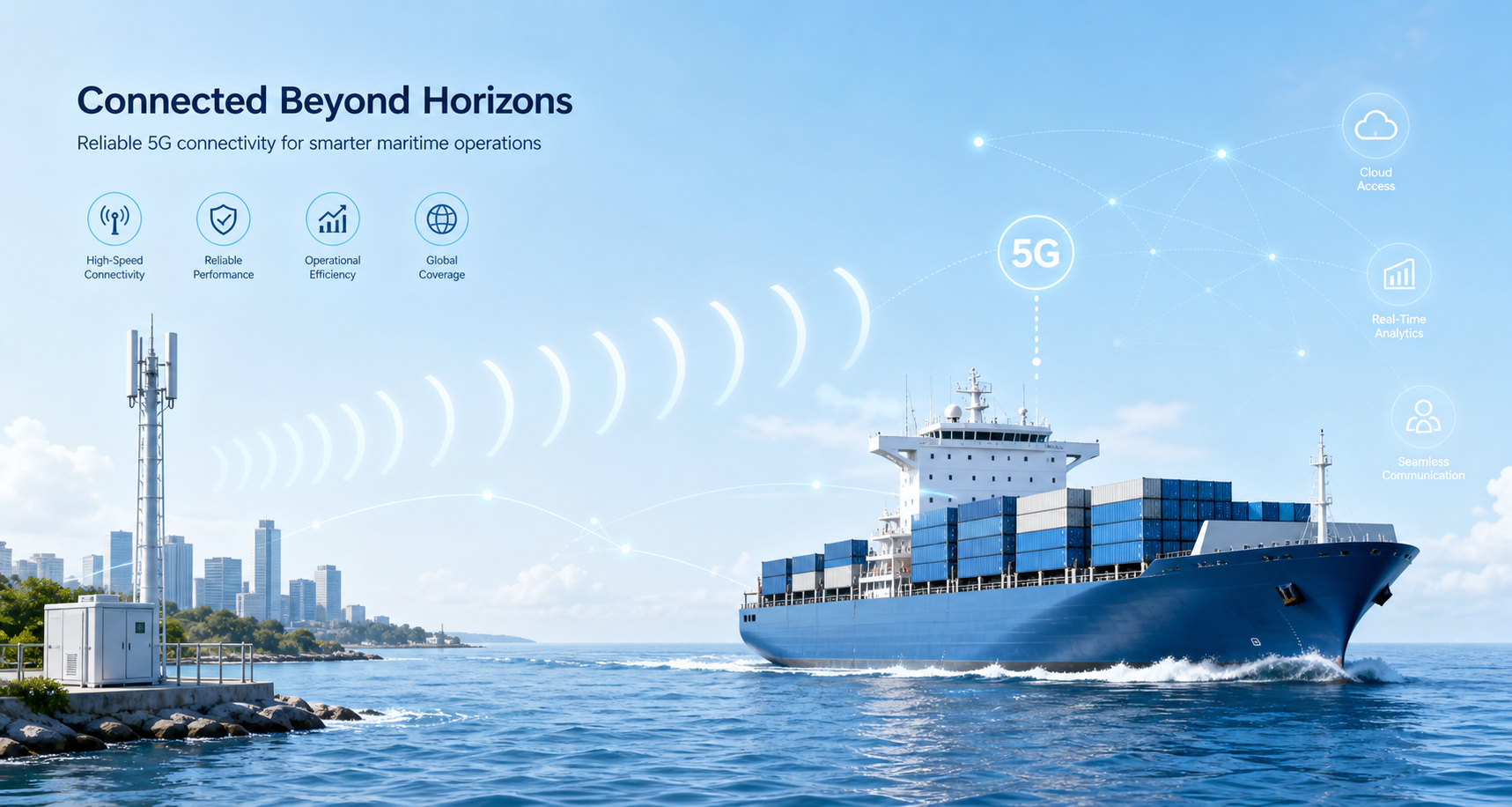
Maritime connectivity is undergoing a fundamental transformation. The traditional model — satellite-dominated, low-throughput, high-latency — is being disrupted by the extension of terrestrial 5G networks into coastal waters, port facilities, and offshore energy installations. For operators, system integrators, and enterprise buyers serving the maritime sector, specifying the right 5G CPE for these extreme environments requires a distinct set of technical evaluation criteria that go well beyond conventional indoor FWA requirements.
The Maritime Connectivity Landscape
Vessels operating within 30-50 km of shorelines can now access multi-gigabit 5G connectivity through high-gain directional antenna systems and extended-range CPE configurations. This near-shore bandwidth — previously only available dockside — is transforming vessel operations: real-time engine telemetry monitoring, crew welfare broadband, electronic navigational chart updates, remote pilotage video feeds, and IoT sensor backhaul for cargo condition monitoring all become practical when reliable high-throughput connectivity is available at sea.
The International Maritime Organization (IMO) estimates that over 60% of global vessel operating time occurs within 50 km of coastlines — exactly the range envelope where 5G extended-range CPE can complement or replace satellite connectivity for primary broadband services.
Environmental Hardening: Beyond Standard Outdoor Ratings
Maritime environments impose unique stresses that exceed typical outdoor telecom equipment specifications. Procurement teams should evaluate CPE against these enhanced criteria:
- Salt spray and corrosion resistance: IEC 60068-2-52 severity level 4 or higher for salt mist testing, with EN 50155 or ISO 12944 C5-M corrosion classification for the enclosure and all external connectors. Stainless steel 316L hardware should be specified for all mounting brackets and fastener assemblies.
- Vibration and shock: IACS UR E10 or DNV GL Class B shock and vibration compliance for bridge and mast-mounted installations. Sustained vibration profiles of 2-13.2 Hz at ±1.0mm displacement and 13.2-100 Hz at 1.0g acceleration are typical certification thresholds.
- Humidity and condensation: GORE-TEX or equivalent breathable membrane vents to equalize internal pressure while preventing moisture ingress. Conformal coating on all PCB assemblies per IPC-CC-830B to prevent corrosion-induced failures in 95%+ RH environments.
- UV and thermal cycling: Marine-grade UV-stabilized enclosure materials rated for 10+ years of direct tropical sun exposure, with operating temperature range of -40°C to +70°C to handle deck-level thermal extremes.
- EMI/EMC: Compliance with IMO EMC standards for bridge equipment — deck-mounted CPE must not interfere with navigation, communication, or radar systems operating in adjacent frequency bands.
Antenna Systems for Extended Maritime Range
Achieving reliable 5G connectivity at 30-50 km offshore distances requires antenna configurations that depart significantly from indoor CPE designs. Key considerations include:
- High-gain directional antenna arrays: 4×4 MIMO panel antennas with 10-14 dBi gain per element, optimized for n78 (3.5 GHz) and n28 (700 MHz) bands — the primary bands for coastal 5G coverage in most regions. The directional pattern should provide 30-45° horizontal beamwidth for practical vessel steering tolerance.
- Antenna stabilization: For smaller vessels subject to roll and pitch, active antenna stabilization (mechanical or electronic beam-steering) maintains optimal base station alignment. The stabilization system should correct for ±30° of motion with <2° pointing accuracy.
- Dual-antenna diversity with intelligent switching: Forward and aft-facing antenna arrays with automatic selection based on signal quality metrics (RSRP, SINR) as the vessel changes heading relative to shore-based cell sites.
- LMR-600 or equivalent low-loss cabling: At vessel-scale cable runs (20-50m from mast to below-deck CPE), cable loss at 3.5 GHz becomes significant. LMR-600 (approximately 6.5 dB/100m at 3.5 GHz) or active RF-over-fiber solutions may be necessary to maintain link budget.
Multi-WAN Architecture: 5G + Satellite + Wi-Fi
Maritime CPE must function as an intelligent multi-WAN gateway that seamlessly integrates multiple connectivity sources:
- Primary WAN (5G NR): Terrestrial 5G connectivity for near-shore and port operations, delivering multi-gigabit throughput with sub-20ms latency.
- Secondary WAN (LEO/MEO/GEO Satellite): Automatic failover to satellite connectivity when beyond 5G coverage range. Modern LEO constellations (Starlink Maritime, OneWeb) now deliver 100-350 Mbps with 25-50ms latency — sufficient for most vessel operational systems during deep-sea passages.
- Tertiary WAN (Wi-Fi as WAN): Automatic connection to marina and port Wi-Fi networks when available at berth, reducing satellite data consumption during extended port stays.
The failover logic must be configurable with hysteresis — avoiding flapping between 5G and satellite as the vessel transits the coverage boundary. Typical parameters include minimum signal strength thresholds (e.g., RSRP > -115 dBm for >30 seconds before switching to 5G) and bandwidth-based policies (e.g., route high-volume traffic to 5G when available, keep low-bandwidth telemetry on satellite for continuity).
Power Architecture for Marine Electrical Systems
Vessel electrical systems present unique power challenges that CPE procurement must address:
- Wide-input DC power: Support for 9-36V DC or 18-75V DC input ranges to accommodate 12V, 24V, and 48V marine electrical systems without external converters. Galvanic isolation (>1500V) between the DC input and the CPE chassis to prevent ground-loop corrosion.
- Battery backup integration: Support for external 12V/24V battery banks with intelligent charging management. The CPE should gracefully power down non-essential services (high-throughput data, Wi-Fi) while maintaining critical telemetry and voice connectivity on battery.
- Power consumption optimization: Configurable power profiles — full-performance mode for active operational periods, low-power mode for anchor/mooring periods where only periodic telemetry transmission is required. Target <15W consumption in low-power mode for extended battery operation.
Offshore Energy: A Growing CPE Market
Beyond vessels, offshore energy installations — wind farms, oil and gas platforms, and floating production storage and offloading (FPSO) units — represent a rapidly growing market for specialized 5G CPE. These fixed installations benefit from dedicated 5G private network deployments or directional links to shore-based macro cells, with CPE requirements that emphasize:
- Explosion-proof certifications: ATEX Zone 2 / IECEx Zone 2 compliance for CPE installed in potentially hazardous areas on oil and gas platforms.
- Fiber backhaul interfaces: SFP/SFP+ ports for direct fiber connection to platform LAN infrastructure when the CPE serves as the shore-to-platform WAN gateway.
- Industrial protocol support: Modbus TCP, Profinet, and OPC-UA for integration with platform SCADA and industrial control systems.
Certifications and Classification Society Approvals
Maritime CPE must navigate a complex regulatory and classification landscape. Technical buyers should verify that target CPE platforms hold or are on track for:
- Type approval from major classification societies: DNV, Lloyd’s Register, Bureau Veritas, ABS, and ClassNK type approval for maritime communication equipment.
- Wheelmark (MED) certification: EU Marine Equipment Directive 2014/90/EU compliance for CPE destined for EU-flagged vessels.
- FCC and CE-RED: Radio equipment compliance for 5G NR bands in target deployment regions, with specific attention to maritime mobile service allocations.
- Inmarsat/FleetBroadband compatibility: For CPE that must coexist with existing satellite communication terminals without mutual interference.
Procurement Checklist Summary
When evaluating 5G CPE for maritime and offshore deployments, procurement teams should verify:
- Salt spray corrosion resistance: IEC 60068-2-52 severity 4+, EN 50155 enclosure classification
- High-gain external antenna support: 4×4 MIMO with 10+ dBi gain, N-type or QMA RF connectors
- Multi-WAN with intelligent failover: 5G → LEO/MEO Satellite → Wi-Fi, with configurable hysteresis
- Wide-input DC power: 9-36V or 18-75V DC with galvanic isolation
- Class society type approvals: DNV, LR, BV, ABS, or ClassNK certification
- Vibration and shock: IACS UR E10 or DNV GL Class B compliance
- Extended temperature range: -40°C to +70°C operating
- Industrial protocol support: Modbus TCP, OPC-UA for platform SCADA integration
- Low-loss cabling provisions: Support for LMR-600 or active RF-over-fiber at 20m+ cable runs
Maritime 5G is not a niche anymore — it is a fast-growing segment where specialized CPE specifications directly determine operational capability and crew safety. For operators and integrators serving the maritime market, the CPE procurement criteria outlined here represent the minimum viable specification for production deployments in 2026.