
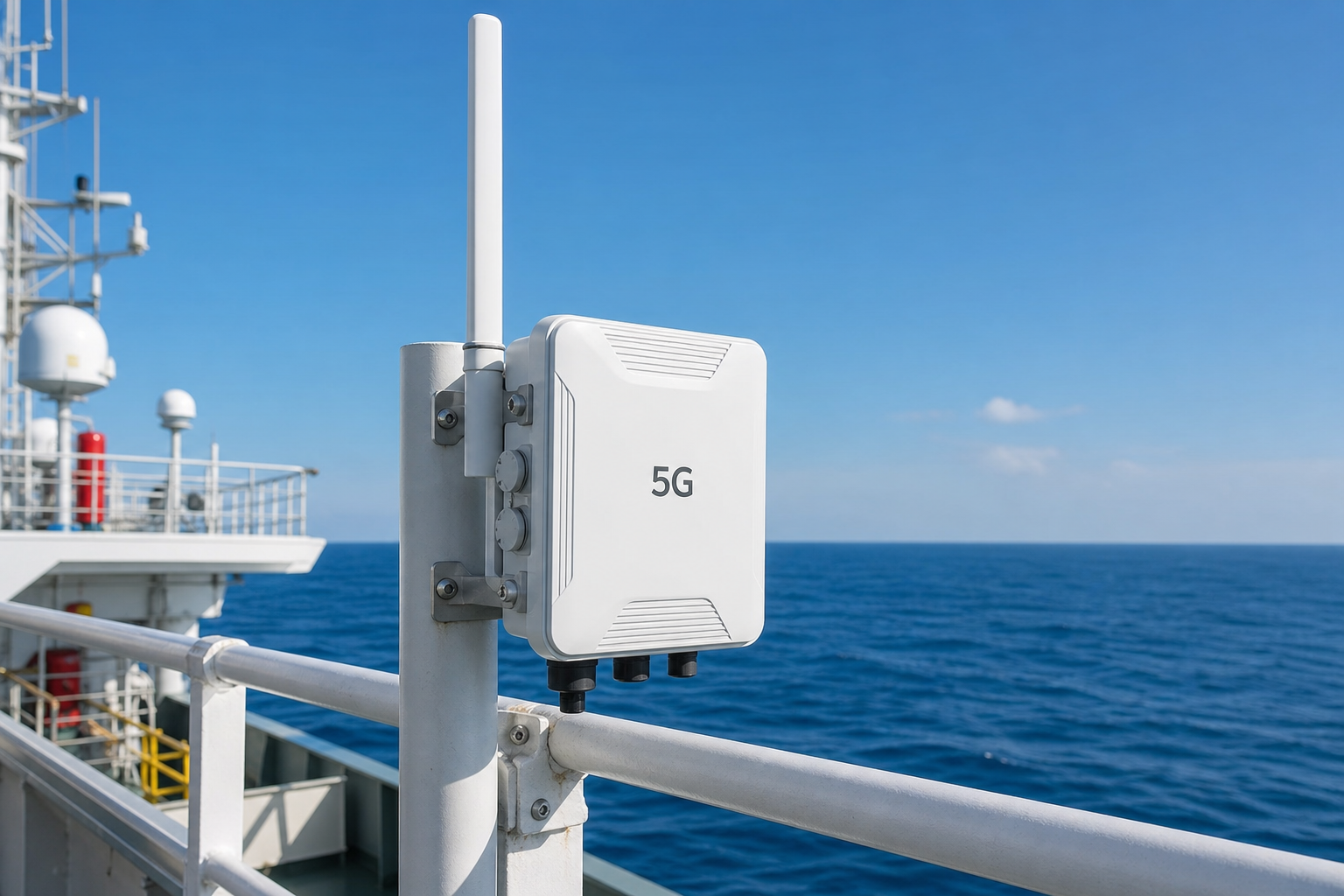
Maritime and offshore industries represent one of the fastest-growing segments for 5G Fixed Wireless Access. From commercial shipping fleets to offshore oil and gas platforms, wind farms, and cruise liners, the demand for high-bandwidth, low-latency connectivity at sea is driving a new class of ruggedized 5G CPE designed for maritime operating conditions.
The Maritime Connectivity Challenge
Providing reliable broadband to vessels and offshore installations presents unique engineering challenges. Salt spray corrosion, extreme vibration, wide temperature swings, and the constant motion of maritime environments demand CPE hardware that far exceeds commercial-grade specifications. Simultaneously, coverage at sea requires intelligent handover between terrestrial 5G coastal networks, satellite backhaul, and private offshore network infrastructure.
Traditional satellite-only solutions — while ubiquitous — suffer from high latency (600ms+ for GEO satellites) and limited throughput. Integrating 5G CPE as the primary near-shore and port connectivity layer, with seamless failover to LEO/MEO satellite constellations beyond coastal range, creates a hybrid WAN architecture that delivers fiber-like performance where it matters most.
Coastal 5G Coverage Strategies
Coastal 5G deployments using the n28 (700MHz) and n71 (600MHz) bands now routinely achieve 30-50km offshore range with directional high-gain antennas. When combined with n78 (3.5GHz) for near-shore high-capacity zones, maritime operators can maintain multi-hundred-megabit throughput within 15km of the coast and reliable narrowband connectivity at extended ranges.
Advanced maritime 5G CPE devices incorporate Doppler-shift compensation algorithms to maintain stable connections at vessel speeds exceeding 30 knots, a critical capability for high-speed ferries and patrol vessels. Multi-SIM architectures with intelligent operator selection ensure continuous coverage across territorial water boundaries.
Satellite-WAN Integration Architecture
The defining feature of maritime-grade 5G CPE is seamless multi-WAN integration with satellite terminals. Modern platforms support simultaneous connections to 5G NR, Starlink Maritime, OneWeb, and traditional VSAT, with policy-based traffic steering that routes latency-sensitive applications (VoIP, real-time monitoring, video conferencing) over 5G when available, while bulk data and background synchronization traverse satellite links.
Key architectural considerations include support for GRE and VXLAN tunneling to maintain consistent IP addressing during WAN transitions, hardware-accelerated IPSec for secure backhaul to onshore corporate networks, and QoS policies that prioritize safety-of-life communications above entertainment traffic.
Ruggedization and Certification Requirements
Maritime 5G CPE must meet stringent environmental and safety certifications. DNV GL type approval, IACS E10 compliance for bridge equipment, IP67 or IP68 ingress protection, and operating temperature ranges from -40°C to +70°C are baseline requirements. Antenna housings must withstand 100-knot wind loads and continuous salt spray exposure without performance degradation.
Vibration resistance per IEC 60068-2-6 and shock resistance per IEC 60068-2-27 ensure reliability in engine-room-adjacent installations and heavy-sea conditions. For hazardous-area deployments — common on oil and gas platforms — ATEX/IECEx Zone 2 certification may be required.
Procurement Checklist for Maritime B2B Buyers
- Verify DNV/IACS certification status for intended vessel class
- Confirm multi-WAN capability with supported satellite constellations (Starlink, OneWeb, VSAT)
- Assess Doppler compensation performance at target vessel speeds
- Evaluate antenna options: integrated high-gain directional vs. external marine-grade MIMO
- Review IP rating and corrosion resistance (316L stainless steel hardware preferred)
- Confirm remote management support via TR-369 USP or proprietary NMS
- Validate ATEX/IECEx certification if deploying in hazardous zones
Honlly Telecom offers purpose-built maritime 5G CPE solutions engineered for the world’s harshest operating environments. Our industrial-grade platforms deliver reliable, high-performance connectivity from port to open water.
Frequently Asked Questions
Q: What is the maximum offshore range for coastal 5G CPE?
A: With n28/n71 low-band spectrum and high-gain directional antennas, reliable connectivity at 30-50km is achievable. Near-shore high-capacity n78 coverage typically extends 12-15km.
Q: Can maritime 5G CPE maintain connections during rough seas?
A: Yes, Doppler-shift compensation and advanced beam tracking algorithms maintain stable links at vessel speeds up to 30+ knots and in Sea State 5-6 conditions.
Q: How does multi-WAN failover work between 5G and satellite?
A: Policy-based routing with sub-second failover using BFD (Bidirectional Forwarding Detection) ensures seamless transition. GRE/VXLAN tunneling maintains session persistence across WAN transitions.
Q: Is ATEX certification available for offshore oil and gas deployments?
A: Yes, select maritime 5G CPE models are available with ATEX/IECEx Zone 2 certification for hazardous-area installations.
Contact Honlly Telecom to discuss maritime and offshore 5G CPE solutions for your fleet or installation.