
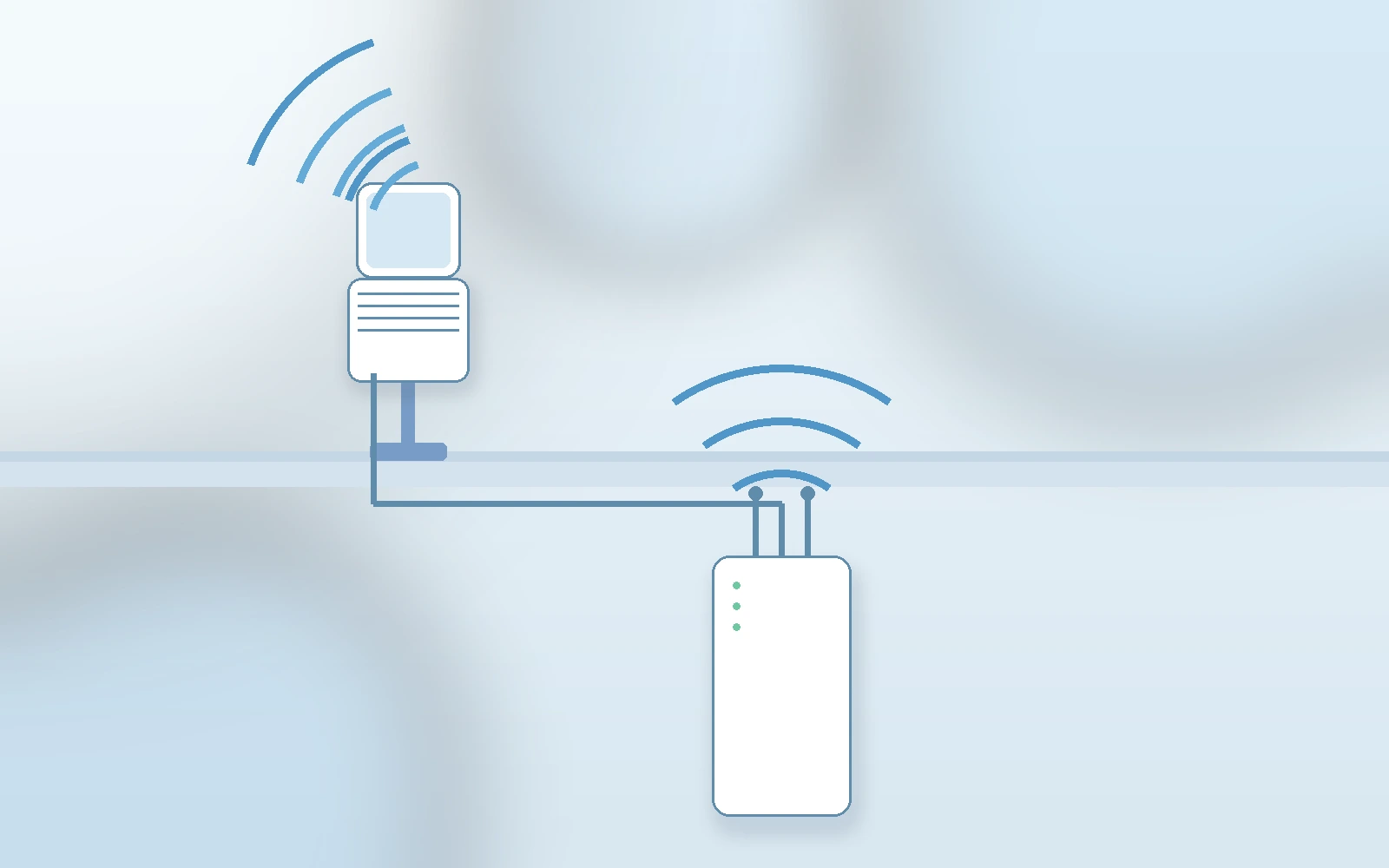
The outdoor unit (ODU) + indoor unit (IDU) split architecture has quietly become the default for carrier-grade 5G fixed wireless access (FWA). Mounting the radio and antenna on the rooftop and keeping routing, Wi-Fi and power indoors delivers higher signal-to-interference-plus-noise ratio (SINR), removes long coax losses and lets operators reach cell-edge subscribers a single-box gateway never could. But the split design also pushes a new set of procurement decisions onto the rooftop — and getting them wrong shows up fast in return rates, truck rolls and total cost of ownership.
For ISP, MVNO and operator procurement teams, here is the field checklist that separates a deployable carrier-grade ODU from a device that looks good on a datasheet.
Why the ODU/IDU Split Is Winning Carrier Deployments
In a split architecture the ODU handles the RF chain — antenna, front-end, modem — and the IDU handles the IP layer, Wi-Fi, Ethernet switching and power. That separation has three practical payoffs. First, the antenna lives where the signal is, typically 5–10 dB better than an indoor window position. Second, a short outdoor link (PoE cable or fiber) replaces the long, lossy coax runs that sapped legacy outdoor-CPE performance. Third, indoor electronics no longer need to survive rain, UV and temperature swings, which simplifies thermal design and cuts cost.
The trade-off is real, though: the operator now owns a weather-exposed, powered, remotely-managed asset at height, and every selection criterion below flows from that fact.
1. Antenna Gain vs. Beamwidth: The Cell-Edge Balancing Act
Antenna gain, measured in dBi, is the first number buyers reach for — and the easiest to misuse. A 10–12 dBi directional antenna can pull a weak mid-band cell-edge signal up to usable throughput, but higher gain means a narrower beam. A 12 dBi unit that is 10 degrees off-axis may perform worse than an 8 dBi unit aimed correctly.
What to verify on the datasheet: gain across the operating bands (not just the headline peak), azimuth and elevation beamwidth, and polarization. For self-install and semi-skilled installs, a wider beamwidth with slightly lower gain often wins on total deployment success because alignment tolerance is forgiving. For fixed, professionally-installed rooftop sites, a high-gain narrow-beam unit is justified. Ask vendors for gain plots per band, not a single marketing number.
2. Weatherproofing: IP67 vs. IP68, UV and Thermal Headroom
IP ratings are the most commonly misread spec in ODU procurement. IP67 means the enclosure survives temporary immersion (up to 1 metre for 30 minutes); IP68 means continuous immersion, with depth and duration specified by the vendor. For a rooftop unit, IP67 is usually sufficient — the real stress is wind-driven rain, dust and UV, not submersion.
The specs that predict field survival are often the quieter ones: UV-rated enclosure material that will not yellow and crack over five years, an operating temperature window of −40°C to +55/60°C (not just storage temperature), and a stated ingress path for the cable gland. Confirm whether the IP rating applies to the unit with the cable and connector installed, because an open gland is where most water actually enters.
3. PoE Power Budget and Cable Length
ODUs are almost always powered over Ethernet from the IDU, and the power budget is a silent killer of installations. A 5G ODU with carrier aggregation can draw 15–25 W or more; with 802.3bt (PoE++, up to 60–90 W) you have headroom, but with 802.3at (30 W) a high-power ODU plus a long cable run can brown-out under load.
Check three numbers together: the ODU’s maximum power draw, the PoE class the IDU actually delivers, and the maximum cable length at that class. Voltage drop over a 60–100 m outdoor-rated Cat6 run is real. Procurement should specify a minimum PoE class and a minimum cable gauge in the BOM, not assume the vendor’s bundled cable will work at distance.
4. Interoperability and Multi-Vendor Lock-In
The most expensive ODU mistake is the one that locks you to a single vendor. In a split architecture, the ODU-to-IDU interface is frequently proprietary, which means a firmware or supply issue on one side forces a paired swap on both. Before committing, ask: is the ODU/IDU pair sold and supported as a unit, or are there standardized interfaces that let you mix vendors?
For operators planning multi-vendor sourcing or gradual network migration, favor vendors that expose a documented management plane (TR-369 USP is the emerging standard here) and whose ODU can be managed, monitored and firmware-updated independently of the IDU. Multi-vendor interoperability is also a lever in price negotiation — a locked pair is a single point of pricing power.
5. Remote Management: The Opex That Decides TCO
An ODU you cannot see is an ODU you must roll a truck to. Remote management requirements are not optional at carrier scale: TR-369 (User Services Platform) for modern device management, zero-touch provisioning so units self-configure on first boot, and FOTA so the fleet stays patchable without site visits. Confirm the ODU reports RF KPIs — RSRP, RSRQ, SINR, cell ID, band — and not just “online/offline”, because that telemetry is what lets a NOC diagnose a weak-signal or interference fault remotely instead of dispatching a technician.
6. Return Rate and Off-Grid Rate: Read the Field Data, Not the Brochure
The single most useful procurement question is not on most RFQs: “What is your field return rate and off-grid rate at 12 months for this ODU, by climate zone?” Vendors that can answer it — and can separate hardware failure from mis-installation — are the ones with a mature quality process. A cheap ODU with a marginal IP rating and no remote telemetry will “win” on CAPEX and lose decisively on TCO once field failure, replacement and truck-roll costs are added. Ask for failure-mode Pareto data, not just a MTBF number.
The Field Checklist, in One View
- Antenna: gain plots per operating band, beamwidth, polarization — not a headline dBi figure.
- Enclosure: IP67 minimum, UV-rated material, operating temp −40°C to +55/60°C, IP rated with cable installed.
- Power: maximum draw vs. PoE class (802.3at/bt) and max cable length at that class.
- Interoperability: standardized or documented ODU/IDU interface, independent ODU management.
- Management: TR-369 USP, zero-touch provisioning, FOTA, RF KPI telemetry (RSRP/RSRQ/SINR/cell/band).
- Field data: 12-month return rate and off-grid rate by climate zone, with failure-mode breakdown.
The ODU is where 5G FWA either works at the cell edge or quietly fails in the field. Scoring vendors against these six criteria — instead of against a single CAPEX-per-unit number — is the difference between a deployment that scales and one that gets rebuilt a year later.