
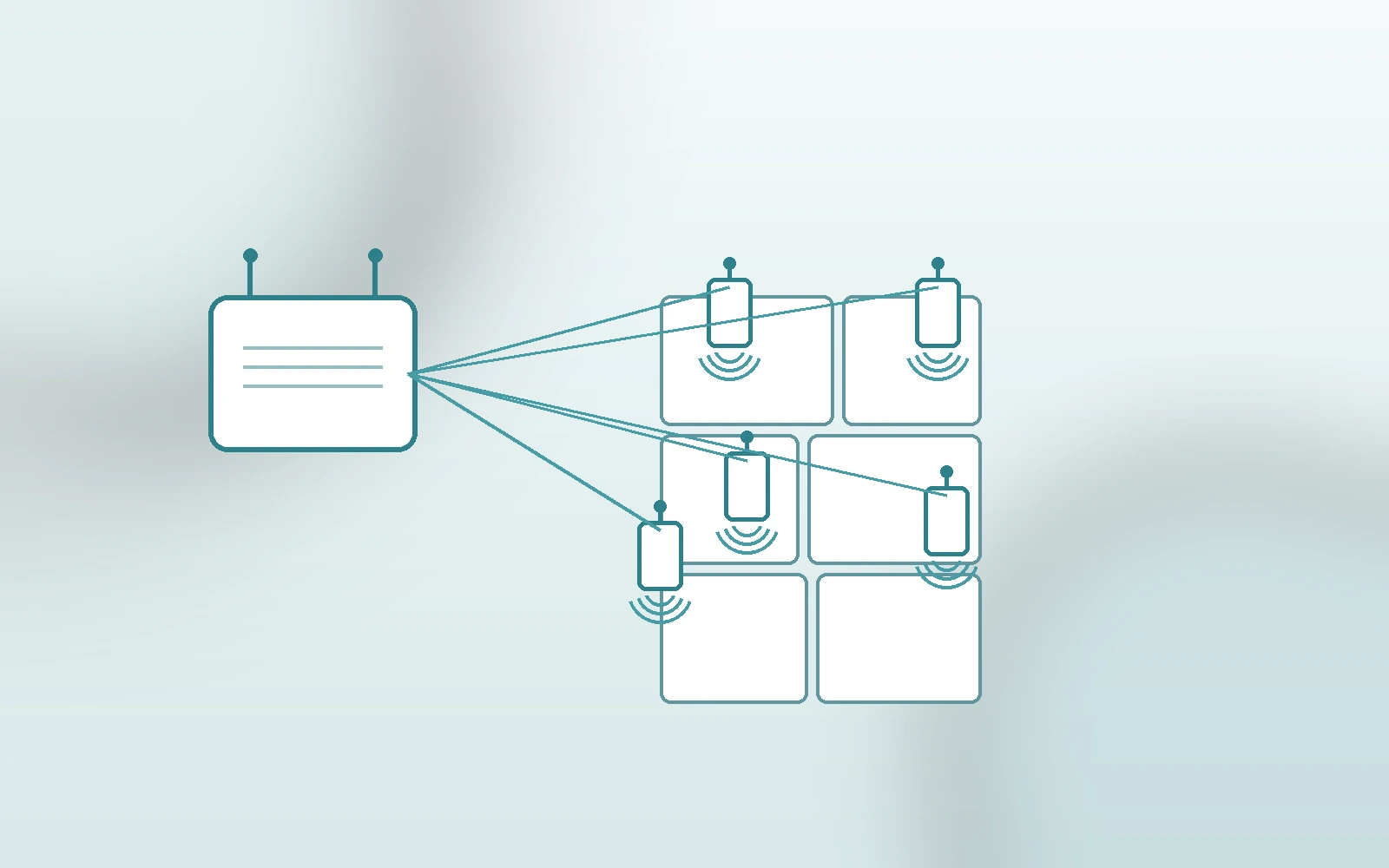
A 5G FWA gateway can deliver a gigabit or more to the home, but that performance means nothing if it stalls at a single access point. Thick walls, multiple floors and distant rooms all erode Wi-Fi throughput long before the WAN link is exhausted. For operators, whole-home coverage is not a premium add-on; it is the difference between a satisfied subscriber and a churn risk. Wi-Fi EasyMesh has emerged as the standardised way to deliver that coverage without locking an operator into a single vendor’s proprietary mesh.
What Wi-Fi EasyMesh is
Wi-Fi EasyMesh is a multi-vendor, standards-based framework from the Wi-Fi Alliance that lets a controller device—typically the main gateway or router—manage a set of agent devices, usually extenders, as one coordinated network. It standardises device onboarding, automatic channel and band selection, client steering between access points, and network diagnostics. The key difference from proprietary mesh is interoperability: an operator can combine a gateway and extenders from different vendors, or add an EasyMesh extender to an existing deployment, without rebuilding the network.
Why EasyMesh beats proprietary mesh for operators
Proprietary mesh systems are optimised but closed: every node must come from the same vendor, which constrains supply, pricing and long-term roadmap. EasyMesh gives operators procurement flexibility, avoids single-vendor lock-in and lets them introduce extenders incrementally. It also simplifies the subscriber experience—one network name, one password, one management view—while giving the operator consistent diagnostics and steering behaviour across a mixed fleet.
Band and client steering, and backhaul design
Two engineering details decide whether whole-home Wi-Fi actually performs. Band steering moves capable clients from the congested 2.4 GHz band to 5 GHz or 6 GHz, while client steering nudges a device toward the access point that will serve it best as the subscriber moves around the home. Backhaul is the other half: extenders should ideally connect over wired Ethernet for the highest throughput, with wireless backhaul—ideally on a dedicated band—as the fallback where cable is impractical. Buyers should confirm both the steering behaviour and the backhaul options a device actually supports.
The operator business case
- Fewer truck rolls: self-install extenders and remote diagnostics cut the costliest part of FWA support.
- Lower churn: reliable whole-home Wi-Fi addresses the most common broadband complaint—dead zones.
- Upsell opportunity: whole-home coverage is a natural premium tier and a reason to retain subscribers.
- Future-proofing: an EasyMesh architecture accepts Wi-Fi 6/6E/7 extenders as the network evolves without a gateway rip-and-replace.
Evaluation checklist for whole-home multi-AP FWA
- Wi-Fi EasyMesh certification on both the gateway (controller) and extenders (agents)
- Band steering and client steering enabled and working across a mixed-vendor setup
- Backhaul options: wired Ethernet and, for wireless, a dedicated or 5/6 GHz band
- Seamless onboarding with a single SSID and password across all nodes
- Remote management and per-node diagnostics via TR-069/TR-369
- Wi-Fi 6 or later on the gateway, with an upgrade path to Wi-Fi 7 extenders
The WAN is only half of the fixed wireless promise. By specifying Wi-Fi EasyMesh and a proper whole-home multi-AP architecture, operators can deliver full-rate connectivity to every room, cut their support burden and turn the in-home experience into a reason subscribers stay—not a reason they leave.