
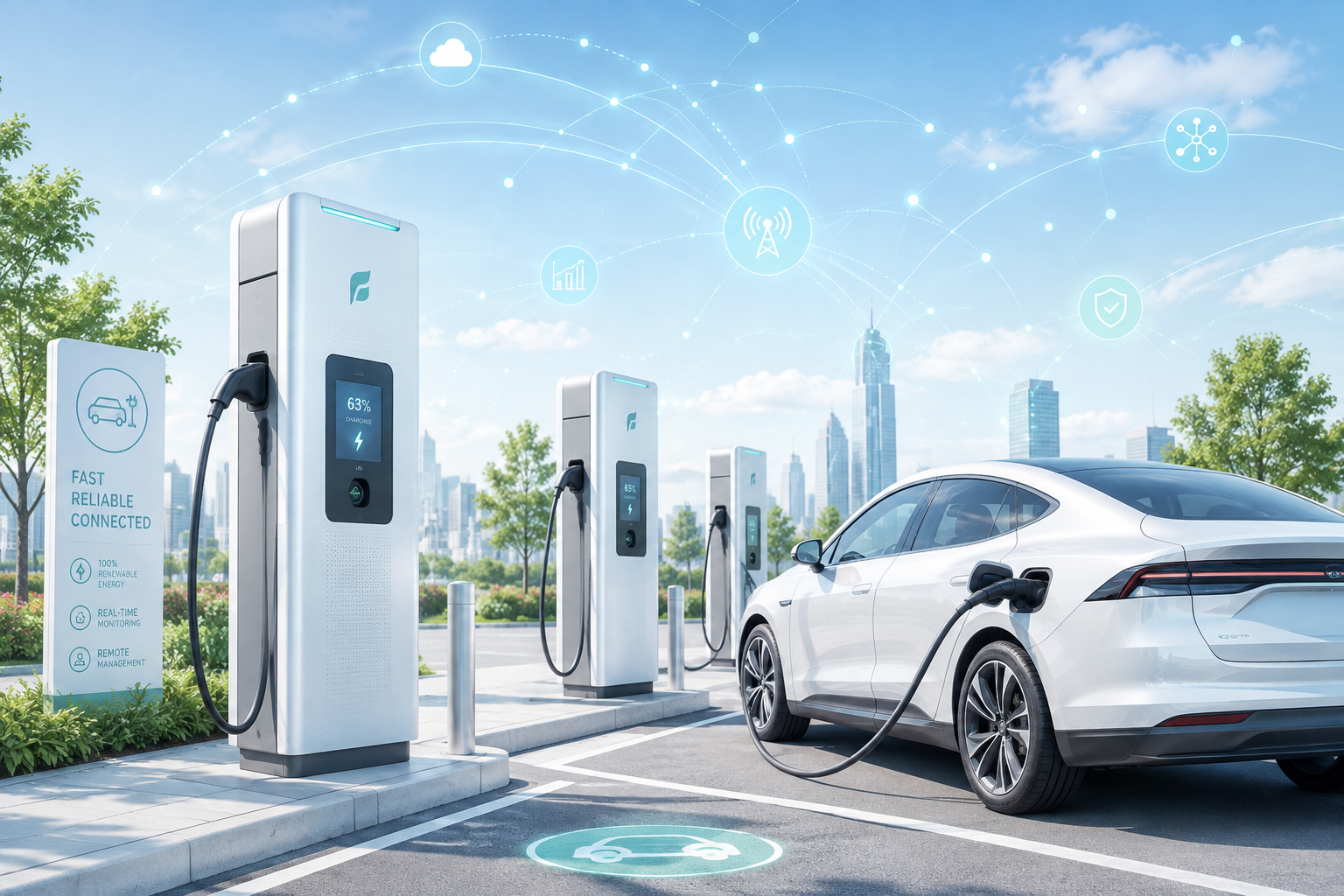
Electric-vehicle charging networks are expanding faster than the wired infrastructure that connects them. Charging operators, utilities, and the site hosts who deploy them — retail plazas, motorway service areas, parking operators, and fleet depots — need reliable, secure connectivity at thousands of distributed locations. Charging points must report status, process payments, support remote management, and integrate with smart-grid and load-management systems. In many locations, trenching fiber to every charger is too slow or too costly. For charging-network operators and the integrators who serve them, 5G Fixed Wireless Access (FWA) CPE offers a fast, resilient, and scalable way to connect charging infrastructure at scale.
This guide covers what buyers should evaluate when selecting a 5G CPE for EV charging networks, where availability, security, and remote management are the priorities.
The connectivity demands of an EV charging site
An EV charging site is more than a row of plugs. A single location may run:
- Charger telemetry and status: real-time monitoring of charger availability, faults, and session state.
- Payment processing: card and mobile-payment terminals that require secure, low-latency authorization.
- Smart-grid integration: demand-response, load balancing, and time-of-use signals exchanged with utilities.
- Video surveillance and signage: IP cameras for site security and digital signage for pricing and availability.
- Customer Wi-Fi: guest connectivity at retail and motorway locations.
Why 5G FWA fits EV charging networks
Charging sites are geographically distributed and often located where wired connectivity is slow to deliver. 5G FWA addresses this directly:
- Rapid activation: a new charging hub can be online within days, accelerating revenue and site turnover.
- Lower deployment cost: fixed wireless avoids the cost and time of trenching fiber to every charger and cabinet.
- Scalability: operators can roll out hundreds of sites with zero-touch provisioning and central management.
- Resilience: cellular provides a dependable primary or failover path, keeping payments and charger status live.
Designing a secure, resilient charging network
The CPE is the gateway, but availability and security come from how it is integrated. Best practices for EV charging deployments include:
- Segmented VLANs: isolating charger control, payment, video, and guest Wi-Fi traffic to protect critical systems.
- Dual-WAN failover: a second carrier or wired link with automatic failover so payments and telemetry continue through an outage.
- QoS for payments and telemetry: prioritizing transaction and charger-status traffic over bulk data and guest Wi-Fi.
- Central management: cloud or ACS control for firmware, configuration, and health monitoring across all sites.
Outdoor and site considerations
Charging infrastructure lives outdoors, often in exposed locations. Buyers should prioritize hardware built for the conditions:
- Rugged, weatherproof enclosure: wide-temperature, IP-rated hardware suited to outdoor cabinets and pedestals.
- External antenna options: high-gain antennas to reach cell sites across open lots and service areas.
- Reliable power: support for PoE or backup power to keep chargers and payment terminals online during outages.
- Cabinet mounting: compact form factors that fit inside charging cabinets and electrical enclosures.
What to evaluate in a 5G CPE for EV charging
- Reliability and uptime: carrier-grade hardware built for always-on payments and charger telemetry.
- Security features: hardware VPN, VLAN, and secure boot to protect payment and grid data.
- Ruggedization: IP-rated, wide-temperature hardware matched to outdoor charging environments.
- Throughput: sufficient capacity for concurrent payment, telemetry, surveillance, and guest Wi-Fi traffic.
- Remote management: multi-site visibility and zero-touch provisioning for rapid, consistent rollouts.
FAQ
Is 5G FWA reliable enough for EV charger payments and telemetry?
For a charging-site project, confirm the payment and telemetry requirements with the equipment supplier. Test coverage, traffic and connection recovery at the proposed installation before selecting a CPE.
How do operators keep chargers working during a carrier outage?
Deploy dual-WAN failover plus local buffering — chargers and gateways queue session and status data locally and forward it once the link returns — so payments and telemetry keep flowing and no session record is lost.
How is payment and grid data kept secure over 5G?
Use hardware VPN tunnels, VLAN segmentation, and secure boot to keep payment, charger, and smart-grid traffic encrypted and isolated from guest and enterprise traffic.
Can one CPE serve an entire charging hub with multiple chargers?
Yes, a single 5G CPE can backhaul multiple chargers and site services, feeding local switching and Wi-Fi. Large multi-charger hubs may use multiple CPE units or extend coverage with access points backhauled through the gateway.
Get started
Contact Honlly Telecom with the charging-site location, payment or telemetry requirements and intended network. Confirm the appropriate device configuration and documentation before ordering.