
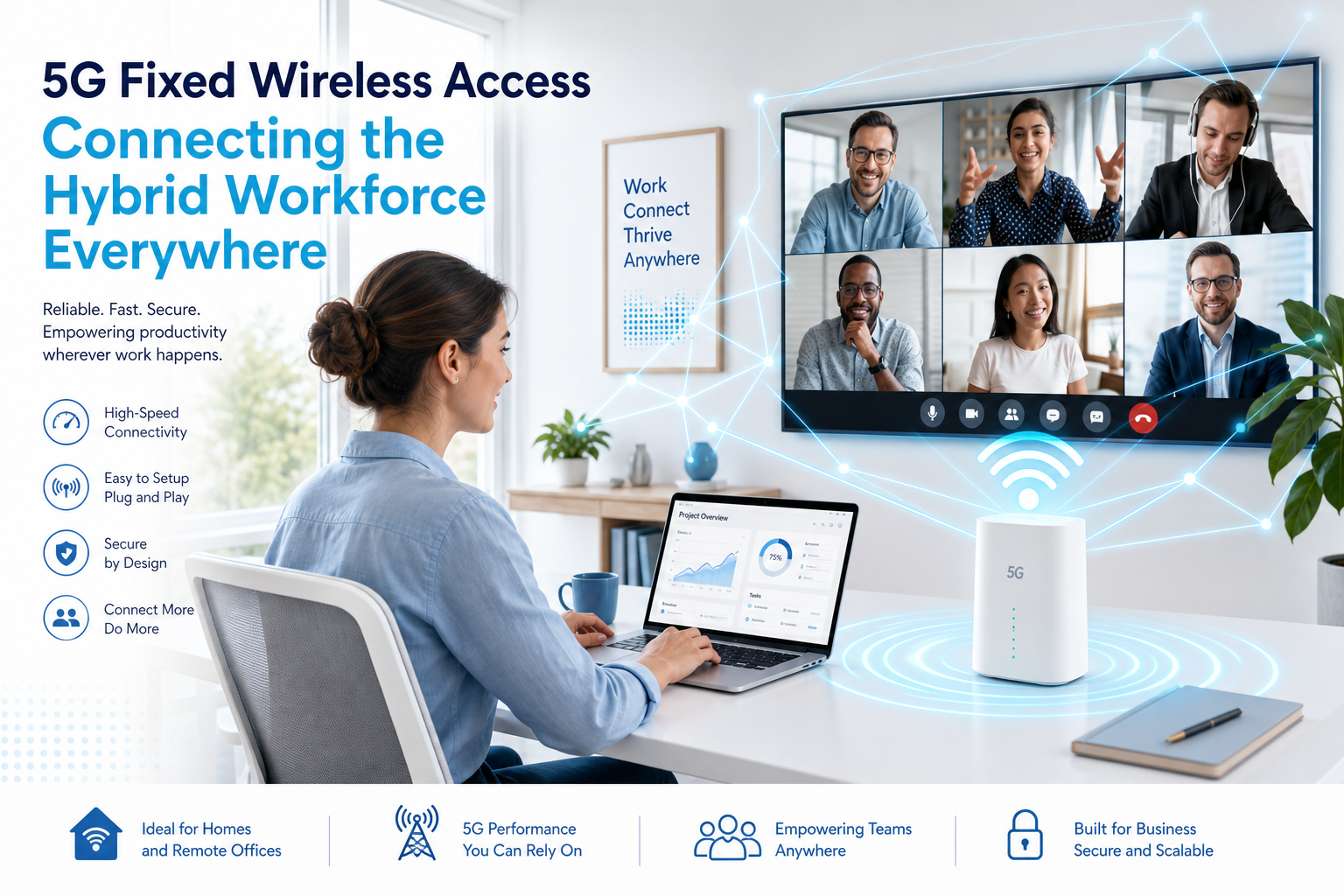
As enterprises settle into a durable hybrid model, the boundary between the office WAN and the home network has blurred. Employees now expect the same quality of connectivity at a kitchen-table office as they get at headquarters — and IT teams need a way to deliver it without dispatching a technician to every residence. Across 2026, distributed workforces are emerging as a major demand driver for 5G Fixed Wireless Access (FWA) CPE in small-office/home-office (SOHO) and remote-worker deployments.
For managed service providers, telecom operators, and enterprise IT leaders, the appeal is a simple one: a 5G CPE can stand up a secure, carrier-grade connection in a home or satellite office in minutes, with no truck roll and no dependence on whatever consumer broadband happens to be available.
Why hybrid work is pushing FWA into the enterprise edge
Hybrid work has redefined the enterprise network perimeter. In the past, a corporate VPN client on a laptop was enough; today, organizations want the same segmentation, policy, and visibility at the home office that they enforce in the branch. Several forces are converging:
- Distributed-by-default teams: with hiring no longer tied to a metro area, workers may be far from any wired broadband option with adequate upstream capacity.
- Cloud-first tooling: video conferencing, UCaaS, and collaboration platforms are latency- and uplink-sensitive, exposing the limits of asymmetric consumer connections.
- Security mandates: compliance and zero-trust policies increasingly require hardware-enforced isolation between work and personal traffic.
- Provider consolidation: enterprises would rather manage a fleet of uniform, remotely provisioned CPEs than support thousands of home router models.
Secure home-office connectivity without a truck roll
A purpose-built 5G FWA CPE gives remote workers a dedicated, business-grade path that is independent of the household connection. The device typically sits between the employee’s home LAN and the cellular network, creating a clean demarcation point that IT can own and manage. Key deployment patterns include:
- Dedicated work VLAN: the CPE segments corporate traffic from personal and smart-home devices on a separate SSID and VLAN.
- Hardware VPN tunnel: always-on IPsec or WireGuard back to the corporate network or cloud gateway.
- Zero-touch provisioning: devices are drop-shipped to employees and auto-configure on first power-up via cloud or ACS management.
- Failover pairing: the 5G link backs up a consumer broadband line, or serves as the primary path where fixed-line is unavailable.
Performance requirements for video-first work
Remote work is dominated by real-time traffic. Buyers evaluating CPE for a distributed workforce should focus on the metrics that determine whether video calls feel crisp and responsive:
- Uplink throughput: home broadband often caps upstream far below downstream, yet screen sharing and webcam uploads are uplink-heavy.
- Latency and jitter: sub-30 ms latency and low jitter keep voice and video natural during collaboration sessions.
- Carrier aggregation: bonding mid-band and low-band spectrum improves both speed and reliability at the edge of coverage.
- Wi-Fi performance: integrated Wi-Fi 6 or Wi-Fi 7 keeps the wireless last hop from becoming the bottleneck.
Management and security at fleet scale
For a distributed workforce numbering in the hundreds or thousands, the CPE is only as good as its management plane. Requirements include:
- Remote management: TR-069/TR-369 or a cloud controller for configuration, monitoring, and firmware updates at scale.
- Policy enforcement: centralized firewall rules, DNS filtering, and segmentation pushed to every device.
- Visibility: per-device telemetry on signal quality, throughput, and uptime for proactive support.
- Security: hardware VPN, stateful firewall, and secure boot to protect the corporate edge in an uncontrolled environment.
FAQ
Can a 5G CPE replace consumer broadband for remote workers?
Yes. In areas with strong 5G coverage, a business-grade FWA CPE can serve as the primary connection, often with better upstream throughput and a cleaner management story than consumer service. It can also back up an existing line for resilience.
How does IT secure a home-office CPE?
Use hardware VPN tunnels, VLAN segmentation to isolate work traffic, centralized policy management, and secure boot. This creates a corporate-owned demarcation point even in an employee’s home.
Can remote workers be provisioned without an on-site visit?
Yes. Devices with zero-touch provisioning and cloud or ACS management can be drop-shipped and auto-configured on first boot, eliminating truck rolls.
What throughput does a remote worker actually need?
For heavy video conferencing and cloud collaboration, plan for at least 50–100 Mbps down and 20–50 Mbps up per concurrent user, with low latency and jitter for real-time quality.
Get started
Honlly Telecom supplies industrial-grade 5G FWA CPE and wireless routers engineered for secure, remotely managed SOHO and distributed-workforce deployments. Contact our team to discuss fleet connectivity for your remote and hybrid workforce.