
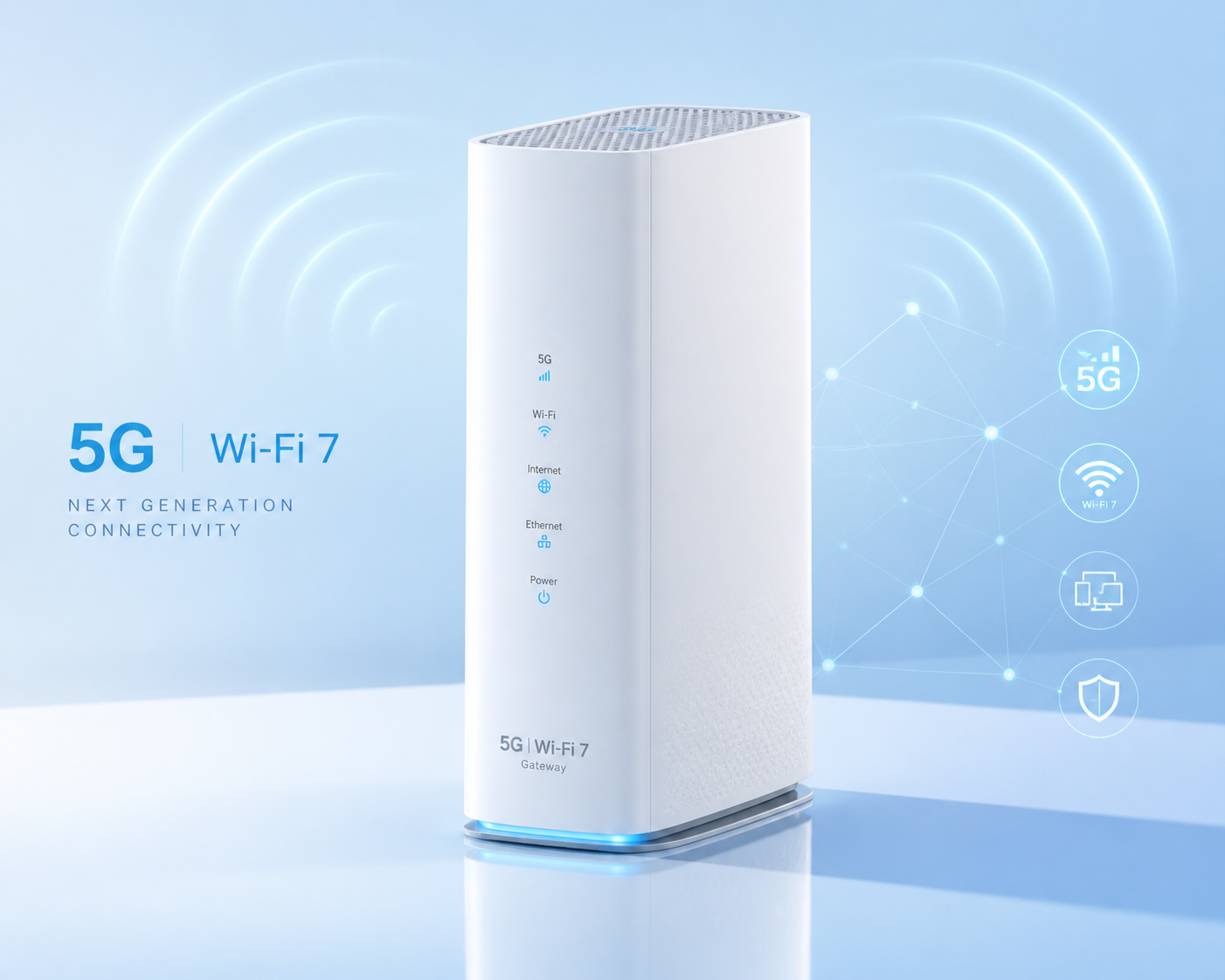
For years, fixed wireless access (FWA) and enterprise Wi-Fi lived in separate worlds. FWA was an access technology for the last mile, delivering broadband to a building; Wi-Fi was an indoor technology that distributed that broadband to users and devices. In 2026 that boundary is dissolving. A new generation of converged enterprise gateways combines a 5G FWA modem with a Wi-Fi 7 access point in a single managed device, and both operators and enterprise IT teams are adopting it at pace.
The Rise of the Converged Enterprise Gateway
The converged gateway is a direct response to two forces. First, 5G FWA has matured into a credible primary connection for branch offices, retail stores, temporary sites, and underserved locations where fiber is unavailable or uneconomical. Second, Wi-Fi 7 brings multi-link operation, wider channels, and deterministic low latency that finally match the experience users expect from a wired LAN.
Putting the two together eliminates a box, a power supply, a cable, and a management interface. For a business with hundreds or thousands of small sites, that simplification compounds into meaningful savings in procurement, installation, and ongoing operations.
What Wi-Fi 7 Brings to Fixed Wireless Deployments
Wi-Fi 7 (IEEE 802.11be) is not simply faster Wi-Fi; it changes how the LAN behaves under load. Multi-link operation lets a device transmit over multiple bands simultaneously, improving both throughput and reliability in dense or congested environments. The 6 GHz band adds 320 MHz ultra-wide channels for high-capacity applications, while preamble puncturing reduces the impact of interference.
For fixed wireless deployments, these capabilities matter most in high-density spaces — retail floors, clinics, branch lobbies, and light-industrial floors — where dozens of devices share spectrum. A converged 5G-plus-Wi-Fi 7 gateway can carry more simultaneous clients and more demanding traffic without the latency spikes that plagued earlier all-in-one devices.
Why Operators and Enterprises Are Combining 5G FWA with Wi-Fi 7
Operators like the converged gateway because it extends their service footprint with a single installable device and gives them visibility into the indoor experience, not just the WAN link. A carrier-provided gateway that also runs the Wi-Fi network lets the operator manage the full path from radio access network to client device, reducing support calls and improving quality-of-experience metrics.
Enterprises like it for a different reason: speed and agility. A new store or branch can be brought online in days rather than waiting weeks for a wired circuit, with the Wi-Fi network provisioned from a cloud controller at the same time the WAN comes up. When the site later qualifies for fiber, the gateway can be repurposed as a backup or failover link without replacing the LAN infrastructure.
Technical Considerations for Converged Gateways
Buyers evaluating a converged 5G/Wi-Fi 7 gateway should look beyond headline speeds. Thermal design is critical, because a single enclosure now contains a cellular modem, a multi-band Wi-Fi radio, and the routing silicon — all of which generate heat and can throttle under sustained load. Antenna design is equally important: the cellular and Wi-Fi radios must coexist without interference, and outdoor or window-mounted placement may be required to maximize the 5G signal.
Management and security complete the picture. Look for devices that support unified cloud management, automatic firmware updates, TR-369/USP remote management, VLAN segmentation between guest, staff, and IoT traffic, and hardware-accelerated VPN for sites that require encrypted backhaul. A converged gateway is only as good as its ability to be operated at scale.
What This Means for CPE Buyers
The convergence of 5G FWA and Wi-Fi 7 shifts the evaluation from individual components to the integrated platform. Operators and enterprise buyers should assess the gateway as a system — modem, radio, antennas, thermal design, and management stack — rather than as a list of specifications. Devices that look strong on paper but throttle under load, or that cannot be managed remotely at scale, will underperform in the field.
For procurement teams, the converged gateway also changes the total-cost-of-ownership equation. One device instead of two means fewer SKUs, simpler installation, and a single vendor to hold accountable. In a competitive broadband and managed-services market, that consolidation is increasingly the difference between a profitable deployment and a costly one.
FAQ
What is a converged 5G FWA and Wi-Fi 7 gateway?
It is a single managed device that combines a 5G fixed wireless access modem with a Wi-Fi 7 access point and routing, replacing separate WAN and LAN equipment with one integrated platform.
Why is Wi-Fi 7 important for fixed wireless deployments?
Wi-Fi 7 adds multi-link operation, 6 GHz ultra-wide channels, and lower latency, which improves reliability and throughput in dense environments where many devices share spectrum.
Should a converged gateway be used as a primary or backup connection?
It works for both. It can serve as a fast-to-deploy primary connection at sites without fiber, and later be repurposed as a failover link once a wired circuit is available.
What should buyers look for in a converged gateway?
Prioritize thermal design, antenna coexistence, unified cloud management, TR-369/USP remote management, VLAN segmentation, and hardware-accelerated VPN alongside raw throughput.
Partner with Honlly for Carrier-Grade 5G CPE
Honlly Telecom designs and manufactures industrial and carrier-grade 4G/5G wireless routers, outdoor CPE, and MiFi devices for ISPs, operators, MVNOs, system integrators, and enterprise buyers worldwide. We support OEM/ODM programs, custom firmware, and regional band certification to match your deployment requirements. Contact our team to discuss your next fixed wireless project.