
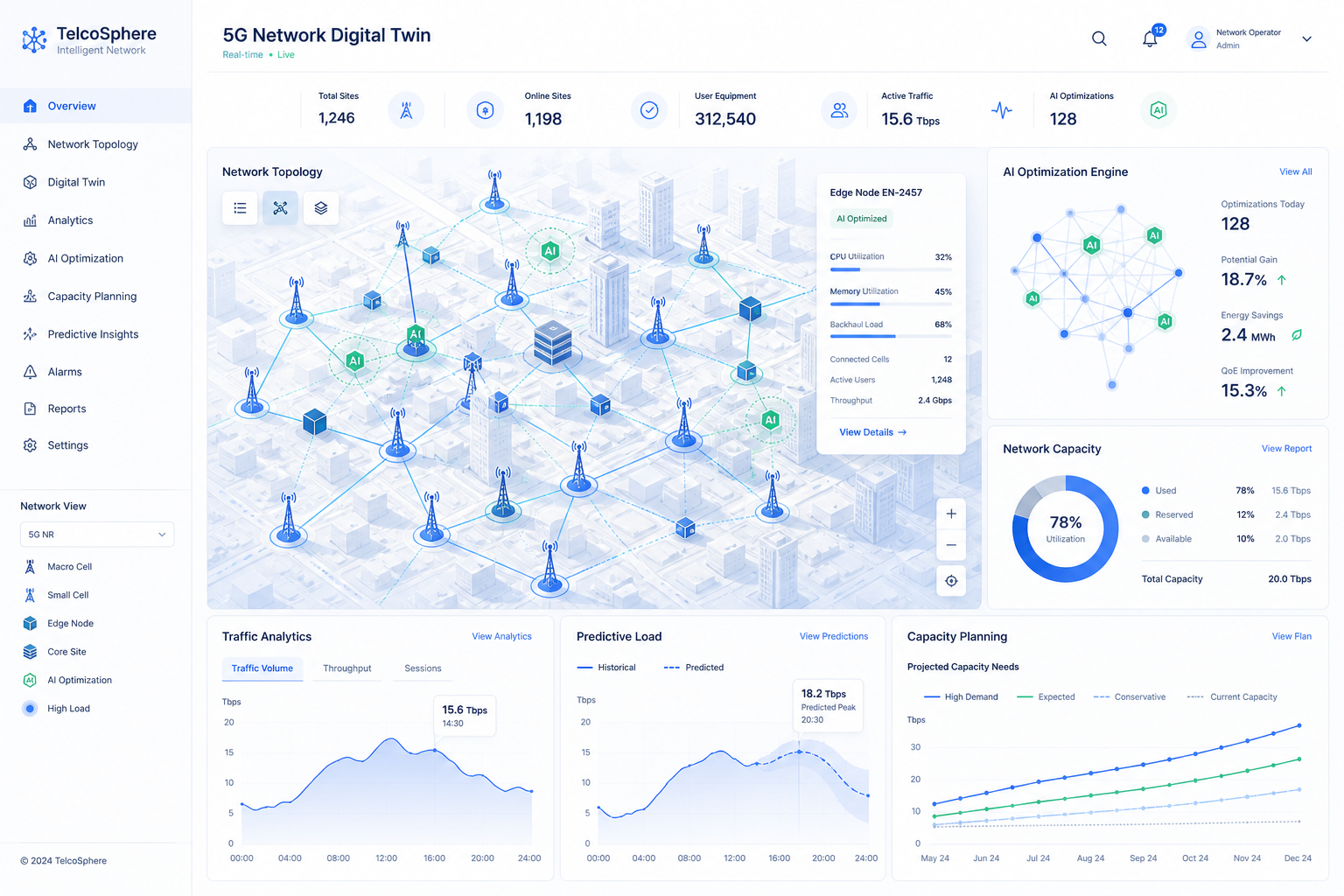
As 5G fixed wireless access (FWA) matures into a mainstream broadband product, operators are discovering that the biggest cost is no longer the spectrum or the radio access network — it is operating a fast-growing fleet of customer premises equipment (CPE). Each deployed unit generates a stream of telemetry on signal quality, throughput, temperature, firmware version, and uptime. Turning that data into lower costs and better service is the core challenge, and two technologies are emerging as the answer: the network digital twin and AIOps.
Why 5G FWA CPE Fleets Are Getting Harder to Manage
FWA CPE sits at the edge of the operator network, often in locations with no on-site technical staff. A single subscriber issue can require a truck roll that costs more than the margin earned on months of service. As subscriber counts scale into the hundreds of thousands, traditional reactive operations break down: manual firmware upgrades, ad-hoc capacity decisions, and rule-based alarm thresholds cannot keep pace with a distributed, heterogeneous CPE estate.
The result is a familiar set of pain points — unpredictable churn, inefficient truck rolls, and capacity that is either over-provisioned (wasted capital) or under-provisioned (poor customer experience). Operators increasingly recognize that these problems are data problems, not hardware problems.
What a Network Digital Twin Adds to CPE Operations
A network digital twin is a continuously updated software model of the physical FWA network: sites, cells, spectrum, backhaul, and the CPE attached to each sector. By ingesting live telemetry from CPE devices and radio access network counters, the twin lets operations teams simulate changes before applying them in the real world.
For CPE operations, the twin supports three practical use cases. First, capacity planning: operators can model how a new housing development or enterprise cluster will load a given sector before committing to spectrum or cell-splitting investments. Second, configuration validation: firmware and parameter changes can be tested against the twin to predict the impact on a representative sample of devices. Third, fault isolation: when performance degrades, the twin helps engineers trace whether the root cause is radio, backhaul, or a specific CPE model — often without a physical visit.
Because the twin reflects the real deployment rather than an idealized lab, it improves the accuracy of decisions that previously relied on spreadsheets and engineering judgment.
How AIOps Turns Telemetry into Action
AIOps applies machine learning to the same telemetry stream to automate detection, diagnosis, and remediation. Instead of static thresholds that fire too late or too often, AIOps models learn the normal operating envelope of each CPE model and location, flagging anomalies before they become subscriber-visible faults.
Concrete applications include predictive CPE failure, where models combine temperature, signal, and error counters to flag units likely to fail in the next weeks; automated root-cause classification, which reduces mean time to repair by directing the right technician with the right part on the first visit; and self-healing actions such as safe reboot, band re-selection, or fallback to a secondary carrier without human intervention.
The operational payoff is measurable: fewer truck rolls, shorter outages, and a service desk that resolves more issues remotely.
Real Capacity Planning Benefits for Operators
Capacity planning is where digital twin and AIOps techniques deliver the clearest financial return. Rather than upgrading a sector when aggregate utilization crosses a fixed threshold, operators can forecast demand using subscriber growth patterns, usage trends, and seasonal effects captured in the twin. This shifts investment from reactive to predictive, smoothing capital expenditure and reducing the number of sectors that are provisioned well ahead of actual need.
The same models help operators decide where mid-band versus high-band capacity makes sense, which CPE categories to recommend for a given area, and when a fixed wireless connection should be migrated to fiber. In a competitive broadband market, this precision is a direct competitive advantage.
What This Means for CPE Procurement
These operational techniques only work if the CPE itself is instrumented and open. Buyers — operators and the system integrators serving them — should prioritize devices that expose a rich, standards-based telemetry interface, support TR-369/USP or equivalent remote management, and allow over-the-air firmware and configuration updates. A device that cannot report its own health cannot participate in a digital twin or AIOps workflow.
For procurement teams, this shifts the evaluation criteria beyond raw throughput. CPE should be assessed on manageability, telemetry granularity, firmware update reliability, and long-term vendor support. The most economical device is increasingly the one that costs the least to operate, not the one with the lowest unit price.
FAQ
What is a network digital twin in 5G FWA?
A network digital twin is a live software model of the physical fixed wireless network — sites, cells, spectrum, backhaul, and CPE — updated continuously with telemetry so operators can simulate and validate changes before applying them.
How does AIOps reduce CPE operating costs?
AIOps applies machine learning to CPE telemetry to predict failures, automate root-cause analysis, and trigger self-healing actions, which reduces truck rolls, shortens outages, and increases remote resolution rates.
What CPE features support digital twin and AIOps workflows?
Look for standards-based telemetry interfaces, TR-369/USP or equivalent remote management, over-the-air firmware and configuration updates, and reliable vendor support over the device lifecycle.
Does this change how operators should buy FWA CPE?
Yes. Manageability, telemetry granularity, and operational cost should be weighted alongside throughput and price, because the cheapest device to operate often delivers the best total cost of ownership.
Partner with Honlly for Carrier-Grade 5G CPE
Honlly Telecom designs and manufactures industrial and carrier-grade 4G/5G wireless routers, outdoor CPE, and MiFi devices for ISPs, operators, MVNOs, system integrators, and enterprise buyers worldwide. We support OEM/ODM programs, custom firmware, and regional band certification to match your deployment requirements. Contact our team to discuss your next fixed wireless project.