
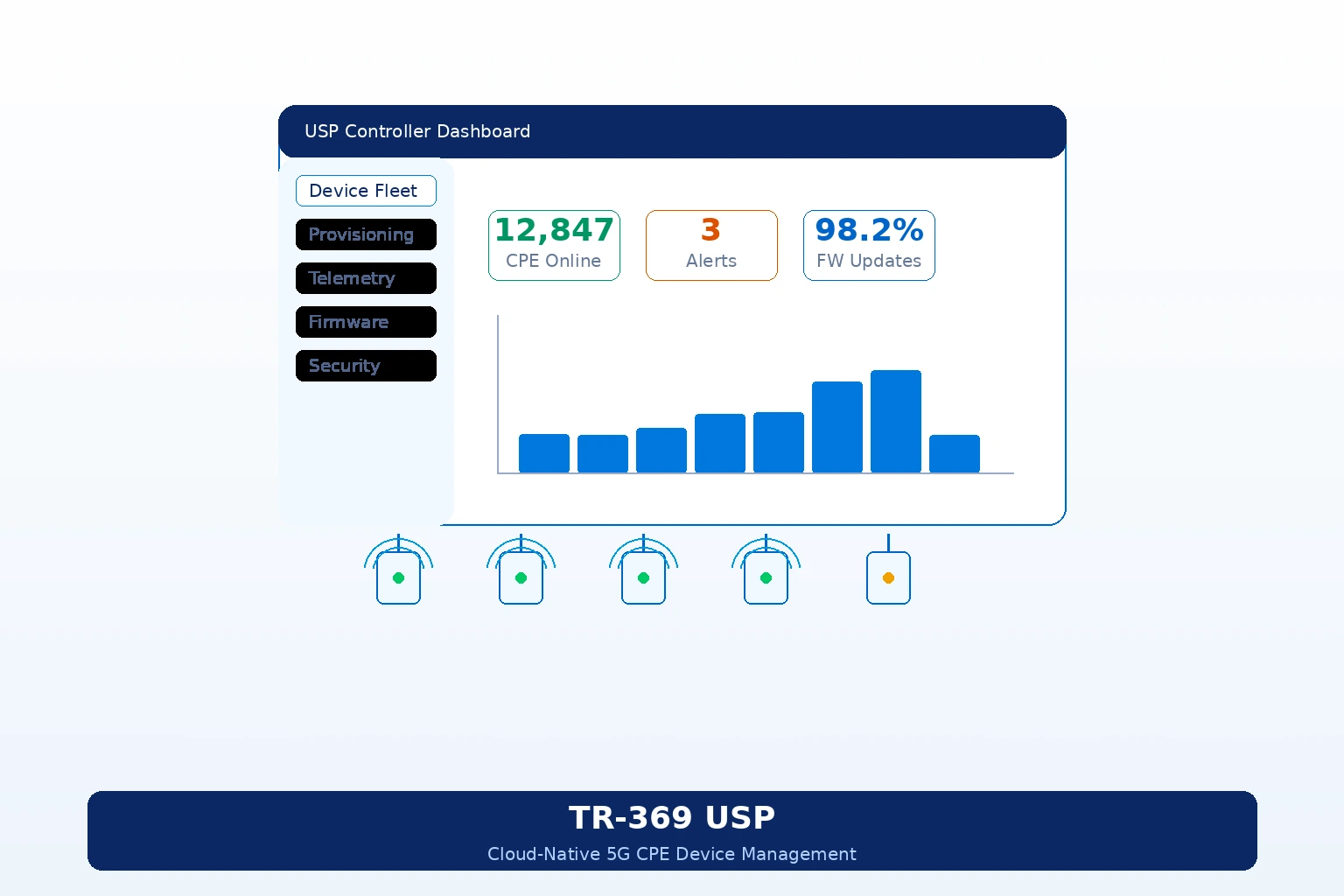
For over 15 years, TR-069 (CPE WAN Management Protocol, or CWMP) has been the workhorse of broadband device management, enabling operators to remotely configure, monitor, and troubleshoot millions of CPE devices. But as 5G networks push toward cloud-native, microservices-based operations, TR-069’s SOAP/XML foundations and rigid client-server architecture are showing their age. The Broadband Forum’s TR-369 USP (User Services Platform) — commonly referred to as USP — is the designated successor, and operator migration timelines are accelerating through 2026.
Why TR-069 Is Reaching Its Limits in the 5G Era
TR-069 was designed in the DSL era and optimized for intermittent connectivity, low-bandwidth management traffic, and centralized ACS (Auto Configuration Server) architectures. In modern 5G FWA deployments, several limitations have become critical:
- Connection-oriented polling: TR-069 relies on periodic CPE-initiated sessions (Periodic Inform) or ACS-triggered Connection Requests. In 5G networks with NAT44/NAT64/CGNAT traversal, Connection Requests frequently fail or require STUN-based workarounds that add latency.
- SOAP/XML overhead: Each TR-069 transaction wraps parameter values in multiple layers of SOAP envelope, XML namespace declarations, and CWMP method framing. For bulk parameter queries across thousands of CPEs, this overhead is computationally expensive on both the ACS and CPE sides.
- Limited concurrency model: TR-069 sessions are single-threaded per CPE. Simultaneous configuration changes, firmware downloads, and diagnostics require sequential session handling, creating bottlenecks in large-scale operations.
- No native push-notification architecture: CPE-originated events (alarms, threshold breaches, connectivity changes) are batched into the next Periodic Inform interval rather than delivered in real time — a significant operational gap for carrier-grade 5G FWA.
TR-369 USP: Architecture and Key Capabilities
TR-369 USP fundamentally rearchitects the device-management paradigm around three principles: message-oriented communication, multi-protocol transport, and service-based abstraction.
USP Message Architecture
USP uses a compact, binary-encoded message format (Protocol Buffers, or protobuf) transported over WebSocket, MQTT, STOMP, or CoAP — a dramatic departure from TR-069’s HTTP/1.1 + SOAP/XML stack. Each USP message carries:
- Header: Message ID, message type (Get, Set, Add, Delete, Operate, Notify), source/destination endpoint identifiers.
- Body: A Request/Response or Notification payload, encoded in protobuf with strong typing and schema validation.
- Record-level integrity: USP supports per-message digital signatures (using JWS) and TLS 1.3 mutual authentication, meeting carrier security requirements without the XML Signature overhead of TR-069.
Multi-Protocol Transport and Always-On Connectivity
Unlike TR-069’s session-based HTTP model, USP supports persistent connections via WebSocket, enabling:
- Real-time push notifications: CPE events (link status changes, throughput threshold alarms, security incidents) are pushed to the controller in real time, enabling proactive network operations.
- Bidirectional command flow: The controller can send configuration commands to the CPE at any time without waiting for a Connection Request cycle or Periodic Inform window.
- MQTT integration: For operators with existing MQTT-based IoT or telemetry infrastructure, USP agents can connect directly to MQTT brokers, unifying CPE management with broader IoT device management under a single message bus.
USP Data Model: TR-181 Device:2 and Service Objects
USP reuses the TR-181 Device:2 data model (already familiar from TR-069) but extends it with service objects that map directly to 5G-specific management domains:
- Device.WiFi.* objects for Wi-Fi 6/6E/7 radio, SSID, and band steering configuration.
- Device.Cellular.* objects for 5G NR modem status, PLMN selection, band locking, carrier aggregation state, and signal quality metrics (RSRP, RSRQ, SINR per component carrier).
- Device.Firewall.*, Device.Routing.*, Device.QoS.* for advanced networking configuration.
- Device.BulkData.* for throughput and latency telemetry streaming (IPFIX-based).
- Device.SoftwareModules.* for containerized firmware component management (DU, CU separation in multi-component CPE architectures).
Migration Path: From TR-069 ACS to USP Controller
Most operators cannot execute a “big-bang” replacement of their TR-069 infrastructure. The Broadband Forum anticipates a 3-5 year coexistence period during which CPE fleets will include a mix of TR-069-only, USP-only, and dual-stack devices. The recommended migration strategy includes:
Phase 1: USP Controller Deployment with TR-069 Proxy (2026)
Deploy a USP Controller that also implements a TR-069 southbound proxy (or integrates with the existing ACS via northbound APIs). This enables:
- Unified operator dashboards that query and configure both TR-069 and USP CPE through a single interface.
- Gradual CPE replacement or firmware upgrade without service disruption on legacy devices.
- Parallel monitoring of Key Performance Indicators (KPIs) across protocol generations.
Phase 2: Dual-Stack CPE with USP Preference (2026-2027)
Procure or upgrade CPE firmware to support both TR-069 and USP agents simultaneously, with USP as the preferred management channel and TR-069 as fallback. New CPE should:
- Register with both the legacy ACS and the new USP Controller on initial boot.
- Accept configuration changes through either channel, with USP taking precedence when both attempt to modify the same parameter.
- Report telemetry and events through USP while maintaining TR-069 Inform-based health checks for backward compatibility.
Phase 3: TR-069 Decommissioning (2027-2028)
Once the USP Controller demonstrates equivalent or superior operational KPIs (provisioning success rate, alarm delivery latency, bulk configuration throughput), operators can begin phasing out TR-069 ACS infrastructure. Legacy CPE that cannot be upgraded should be targeted for replacement as part of natural hardware refresh cycles (typically 3-5 years for FWA CPE).
Operational Benefits of USP Migration
Operators who have completed pilot USP deployments report significant operational improvements:
- Provisioning time reduction: Bulk configuration of 10,000 CPEs completes in minutes rather than hours, thanks to USP’s concurrent message processing and protobuf’s compact encoding (typically 5-10x smaller than equivalent SOAP/XML payloads).
- Real-time alarm response: CPE-originated alarms (5G signal degradation, WAN link failure, security intrusion detection) arrive at the NOC in under 5 seconds rather than the 5-15 minute Periodic Inform window, enabling faster mean-time-to-resolution (MTTR).
- Firmware upgrade success rates: USP’s segmented file transfer with integrity verification and resume capability improves firmware upgrade success rates in lossy 5G environments compared to TR-069’s monolithic HTTP download model.
- Cloud-native integration: USP Controller implementations built on Kubernetes and Kafka integrate natively with operator DevOps toolchains (CI/CD pipelines, Prometheus/Grafana monitoring, ELK logging), reducing operational overhead compared to monolithic ACS appliances.
Selecting a USP Stack: Build vs. Buy
Operators have several options for USP infrastructure:
- Open-source USP Controller (OB-USP-Agent + OB-USP-Controller): The Broadband Forum’s reference implementations provide a solid starting point. Suitable for operators with in-house CPE management development teams who want full customization.
- Commercial USP platforms: Vendors including Axiros, Friendly Technologies, Incognito, and AVSystem offer carrier-grade USP Controllers with TR-069 coexistence, multi-tenancy, and integration with existing OSS/BSS. Typically the faster path to production for operators without large in-house CPE management teams.
- CPE vendor-managed USP: Some CPE manufacturers (including Honlly Telecom) provide USP agent firmware and can host managed USP Controller instances, offering a turnkey device management solution for smaller operators and MVNOs.
USP Agent Requirements for 5G FWA CPE
When evaluating and procuring 5G FWA CPE with USP support, operators should verify the following agent capabilities:
- USP 1.3+ compliance with WebSocket and MQTT transport support.
- TR-181 Device:2.16+ data model support including Cellular interface extensions for 5G NR (NRCell, NRCarrier, ENDC combination status).
- TLS 1.3 with mutual authentication using device certificates (SMI or operator PKI issued).
- Bulk data collection (BulkData object) with configurable reporting intervals for throughput, latency, and signal quality telemetry.
- Firmware upgrade with USP segmented download and digital signature verification.
- Concurrent session support for simultaneous configuration and monitoring operations.
- TR-069 coexistence mode (dual-agent) for migration-phase deployments.
Conclusion
The migration from TR-069 to TR-369 USP is not merely a protocol upgrade — it is a fundamental shift toward cloud-native, event-driven device management that aligns 5G FWA CPE operations with modern carrier infrastructure. Operators who begin their USP migration in 2026 will be well-positioned to exploit real-time telemetry, automated service orchestration, and containerized firmware management as their 5G FWA subscriber bases scale through the end of the decade.
For operators planning 5G FWA CPE deployments, specifying TR-369 USP support in procurement RFPs today ensures that device fleets deployed in 2026-2027 will support the management architecture carriers will operate through 2030 and beyond.
Honlly Telecom’s 5G FWA CPE platforms support TR-369 USP with TR-069 coexistence. Contact our solutions team to discuss USP integration for your device fleet.