
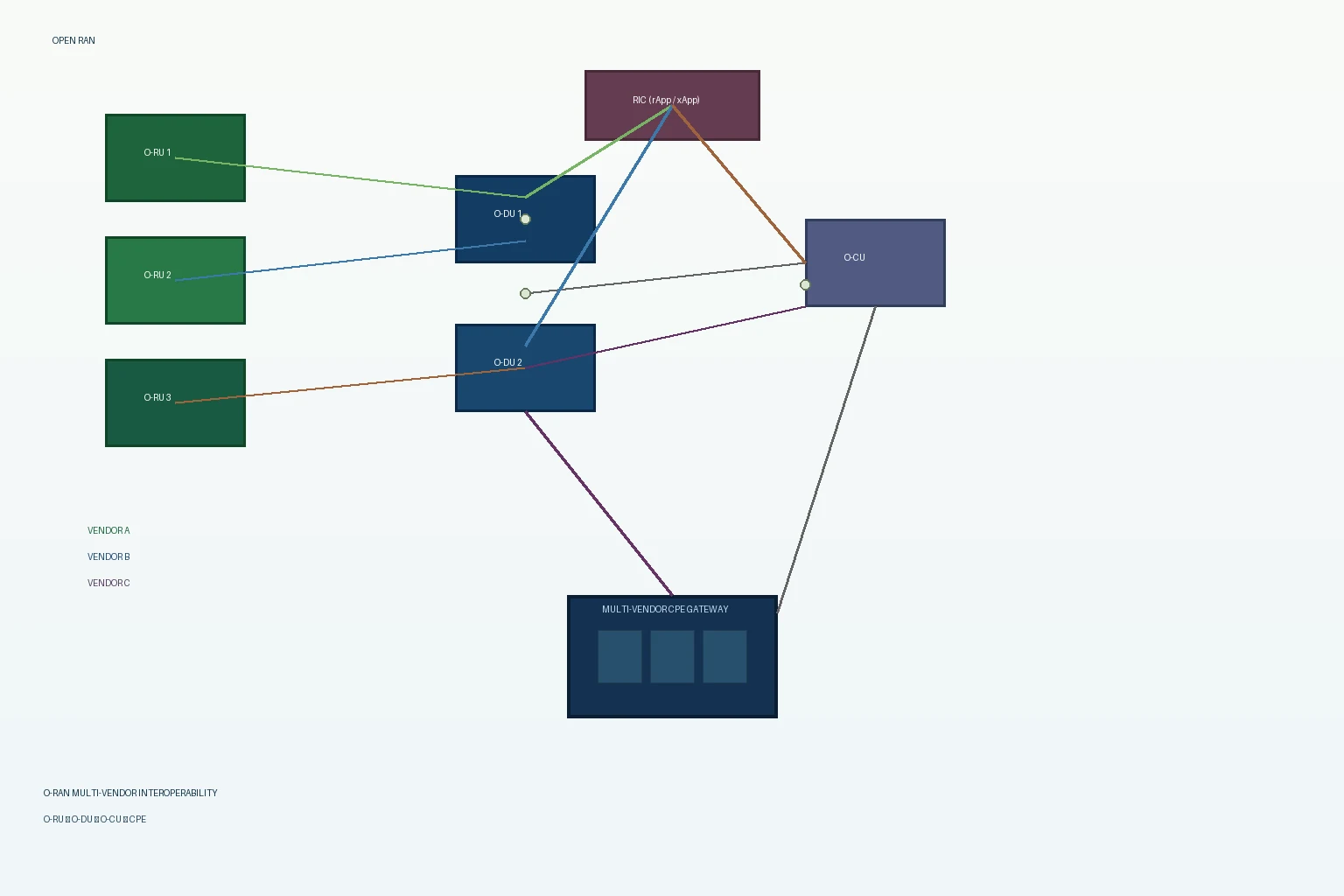
Open RAN (O-RAN) represents the most significant architectural shift in radio access networks since the transition from 2G to 3G. By disaggregating the RAN into standardized, interoperable components — radio units (O-RU), distributed units (O-DU), and centralized units (O-CU) — Open RAN enables operators to mix and match equipment from multiple vendors rather than being locked into a single supplier’s end-to-end stack.
For Fixed Wireless Access (FWA) operators, this architectural openness extends to Customer Premises Equipment. As O-RAN deployments scale globally — with over 45 commercial O-RAN networks now in operation and cumulative investments exceeding $15 billion — CPE interoperability has become a critical procurement consideration. This guide examines the standards, testing frameworks, and strategic considerations for B2B buyers evaluating O-RAN compliant FWA gateways.
The O-RAN Alliance and CPE Relevance
The O-RAN Alliance, founded in 2018 by AT&T, China Mobile, Deutsche Telekom, NTT DOCOMO, and Orange, now includes over 300 member organizations. While O-RAN specifications primarily focus on the RAN infrastructure (O-RU, O-DU, O-CU, RIC), several working groups produce specifications that directly impact CPE design and interoperability:
- WG4 (Open Fronthaul): Defines the interface between O-RU and O-DU. While CPE does not connect at this interface, fronthaul architecture choices (split 7.2x vs split 8) affect CPE-visible parameters like timing alignment and beamforming coordination.
- WG7 (White-box Hardware): Publishes reference designs for white-box hardware, including indoor and outdoor radio units. Some WG7 design principles — particularly around thermal management, power efficiency, and modular architecture — influence CPE hardware design.
- WG8 (Stack Reference Design): Defines reference software stacks for O-DU and O-CU. CPE protocol stacks must interoperate with multi-vendor implementations of these reference designs.
- WG11 (Security): Defines security requirements for O-RAN components, including zero-trust principles that extend logically to CPE authentication and secure boot.
How Open RAN Changes CPE Interoperability Requirements
In a traditional single-vendor RAN, the CPE is typically validated against one implementation of the 3GPP protocol stack — the RAN vendor’s proprietary implementation. Interoperability testing is simplified because both the network side and the CPE side are developed, tested, and optimized together.
In an O-RAN environment, the CPE may need to interoperate with:
- O-RUs from Vendor A (e.g., NEC, Fujitsu, Comba)
- O-DUs from Vendor B (e.g., Mavenir, Parallel Wireless, Rakuten Symphony)
- O-CUs from Vendor C (e.g., Nokia, Ericsson, Samsung — all of which now offer O-RAN compliant CU software)
- RIC (RAN Intelligent Controller) from Vendor D
- Core network from Vendor E
This multi-vendor environment introduces interoperability challenges that single-vendor RANs avoid. CPE must be validated against a matrix of possible RAN component combinations, not just one stack.
Key CPE Capabilities for O-RAN Environments
1. 3GPP Standards Compliance — Beyond the Minimum
While all 5G CPE must comply with 3GPP Release 15+ UE specifications, O-RAN environments demand stricter adherence. Single-vendor RANs may tolerate minor deviations from the standard because the vendor controls both sides of the air interface. In multi-vendor O-RAN, every deviation is a potential interoperability failure point.
B2B buyers should verify that CPE has been tested against ATIS or ETSI-defined 3GPP conformance test suites — specifically TS 38.521 (UE RF conformance), TS 38.523 (UE protocol conformance), and TS 38.533 (UE RRM conformance).
2. Beam Management and Mobility in Multi-Vendor Deployments
Beam management procedures — including initial beam acquisition, beam failure detection, and beam failure recovery — must work correctly across O-RUs from different vendors. In a single-vendor deployment, the gNB and CPE may use vendor-optimized beam codebooks that implicitly share assumptions. In O-RAN, the CPE must handle standard-compliant beam management with O-RUs that may implement different beam-sweeping patterns and SSB configurations.
3. RAN Slicing Awareness
O-RAN’s RIC enables dynamic RAN slicing — allocating different radio resources to different network slices serving different enterprise customers or service types. CPE that is slice-aware can request and utilize dedicated RAN slices for specific traffic types (e.g., a dedicated slice for industrial automation vs. best-effort internet).
CPE should support NSSAI (Network Slice Selection Assistance Information) signaling in RRC and NAS layers, enabling the device to request specific slices and accept slice-specific PDU sessions.
4. O-RAN Security Requirements
O-RAN WG11 defines security requirements including mutual TLS (mTLS) for all O-RAN interfaces, secure boot with hardware root of trust, and continuous integrity monitoring. CPE deployed in O-RAN environments should provide equivalent security capabilities: hardware-backed secure boot, TPM-backed key storage, signed firmware updates, and certificate-based device authentication on the network.
Multi-Vendor Interoperability Testing Frameworks
Several industry initiatives provide interoperability testing infrastructure for O-RAN components, including CPE:
- O-RAN Alliance OTIC (Open Testing and Integration Centers): Currently 15 OTICs operate globally, including facilities in Berlin, Tokyo, Beijing, Bangalore, and the United States. OTICs provide conformance, interoperability, and end-to-end testing for O-RAN equipment.
- Telecom Infra Project (TIP) Community Labs: TIP operates testing facilities focused on open and disaggregated network equipment, with specific test cases for CPE interoperability.
- NTIA/ITS O-RAN Test Lab (US): Funded by the US NTIA’s $1.5 billion Public Wireless Supply Chain Innovation Fund, this facility provides independent O-RAN testing for equipment vendors seeking US market access.
B2B buyers should request OTIC or equivalent test reports demonstrating CPE interoperability with their specific O-RAN component mix before committing to volume procurement.
Procurement Strategies for O-RAN FWA CPE
Strategy 1: Pre-Validated Bundles
Several system integrators (including Rakuten Symphony, Mavenir, and NEC) now offer pre-validated O-RAN bundles that include specific CPE models tested against their RAN stack. This approach reduces integration risk but may limit CPE vendor choice to the integrator’s validated list.
Strategy 2: Independent Validation + Multi-Source
Operators with in-house integration capabilities can independently validate CPE from multiple vendors against their specific O-RAN configuration. This approach maximizes supply chain diversity and competitive pricing but requires significant testing investment.
Strategy 3: O-RAN Badge Certification
The O-RAN Alliance is developing a formal certification and badging program (expected to launch fully in late 2026) that will provide standardized interoperability certification for O-RAN equipment, including CPE. Operators may choose to require O-RAN Badge certification as a procurement prerequisite once the program matures.
Global O-RAN FWA Deployment Landscape
Japan: Rakuten Mobile operates the world’s largest commercial O-RAN network, serving over 6 million subscribers with a fully virtualized, O-RAN compliant RAN. NTT DOCOMO’s OREC (O-RAN Enterprise Consortium) initiative extends O-RAN to enterprise 5G, including FWA use cases.
United States: DISH Wireless (now EchoStar) built the world’s first greenfield O-RAN 5G network, with O-RAN compliant infrastructure from multiple vendors. The US government’s rip-and-replace program for Huawei equipment is accelerating O-RAN adoption among rural carriers, many of whom use FWA as a primary service offering.
Europe: Vodafone has committed to O-RAN across 2,500 sites in the UK, with plans for 30% of its European RAN to be O-RAN compliant by 2030. Deutsche Telekom’s “O-RAN Town” initiative in Neubrandenburg, Germany, is the operator’s flagship multi-vendor O-RAN deployment.
India: Reliance Jio and Bharti Airtel are both deploying O-RAN elements in their 5G networks. Jio’s in-house 5G RAN stack is claimed to be O-RAN compliant, creating a significant market for O-RAN interoperable CPE.
Cost and Timeline Considerations
O-RAN FWA CPE currently carries a cost premium of approximately 10–20% compared to traditional single-vendor-validated CPE, driven by more rigorous testing requirements and additional features like slice awareness and enhanced security. However, this premium is expected to decline as O-RAN deployments scale and testing processes become more automated.
Operators planning O-RAN FWA deployments in 2026–2027 should budget for a 3–6 month CPE validation cycle, including lab conformance testing, field trials in representative deployment environments, and interoperability testing with each component vendor in their RAN stack.
Frequently Asked Questions
Does O-RAN require special CPE, or can standard 5G CPE work?
Standard 3GPP-compliant 5G CPE should technically work with O-RAN networks, as the air interface is still 3GPP NR. However, to fully leverage O-RAN capabilities — RAN slicing, multi-vendor beam management optimization, and O-RAN security features — purpose-built O-RAN aware CPE is recommended.
How do I verify CPE interoperability with my O-RAN stack?
Request OTIC (Open Testing and Integration Center) test reports or equivalent third-party validation. For large deployments, conduct your own interoperability testing with a representative sample of your specific O-RU/O-DU/O-CU combination.
Will O-RAN CPE cost more than traditional CPE?
Currently, yes — expect a 10–20% premium. However, this is partially offset by supply chain competition benefits. As O-RAN adoption scales, the premium should compress to 5–10% by 2028.
Is O-RAN likely to become mandatory for FWA CPE?
No global mandate exists, but in markets with strong O-RAN policy support (US, UK, Japan, India), O-RAN compliance may become a de facto procurement requirement, particularly for government-funded rural broadband programs.
Planning an O-RAN FWA deployment and need interoperable CPE? Contact Honlly Telecom to discuss our O-RAN validated CPE portfolio and integration support services.