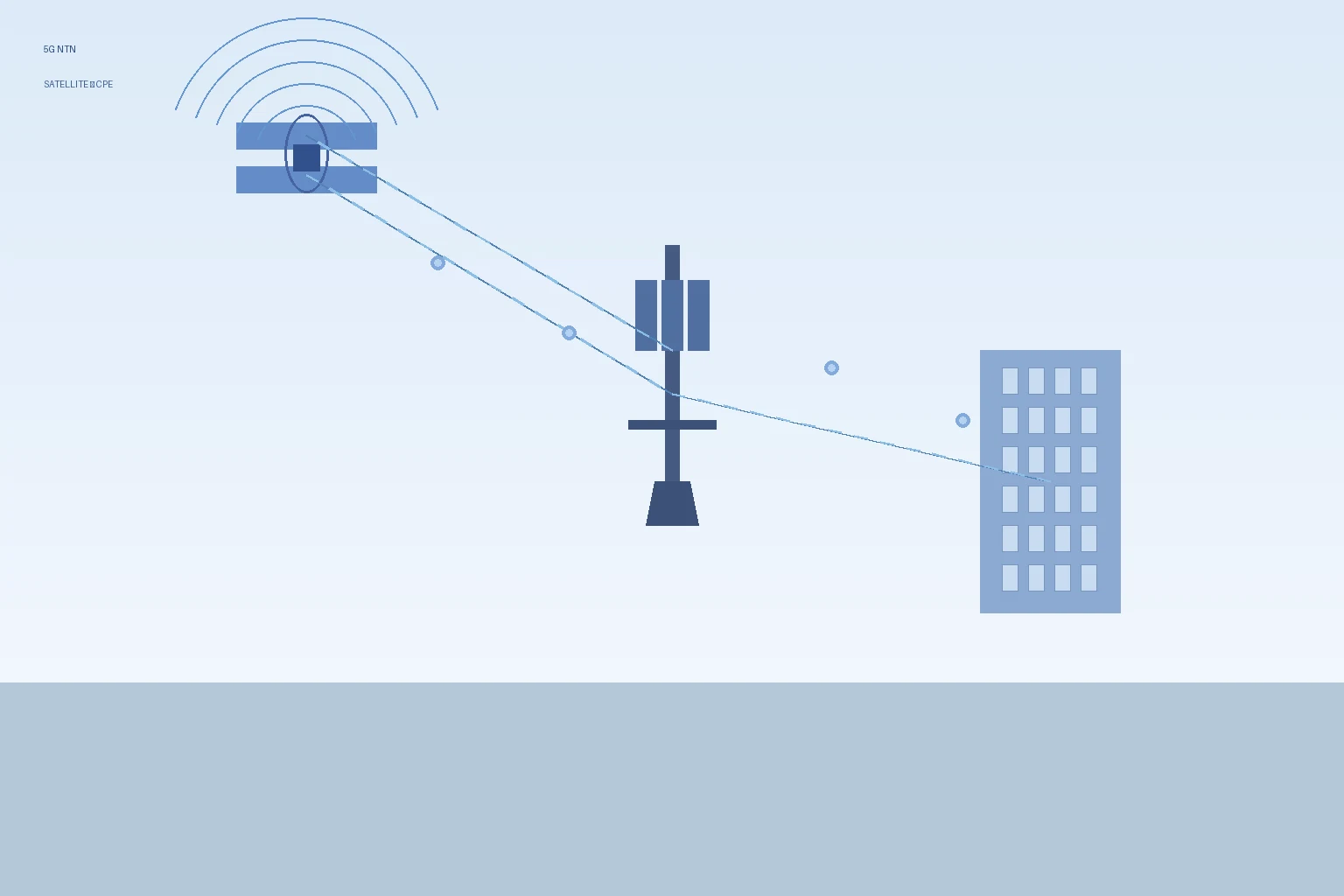
The convergence of satellite and terrestrial mobile networks is no longer a distant roadmap item — it is happening now. 5G Non-Terrestrial Network (NTN) technology, standardized in 3GPP Release 17 and significantly expanded in Release 18 and the forthcoming Release 19, is enabling direct satellite-to-device and satellite-to-CPE communication. For B2B telecom buyers — ISPs, MVNOs, enterprise network operators, and government procurement agencies — this evolution opens an entirely new product category: hybrid satellite-cellular Customer Premises Equipment (CPE) capable of maintaining connectivity far beyond terrestrial tower reach.
What Is 5G NTN and Why Does It Matter for CPE?
5G NTN extends the 5G New Radio (NR) air interface to satellite platforms, allowing standard-compliant user equipment to communicate directly with low-earth orbit (LEO), medium-earth orbit (MEO), or geostationary (GEO) satellites. Unlike traditional satellite broadband terminals, which require proprietary modems and separate service subscriptions, NTN-compatible CPE uses modified 5G chipsets that speak the same protocol whether connecting to a terrestrial gNB or a satellite-borne one.
The practical implication for B2B buyers is significant: a single CPE device can seamlessly switch between terrestrial 5G, 4G LTE, and satellite backhaul based on availability, cost, and QoS requirements — all managed through a unified network architecture.
3GPP Release 19: The Standards Milestone
3GPP Release 19, expected to be finalized in late 2025 and commercially implemented through 2026, introduces several enhancements critical for CPE applications:
- NTN-IoT enhancements — Extended coverage and power-saving modes for IoT-over-satellite use cases, enabling low-data-rate CPE applications like remote sensor gateways and asset trackers.
- Regenerative payload support — Satellites with on-board gNB processing capability, reducing latency by eliminating the feeder-link round trip to a ground gateway.
- Multi-orbit interoperability — Standardized handover procedures between LEO, MEO, and GEO constellations, as well as between satellite and terrestrial networks.
- NR-NTN bandwidth expansion — Support for wider carrier bandwidths in S-band and Ka-band, enabling broadband-class throughput suitable for enterprise CPE.
Commercial NTN Services Already in Market
The commercial landscape is maturing rapidly. T-Mobile US, in partnership with SpaceX’s Starlink Direct-to-Cell service, began beta testing satellite-direct SMS in 2024 and expanded to voice and data services in 2025. AST SpaceMobile has demonstrated 5G NTN broadband connectivity with unmodified smartphones via its BlueWalker 3 test satellite. Apple’s partnership with Globalstar for iPhone emergency SOS has validated consumer demand for satellite-direct services.
On the CPE side, several manufacturers are developing NTN-compatible outdoor units (ODUs) and indoor gateways. MediaTek’s MT6825 NTN chipset, announced in 2023, has been integrated into multiple IoT and broadband terminal reference designs. Qualcomm’s Snapdragon X80 modem-RF system includes NTN support as a native feature.
Key B2B Use Cases for NTN-Capable CPE
1. Remote Enterprise Branch Connectivity
Mining operations, oil and gas exploration sites, and remote construction projects often operate beyond terrestrial network coverage. NTN CPE provides primary or backup connectivity for VoIP, VPN access, cloud application sync, and IoT sensor backhaul without requiring separate satellite terminal infrastructure.
2. Maritime and Offshore Communications
Commercial shipping fleets, offshore wind farms, and aquaculture operations need reliable connectivity at sea. Hybrid NTN-terrestrial CPE can use coastal 5G when in range and seamlessly failover to satellite connectivity in open waters, reducing operational costs compared to always-on VSAT.
3. Disaster Recovery and Emergency Response
When terrestrial infrastructure is damaged by natural disasters, NTN CPE can restore connectivity within minutes — not days. Emergency response teams, field hospitals, and temporary command centers can deploy satellite-direct gateways without waiting for terrestrial network restoration.
4. Rural ISP Backhaul Extension
Rural WISPs and regional operators can use NTN CPE as a backhaul option for extending coverage to underserved communities, complementing existing FWA and fiber deployments with satellite reach where CAPEX for new towers is prohibitive.
Technical Considerations for B2B Buyers
Antenna design: NTN CPE requires antennas with circular polarization and adequate gain for satellite links, which differ from traditional linearly polarized terrestrial antennas. Outdoor units with electronic beam-steering or mechanically steerable phased arrays are emerging as the preferred form factor.
Latency profiles: LEO constellations (e.g., Starlink at ~550 km altitude) offer round-trip latency of 25–50 ms, acceptable for most enterprise applications. GEO satellites at 35,786 km introduce ~600 ms latency, which degrades real-time applications but remains viable for bulk data and asynchronous workloads.
Throughput expectations: Current NR-NTN implementations in S-band deliver 5–15 Mbps per carrier, while Ka-band configurations can reach 50–150 Mbps. These figures are lower than terrestrial 5G but sufficient for most enterprise branch-office workloads when paired with WAN optimization.
Regulatory compliance: NTN CPE operating in satellite bands must comply with both terrestrial spectrum regulations and ITU satellite coordination rules. Buyers should verify that equipment is type-approved for their target deployment countries and frequency bands.
Procurement Considerations for 2026
For operators and enterprises evaluating NTN CPE in 2026, several factors should guide procurement decisions:
- Chipset maturity: Look for devices using 3GPP Release 17+ compliant NTN chipsets from established vendors like Qualcomm, MediaTek, or Samsung. Avoid pre-standard proprietary solutions that may lack future interoperability.
- Multi-constellation support: The best NTN CPE will support multiple satellite constellations (Starlink, OneWeb, AST SpaceMobile, Inmarsat) rather than being locked to a single provider.
- Terrestrial fallback: Hybrid devices that default to terrestrial 5G/4G when available, only using satellite when necessary, will deliver the best TCO.
- Management and orchestration: CPE should support TR-369 USP or TR-069 for remote management, including satellite link monitoring, policy-based routing, and usage analytics.
Market Outlook
Analyst forecasts project the 5G NTN equipment market — including CPE, IoT terminals, and satellite payloads — to exceed $18 billion by 2030, with a CAGR of approximately 27% from 2025. The CPE segment alone is expected to account for roughly 30% of this market, driven by enterprise demand for resilient multi-path connectivity.
For B2B telecom buyers, 2026 represents the inflection point where NTN CPE transitions from proof-of-concept to commercially viable procurement. Organizations that evaluate and pilot NTN solutions now will be positioned to deploy at scale as the ecosystem matures through 2027–2028.
Frequently Asked Questions
What is the difference between NTN CPE and traditional satellite broadband terminals?
Traditional satellite terminals (VSAT, Starlink dish) use proprietary protocols and require separate service subscriptions. NTN CPE uses standard 3GPP 5G protocols, allowing a single device to connect to both terrestrial cellular towers and satellites through a unified network architecture managed by the mobile operator.
Is NTN CPE available for purchase today?
Limited commercial availability exists as of mid-2026, primarily through operator pilot programs and specialized B2B channels. Wide commercial availability is expected in 2027 as Release 19-compliant chipsets reach volume production.
What throughput can I expect from NTN CPE?
Current implementations deliver 5–50 Mbps depending on frequency band and satellite constellation. Next-generation Ka-band systems targeting 2027–2028 aim for 100–200 Mbps, suitable for most enterprise branch workloads.
Does NTN CPE work indoors?
NTN CPE typically requires an outdoor unit (ODU) with clear line-of-sight to the sky, similar to satellite TV dishes. Indoor-only operation is not feasible with current technology due to satellite signal attenuation through building materials.
Looking for NTN-capable or hybrid satellite-cellular CPE solutions for your enterprise deployment? Contact Honlly Telecom to discuss your connectivity requirements with our engineering team.
