
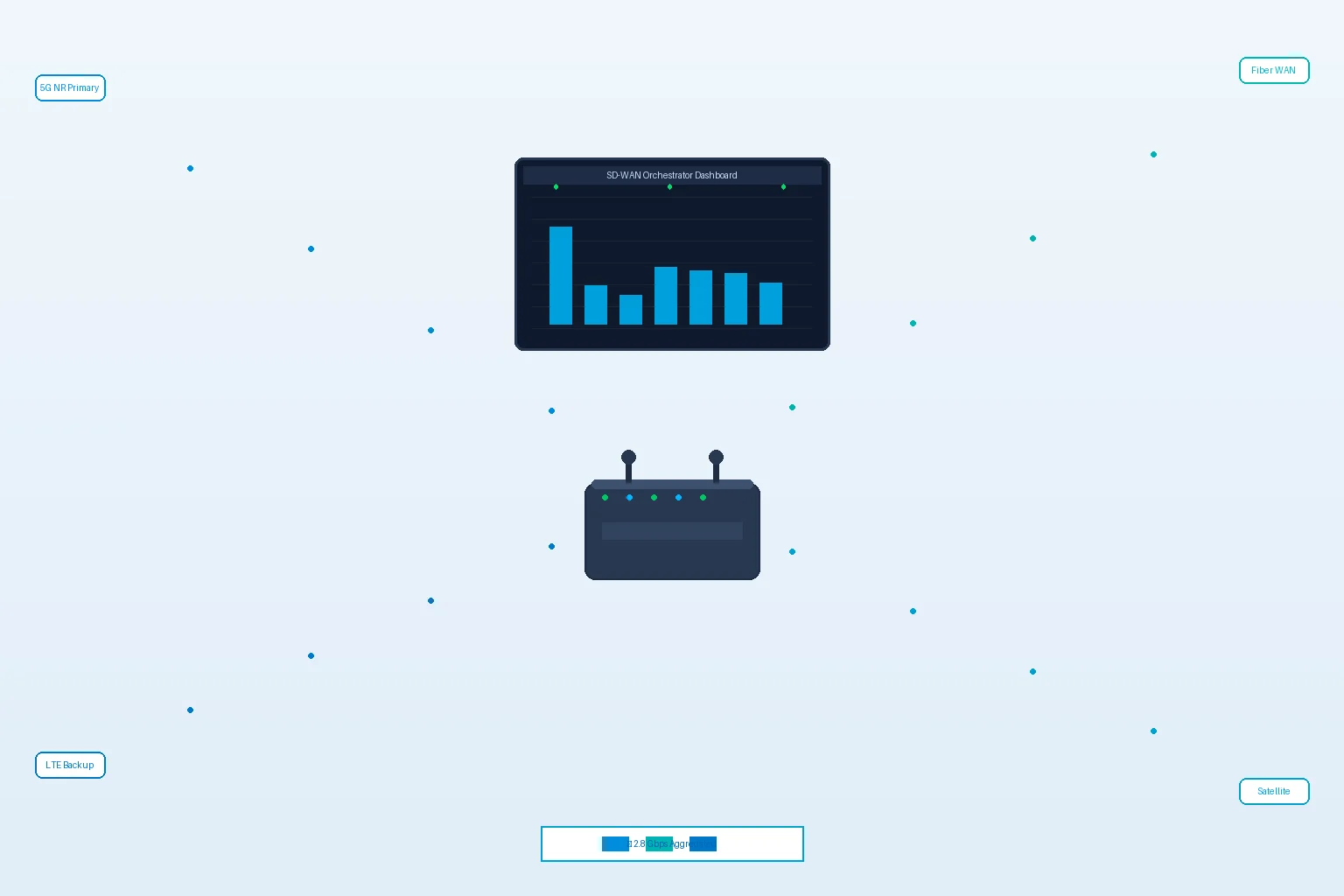
Business continuity demands that enterprise branch networks stay online — no exceptions. A single hour of downtime at a retail location, logistics hub, or financial services branch can cost tens of thousands of dollars in lost transactions, missed shipments, and reputational damage. Multi-WAN 5G CPE devices that natively integrate SD-WAN intelligence, link aggregation, and automatic failover are rapidly becoming the gold standard for enterprise branch connectivity — and for good reason.
The Multi-WAN Imperative
Single-link branch connectivity is a single point of failure. Fixed-line broadband, fiber, or MPLS circuits can go down due to construction damage, equipment failures, carrier outages, or natural events — and restoration times often stretch into days. A 2025 Uptime Institute survey found that 38% of enterprise network outages lasted more than four hours, and 11% exceeded 24 hours. For distributed enterprises, the financial exposure is unacceptable.
Multi-WAN 5G CPE addresses this by combining at least two — and often three or four — WAN interfaces in a single device:
- Primary WAN: 5G NR (sub-6 GHz or mmWave) providing multi-gigabit throughput as the active primary link, with the flexibility to operate in both SA and NSA modes depending on carrier network maturity.
- Secondary WAN: Gigabit Ethernet WAN port for wired broadband, fiber ONT, or legacy MPLS circuit termination.
- Tertiary WAN: Built-in LTE Cat 20 modem or secondary 5G radio on a different carrier for true carrier-diverse cellular failover.
- Optional quaternary: Wi-Fi WAN (client mode) for temporary tethering to a nearby hotspot or mesh node in extreme scenarios.
The value is not just in having multiple pipes — it is in how intelligently they are managed.
SD-WAN Integration: Beyond Simple Failover
First-generation multi-WAN routers used crude mechanisms: ping a gateway IP, and if three pings fail, switch to the backup link. This “dead-or-alive” model is inadequate for modern enterprise applications. Real-time voice and video traffic degrades long before a link is declared dead. Financial transaction applications require sub-second failover to avoid timeout errors. Cloud application performance varies by link quality, not just link availability.
Modern 5G CPE with embedded SD-WAN brings application-aware path selection to the branch edge:
- Per-application steering: Route Microsoft 365 and Salesforce traffic over the 5G link with the lowest latency, while sending bulk backup traffic over the wired broadband link — all dynamically adjusted based on real-time link quality measurements.
- Forward error correction (FEC): Duplicate critical packets across two WAN links simultaneously, reconstructing clean streams at the destination even if one link experiences 30–40% packet loss — essential for VoIP and video conferencing over less reliable connections.
- Sub-second failover with session persistence: When a primary link degrades or fails, active TCP sessions are migrated to the secondary link without dropping. Users on a video call won’t even notice the transition.
- Dynamic path conditioning: Continuous measurement of jitter, latency, and packet loss on each WAN link, with the SD-WAN engine selecting the optimal path per packet in real time.
- SaaS acceleration: Local DNS-based steering that routes Office 365, Google Workspace, and Salesforce traffic through the fastest available path, bypassing congested transit links.
Link Aggregation: More Than the Sum of Parts
Advanced 5G CPE platforms now support true link aggregation — bonding multiple WAN connections into a single logical tunnel with combined throughput. Unlike simple load balancing (which distributes flows across links), link aggregation combines the bandwidth of multiple links for a single flow:
- 5G + wired broadband: A branch requiring 1.5 Gbps sustained throughput for real-time video analytics can combine a 900 Mbps 5G link with a 600 Mbps fiber circuit to achieve the required capacity, with the aggregation tunnel running to a cloud-based gateway or SD-WAN hub.
- Dual 5G carrier aggregation: Two 5G modems on different carriers (e.g., carrier A on n78, carrier B on n41) bonded together through a cloud aggregation gateway, providing carrier-level redundancy plus combined throughput.
- MPTCP (Multipath TCP): Standards-based multipath transport that splits a single TCP connection across multiple WAN interfaces, compatible with existing server infrastructure without requiring proprietary tunnel protocols.
Intelligent Failover Architecture: A Technical Deep Dive
Enterprise-grade multi-WAN CPE implements a multi-layer failover detection system that operates far beyond simple ping-based link monitoring:
Layer 1 — Physical link detection: The CPE continuously monitors the physical layer status of each WAN interface — Ethernet link state, cellular modem registration status, signal quality indicators (RSRP, SINR, RSRQ for 5G NR). Physical link loss triggers an immediate (sub-50ms) failover decision, as there is no point waiting for higher-layer protocols to time out.
Layer 2 — Carrier network reachability: Even with a registered modem, the carrier’s packet gateway may be unreachable. The CPE probes the carrier’s PDN gateway and DNS servers at configurable intervals (typically 500ms–2s). Consecutive failures trigger failover before TCP connections begin timing out.
Layer 3 — End-to-end application reachability: The SD-WAN engine probes actual application endpoints — Salesforce login page, Microsoft 365 front-door IPs, corporate data center gateways — measuring not just reachability but also response time. Degraded performance (e.g., latency exceeding a configured threshold) triggers a proactive failover even if the link is technically “up.”
Layer 4 — Synthetic transaction monitoring: Advanced implementations perform lightweight synthetic transactions — a DNS lookup followed by a TCP connect and TLS handshake — against critical application endpoints every few seconds. This catches subtle failures like DNS misconfigurations or TLS certificate issues that simpler probes would miss.
Deployment Best Practices
For enterprise network architects deploying multi-WAN 5G CPE at scale, several best practices emerge from real-world deployments:
- Carrier diversity is non-negotiable: A primary and backup link from the same carrier share fate during carrier-wide outages. Use different carriers for cellular links, and ideally a wired broadband link from a different physical infrastructure provider.
- Test failover under load: Failover that works perfectly in a lab with 5 Mbps of test traffic may fail in production with 500 Mbps of real user traffic. Conduct regular chaos engineering exercises — deliberately failing primary links during business hours — to validate failover behavior under real-world conditions.
- Monitor the secondary link actively: A backup link that has been silently failing for weeks is worse than no backup at all. The CPE should continuously validate secondary link health by sending synthetic traffic through it, not just waiting for a failover event to discover a problem.
- Align QoS policies with link capacity: When failing over from a 2 Gbps 5G primary to a 300 Mbps LTE backup, QoS policies must automatically adjust to prevent non-critical traffic from starving business-critical applications of bandwidth on the constrained link.
- Plan for asymmetric routing: In link aggregation scenarios, upstream and downstream traffic may take different paths. Ensure that stateful firewalls and security appliances are configured to handle asymmetric flows without dropping legitimate traffic.
The Business Case
For a typical enterprise with 50 branch locations, the math is straightforward: the incremental cost of multi-WAN 5G CPE over single-link routers is roughly $8,000–$15,000 across the fleet. A single 4-hour outage at one branch location can cost $5,000–$50,000 in direct losses alone, not including brand damage and customer churn. The ROI on multi-WAN resilience is measured in weeks, not months.
Multi-WAN 5G CPE with embedded SD-WAN intelligence represents the convergence of connectivity, resilience, and application performance optimization into a single branch-edge platform. For enterprises that cannot afford downtime — which is to say, all of them — it is no longer optional. It is infrastructure.
Honlly Telecom’s enterprise 5G CPE portfolio includes multi-WAN models with embedded SD-WAN, carrier-diverse dual-SIM support, and sub-second intelligent failover — designed for mission-critical branch connectivity. Explore our product line or contact our solutions engineering team for a customized deployment plan.