
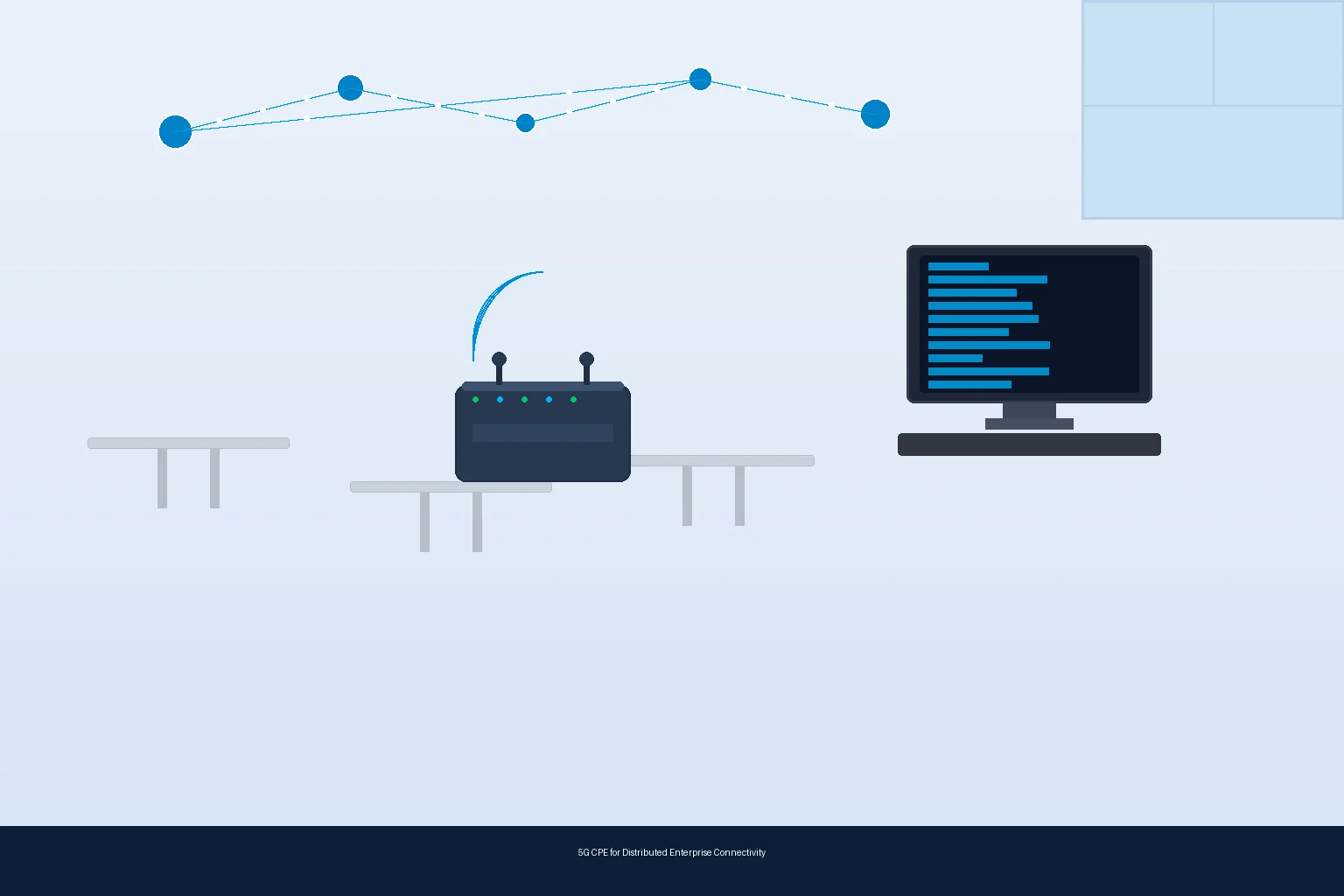
The shift to hybrid and distributed work models has moved beyond a temporary pandemic response into a permanent structural transformation of enterprise network architecture. As of mid-2026, more than 62% of global enterprises operate with at least 40% of their workforce distributed across branch offices, co-working spaces, and home offices — and the traditional hub-and-spoke WAN model is struggling to keep pace. This creates a massive opportunity for 5G CPE (Customer Premises Equipment) to serve as the programmable, cloud-managed connectivity layer for the distributed enterprise.
Why Traditional WAN Falls Short for Distributed Work
Conventional enterprise WAN architectures were designed around centralized data centers and MPLS backhaul circuits. Branch offices connected to headquarters through dedicated lines; remote workers connected through VPN tunnels terminating at a corporate firewall. This model assumes traffic always flows through a central inspection point — an assumption that collapses under the weight of cloud-first SaaS applications, real-time collaboration tools like Microsoft Teams and Zoom, and bandwidth-heavy workloads such as large file synchronization across distributed teams.
The result: increased latency, backhaul bottlenecks, and poor user experience for employees working outside headquarters. IT teams face the impossible task of scaling VPN concentrators and firewall throughput to match traffic that increasingly never needs to touch the corporate data center at all.
5G CPE as the Distributed Enterprise Edge
Modern 5G CPE devices — particularly those based on 3GPP Release 17 and Release 18 (5G-Advanced) chipset platforms — are evolving beyond simple fixed wireless access terminals. They now function as intelligent edge gateways with integrated routing, application-aware QoS, zero-touch provisioning, and cloud-native management. For the distributed enterprise, this means a small-form-factor 5G CPE can serve as the primary WAN termination point for a branch office or remote team hub, delivering fiber-class throughput without requiring a fixed-line installation.
Key capabilities that make 5G CPE viable as enterprise branch gateways in 2026 include:
- Multi-gigabit throughput: 5G-Advanced CPE supporting 3GPP Release 18 carrier aggregation can deliver sustained downlink speeds of 2–4 Gbps, sufficient for 50–100 concurrent office users running SaaS, VoIP, and video collaboration workloads.
- Network slicing awareness: Enterprise-grade CPE devices can now map traffic to specific 5G network slices, enabling guaranteed QoS for latency-sensitive applications like real-time video conferencing while best-effort traffic uses a separate slice — all over a single 5G radio link.
- SD-WAN integration: Leading CPE platforms embed SD-WAN functionality natively, supporting application-based path selection across multiple WAN interfaces (5G, wired broadband, satellite) with sub-second failover and per-packet steering.
- Zero-touch provisioning (ZTP): Cloud-managed CPE platforms allow IT teams to ship pre-configured devices to branch locations or employee home offices; the device auto-connects, authenticates, and pulls its configuration profile within minutes of power-on.
- SASE-ready architecture: 5G CPE with embedded secure access service edge (SASE) client capabilities can terminate encrypted tunnels directly to cloud security gateways, bypassing the need for corporate VPN concentrators entirely.
Use Case: Branch Office-in-a-Box
Consider a mid-sized logistics company opening three new regional dispatch centers. Each location needs connectivity for 15–25 staff, IP phones, CCTV cameras, and real-time fleet tracking dashboards. The traditional approach — ordering fixed-line business broadband, installing routers, configuring VPNs, and waiting 4–8 weeks for circuit activation — is both slow and expensive.
With a 5G CPE-based deployment, the IT team ships a single device to each location. The CPE powers on, connects to the carrier’s 5G standalone (SA) network, authenticates via eSIM-based carrier provisioning, downloads its SD-WAN configuration from the cloud controller, and establishes secure tunnels to the company’s SASE points of presence — all in under 15 minutes. Staff arrive to find Wi-Fi, VoIP, and all cloud applications working at full performance. The entire deployment costs a fraction of MPLS and eliminates the weeks-long circuit provisioning delay.
Security Considerations for Distributed 5G CPE
Deploying CPE at distributed locations raises valid security concerns. Enterprise IT teams should evaluate CPE platforms against these criteria:
- Hardware-rooted identity: TPM 2.0 or equivalent secure element for device attestation and certificate storage.
- Encrypted management plane: All device configuration, telemetry, and firmware updates transmitted over mutually authenticated TLS 1.3 channels.
- Zero-trust network access (ZTNA): CPE should enforce identity-based access policies at the edge, not simply pass all traffic to a central firewall.
- Over-the-air firmware integrity: Signed firmware images with A/B partition rollback protection to prevent bricking or compromise.
- Physical tamper resistance: For publicly accessible branch locations, the CPE enclosure should include tamper-evident seals and secure mounting options.
The Economic Case
For enterprises managing 10 to 500+ distributed locations, the total cost of ownership (TCO) advantage of 5G CPE over traditional fixed-line WAN is compelling. A typical enterprise branch MPLS circuit costs $400–$1,200 per month depending on bandwidth and SLA tier, plus $1,500–$5,000 in upfront installation charges. 5G FWA plans from tier-1 carriers in 2026 offer 500 Mbps to 2 Gbps for $80–$250 per month, with zero installation cost and same-day activation.
When multiplied across dozens or hundreds of locations, the annual savings reach six to seven figures — while simultaneously delivering higher bandwidth, faster deployment, and greater flexibility to scale up or down as business needs change.
Looking Ahead: AI-Optimized Distributed Networking
The next evolution of distributed enterprise CPE will leverage AI/ML models running directly on the CPE’s application processor. These models will analyze traffic patterns in real time, predict congestion before it impacts users, automatically adjust QoS policies, and even pre-warm alternate WAN paths based on learned usage patterns. Combined with carrier network exposure APIs that give CPE devices visibility into RAN conditions, the distributed enterprise network of 2027 will be largely self-optimizing.
For B2B telecom buyers and enterprise network architects, the message is clear: 5G CPE has matured from a “good enough” backup link into a legitimate primary WAN platform for distributed enterprise connectivity. Those who embrace the architecture now will gain a significant competitive advantage in agility, cost efficiency, and user experience.
Honlly Telecom designs and manufactures enterprise-grade 5G CPE solutions with embedded SD-WAN, zero-touch provisioning, and SASE integration — purpose-built for distributed enterprise deployments. Contact our B2B solutions team to discuss your connectivity requirements.