
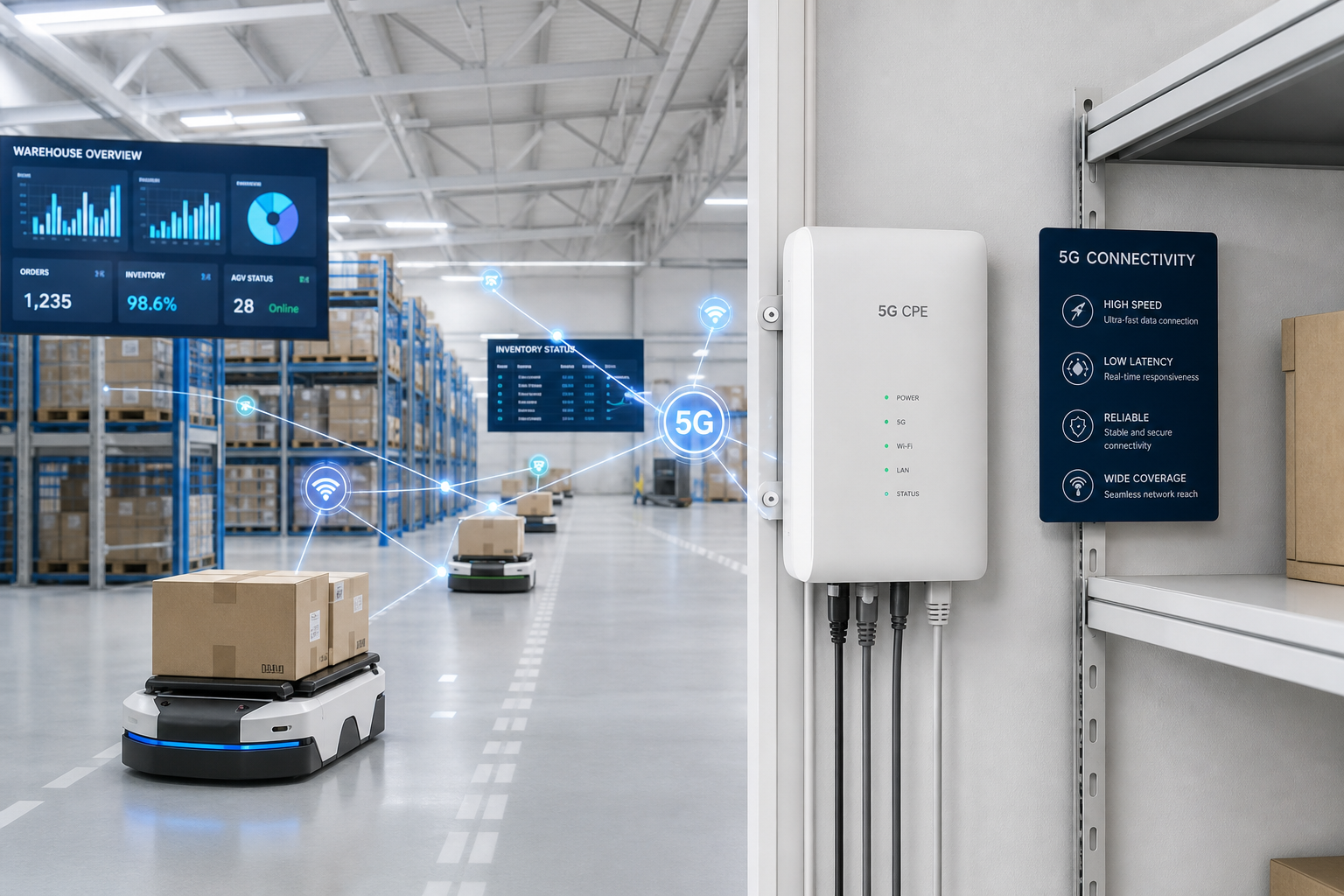
The global smart warehouse market is projected to exceed $45 billion by 2028, fueled by e-commerce growth, labor shortages, and Industry 4.0 automation. At the heart of every connected warehouse lies a critical — and often overlooked — component: reliable, low-latency wireless connectivity. For logistics operators, system integrators, and telecom buyers, selecting the right 5G CPE for warehouse environments requires a fundamentally different evaluation framework than office or residential deployments.
Why Warehouse Connectivity Demands Specialized CPE
Warehouse environments present unique RF and operational challenges that standard indoor CPE cannot reliably address:
- Metal racking and inventory: Steel shelving creates severe multipath interference and signal attenuation. CPE must support advanced antenna designs (4×4 MIMO with beamforming) and optimal placement strategies.
- High device density: A single warehouse may host hundreds of connected devices — barcode scanners, AGVs (Automated Guided Vehicles), IoT sensors, IP cameras, and worker tablets — all competing for spectrum.
- Mobility requirements: Unlike fixed office CPE, warehouse devices (AGVs, forklift-mounted terminals) move at 1-3 m/s, requiring seamless handover between indoor small cells or Wi-Fi access points.
- Environmental extremes: Cold storage (-25°C), loading docks (dust/humidity), and high-bay racking areas (30m+ ceiling heights) demand ruggedized enclosures and extended temperature ratings.
- Real-time deterministic networking: AGV collision avoidance and automated picking systems require sub-20ms latency with 99.999% reliability — far beyond best-effort broadband SLAs.
5G vs Wi-Fi 7 for Warehouse Deployments: A Practical Comparison
| Criterion | 5G (NR) CPE | Wi-Fi 7 AP |
|---|---|---|
| Coverage per node | 500-2000m² (indoor small cell) | 150-400m² |
| Handover latency | ~10-30ms (network-controlled) | ~50-100ms (client-initiated) |
| QoS granularity | 5QI-based, per-flow slicing | 802.11be MLO, limited QoS |
| Interference management | Licensed spectrum, centralized scheduling | Unlicensed, CSMA/CA contention |
| Max connected devices | 10⁵/km² (mMTC capable) | ~256 per AP (practical ~50) |
| Infrastructure cost | Higher (small cells + spectrum) | Lower (unlicensed, mature ecosystem) |
| Best for | AGVs, mission-critical automation | Handheld scanners, general data |
Practical recommendation: Most warehouses deploy a hybrid architecture — 5G NR for mobility-critical applications (AGVs, AS/RS systems) and Wi-Fi 7 for high-throughput stationary devices (IP cameras, fixed workstations). The 5G CPE serves as the backhaul anchor, with integrated Wi-Fi 7 AP functionality for local distribution.
CPE Selection Framework for Warehouse Operators
1. RF Performance in Challenging Environments
Look for CPE with external antenna ports (SMA/TS-9) supporting both sub-6 GHz and mmWave (if applicable). This allows installation of directional panel antennas positioned above racking lines of sight. CPE rated for 4×4 MIMO on n78 (3.5 GHz) delivers the best balance of coverage and capacity in warehouse settings. Carrier Aggregation support (at least 2CA on sub-6 GHz) ensures reliable throughput even at cell edges.
2. Ruggedization and Environmental Rating
Industrial warehouse CPE should carry minimum IP40 rating (IP65 for cold storage and loading docks), operate at -20°C to +55°C, and withstand vibration per IEC 60068-2-6. Fanless passive cooling designs are strongly preferred to avoid dust ingress and mechanical failure points in 24/7 operation.
3. Dual-SIM and Multi-WAN Failover
Warehouse operations cannot tolerate downtime — a connectivity outage during peak picking hours can cost $10,000+ per hour. CPE with dual-SIM (eSIM + physical nano-SIM) and automatic failover between carriers (sub-30-second switchover) is rapidly becoming a baseline requirement for logistics operators.
4. Local Edge Compute for Protocol Translation
As discussed in our coverage of edge-compute CPE, warehouse environments benefit from on-device protocol translation: Modbus TCP, PROFINET, and EtherCAT from industrial PLCs converted to MQTT/HTTP at the CPE edge before forwarding to WMS (Warehouse Management System) cloud platforms. This eliminates the need for separate industrial gateway hardware.
5. Private 5G (NPN) Compatibility
For large distribution centers (50,000m²+), private 5G networks using n77/n78 spectrum offer deterministic performance that public networks cannot guarantee. CPE must support SNPN (Standalone Non-Public Network) credentials, SUPI/SUCI-based authentication, and local breakout (LBO) for on-premises traffic.
Deployment Architecture: 5G-Enabled Smart Warehouse Reference Design
A typical 50,000m² distribution center deployment architecture:
- WAN Layer: Dual 5G FWA CPE (primary + backup) with outdoor directional antennas on rooftop, providing 500 Mbps–1 Gbps backhaul from public 5G network or private 5G core
- Distribution Layer: Industrial-grade 5G CPE with integrated Wi-Fi 7 APs strategically positioned every 100-150m² in ceiling-mounted enclosures above racking aisles
- Access Layer: AGVs and autonomous forklifts connect via 5G NR directly to indoor small cells; handheld scanners and IoT sensors connect via Wi-Fi 7 or BLE to the nearest CPE/AP
- Edge Compute Layer: Selected CPE nodes run containerized WMS edge agents for local inventory sync, AGV path planning, and video analytics
- Management Layer: All CPE managed via TR-369 USP cloud platform with real-time RF KPI monitoring, firmware management, and automated failover orchestration
Total Cost of Ownership Analysis
Comparing TCO over 5 years for a 50,000m² warehouse with 500 connected devices:
- Wi-Fi 7 only (30 APs + wired backhaul): ~$45,000 (APs + controller + cabling + installation)
- 5G CPE + Wi-Fi 7 hybrid (12 CPE + 18 APs): ~$38,000 (fewer nodes, no cabling to distant zones, CPE provides backhaul wirelessly)
- Full 5G private network (12 small cells + 5G core): ~$120,000 (best performance, highest upfront cost)
The hybrid 5G CPE + Wi-Fi 7 model offers the best balance of cost, coverage, and performance for mid-to-large warehouses today, with a clear migration path to full private 5G as equipment costs decline.
FAQ
Q: Can we use consumer-grade 5G routers in a warehouse?
A: Not recommended. Consumer routers lack external antenna ports, industrial temperature ratings, dual-SIM failover, and deterministic QoS — all critical for warehouse reliability. The $200-300 savings per unit are quickly erased by a single hour of downtime.
Q: How many CPE nodes does a typical warehouse need?
A: Rough rule of thumb: one CPE node per 1,500-2,000m² for general coverage, with additional nodes in high-density zones (picking/packing areas). A 50,000m² facility typically needs 25-35 nodes total (mix of 5G CPE and Wi-Fi extenders).
Q: What’s the ROI timeline for upgrading from Wi-Fi 5/6 to 5G CPE-based connectivity?
A: Most operators report 12-18 month ROI through reduced cabling costs (new CPE nodes don’t need Ethernet backhaul), fewer APs (5G CPE covers 3-5x the area), improved AGV uptime (15-25% improvement in picking throughput), and eliminated separate gateway hardware via edge compute consolidation.
Deploying connected warehouse infrastructure? Contact Honlly Telecom for enterprise 5G CPE solutions with industrial ruggedization, dual-SIM failover, and edge compute capabilities optimized for logistics environments.