
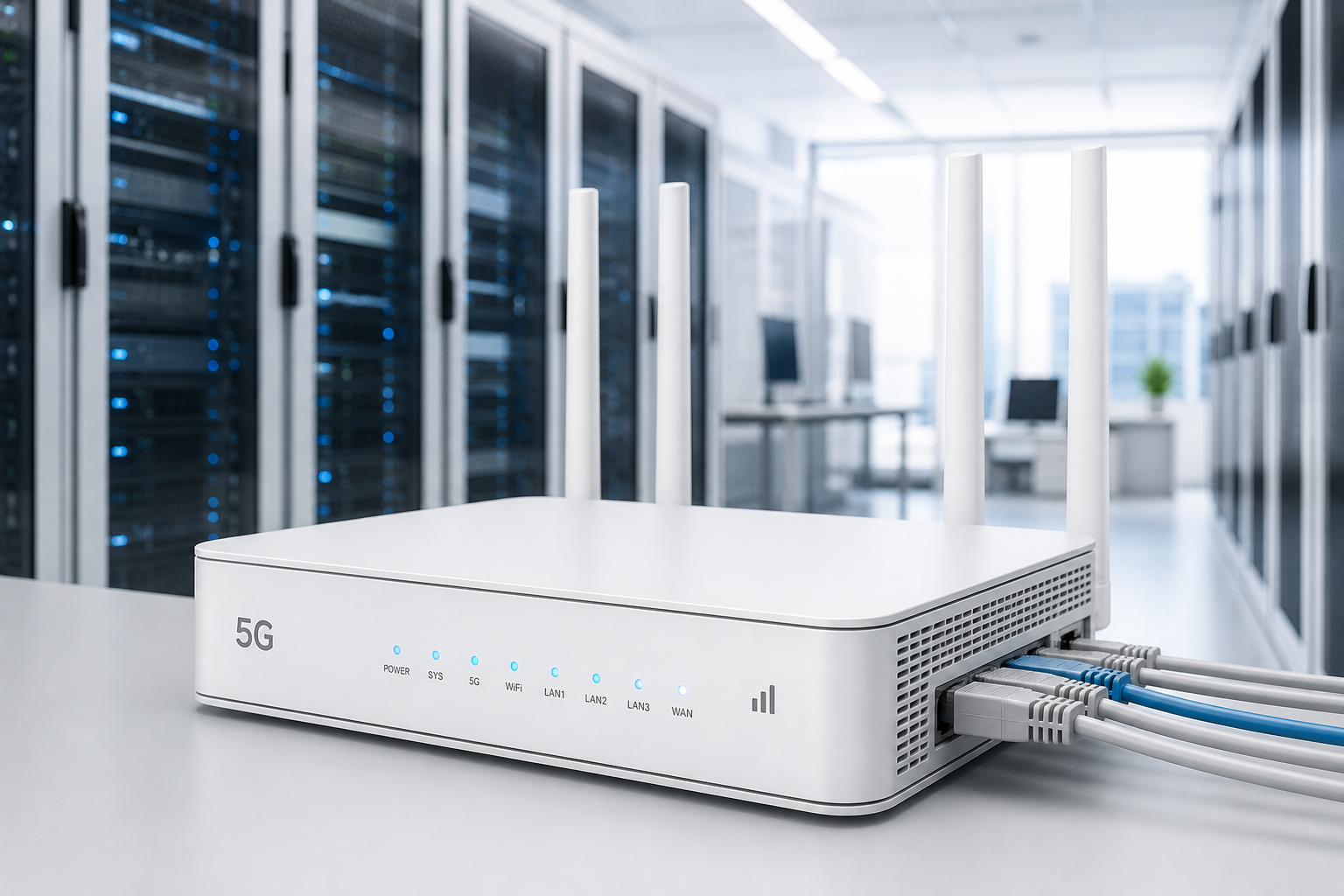
As enterprise Fixed Wireless Access (FWA) deployments scale globally, a new architectural shift is quietly reshaping how telecom operators and ISP buyers evaluate CPE hardware: on-device edge computing. Rather than treating the customer-premises router as a simple pass-through gateway, the 2026 generation of 5G CPE devices increasingly embeds Multi-access Edge Computing (MEC) capabilities directly at the network edge — inside the router itself.
What Is On-Device Edge Computing in CPE?
Traditional CPE routes traffic between the 5G RAN and the local LAN. Edge-compute CPE adds a lightweight compute layer — typically an ARM-based application processor alongside the modem SoC — capable of running containerized workloads at the customer site. This transforms the CPE from a “dumb pipe” into a micro data center at the edge.
Industry analysts at ABI Research project that by 2027, over 35% of enterprise-grade 5G CPE shipped globally will include some form of on-device compute capability, driven by demand for ultra-low-latency applications in manufacturing, retail, and smart logistics.
Key Use Cases Driving CPE Edge Compute Adoption
1. Industrial IoT Data Pre-Processing
Factory-floor sensors generate terabytes of raw telemetry. Instead of backhauling all data to a centralized cloud, edge-compute CPE performs local filtering, anomaly detection, and protocol translation (Modbus TCP → MQTT) before forwarding aggregated insights. This reduces backhaul costs by 40-60% while cutting latency from hundreds of milliseconds to single digits.
2. Retail Branch SD-WAN with Local AI Inference
Retail chains deploying 5G FWA as primary WAN increasingly run lightweight AI models (inventory counting, footfall analytics, POS fraud detection) directly on the CPE. Qualcomm’s latest X75-based CPE reference designs include a dedicated NPU for ONNX model execution at under 3W.
3. Video Surveillance Analytics at the Edge
IP camera streams processed locally on the CPE eliminate the need for separate NVR hardware. Object detection, license plate recognition, and people counting run as Docker containers on the CPE’s application processor, with only metadata and alert clips sent upstream.
4. Zero-Touch Branch Office IT
Enterprise IT teams deploy virtualized network functions (VNFs) — DHCP, DNS, firewall, and SD-WAN overlay — as containerized applications on the CPE, enabling true “router as a server” deployments for small offices with no on-site IT staff.
Procurement Implications for Telecom Buyers
For ISP and MVNO procurement teams evaluating CPE for enterprise FWA deployments, edge compute capability introduces new evaluation criteria beyond traditional RF performance metrics:
- Compute specifications matter: CPU cores, RAM (minimum 2GB recommended for container workloads), and NPU/GPU availability become relevant selection criteria alongside 5G modem category and CA combos.
- Software ecosystem lock-in: Which container runtime does the CPE support? Docker? Kubernetes K3s? Proprietary runtime? Open platforms reduce vendor lock-in.
- Thermal and power budget: Adding compute increases power consumption. Look for CPE with active or advanced passive cooling rated for extended temperature ranges in industrial deployments.
- Remote device management: TR-369 USP or proprietary cloud management must support container lifecycle management alongside traditional CPE WAN management functions.
- Total cost of ownership (TCO): An edge-compute CPE may cost $50-150 more upfront than a basic 5G router, but can displace separate NVR, SD-WAN appliance, or edge server hardware — yielding net savings per site.
Chipset Landscape: Who’s Powering CPE Edge Compute?
The silicon ecosystem is consolidating around three architectures:
- Qualcomm X75/X80 + Kryo CPU: Integrated modem-RF plus octa-core Arm application processor with Hexagon NPU. Dominant in high-end enterprise FWA CPE from vendors like Honlly, ZTE, and Nokia.
- MediaTek T830 + Cortex-A78: Competitive mid-range platform with quad-core A78 application processor. Gaining traction in cost-sensitive APAC and LATAM markets.
- Intel Xeon D / AMD EPYC Embedded + 5G M.2 Module: x86-based CPE for demanding edge workloads requiring full Linux/Windows Server compatibility. Higher cost and power but maximum software flexibility.
Standards and Interoperability
ETSI MEC and 3GPP SA6 have defined reference architectures for edge computing integration with 5G core networks. However, on-device CPE edge compute currently operates in a standards gap — most implementations are proprietary. The GSMA’s Edge Computing in the 5G Era whitepaper (2026 update) recommends operators require:
- ONNX runtime compatibility for AI/ML model portability
- OCI-compliant container images for application portability
- RESTful northbound APIs aligned with ETSI MEC Mp1 interface
FAQ
Q: Does edge-compute CPE require 5G Standalone (SA)?
A: No. While 5G SA’s URLLC features unlock the lowest latency use cases, most edge-compute workloads (video analytics, IoT pre-processing, SD-WAN) function perfectly well over 5G NSA or even LTE-Advanced Pro connections. The edge compute happens locally — the WAN link’s contribution to total latency is often secondary.
Q: What’s the typical power increase for edge-compute CPE?
A: A basic 5G CPE draws 8-15W. Adding an application processor and active workloads typically adds 5-15W, bringing total consumption to 15-30W. This is still a fraction of a traditional x86 edge server (80-200W).
Q: Can existing deployed CPE be upgraded to support edge compute?
A: Generally no — edge compute requires dedicated hardware (application processor, RAM, storage). However, operators can deploy edge-compute CPE incrementally for specific enterprise segments while maintaining existing CPE for basic connectivity users.
Q: How does edge compute affect CPE security posture?
A: It expands the attack surface. Buyers should verify: secure boot chain, TPM 2.0 or equivalent hardware root of trust, signed container images, runtime isolation between containers, and regular CVE-patched base images. TR-369 USP’s secure software module management (SSMM) provides a standardized framework for this.
Looking for 5G CPE with edge computing capabilities for your enterprise FWA deployment? Contact Honlly Telecom to discuss your requirements with our solutions engineering team.