
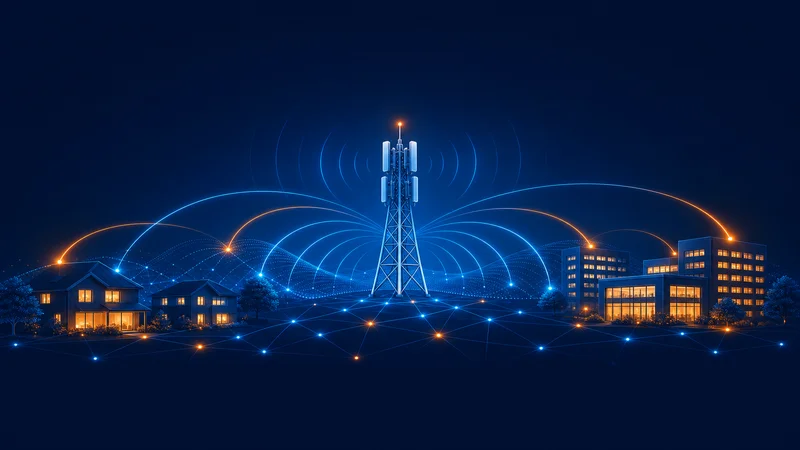
The convergence of 5G Fixed Wireless Access (FWA) and digital healthcare is reshaping how medical services reach patients beyond urban hospital corridors. As telemedicine adoption accelerates worldwide—driven by an aging global population, chronic disease management demands, and the lasting operational lessons of pandemic-era care delivery—healthcare providers are increasingly turning to 5G CPE as the connectivity backbone for remote consultation, real-time patient monitoring, and distributed clinical workflows.
In 2026, the intersection of 5G network maturity and healthcare digitization has created a compelling business case for telecom operators and system integrators serving the B2B healthcare vertical. Unlike consumer-grade broadband, medical-grade connectivity demands ultra-reliable low-latency communication (URLLC), guaranteed quality of service, and stringent data privacy compliance—all of which modern 5G CPE platforms are engineered to deliver.
The Telemedicine Connectivity Imperative
Traditional wired broadband infrastructure has long been the default for healthcare facilities. However, wired deployments face inherent limitations: prolonged installation timelines, high civil engineering costs for last-mile fiber trenching, and physical vulnerability to natural disasters and construction-related outages. For rural clinics, mobile health units, pop-up vaccination centers, and temporary field hospitals, wired connectivity is often economically infeasible or logistically impossible.
5G FWA eliminates these barriers. A single 5G CPE device—deployed in minutes rather than months—can deliver symmetrical multi-hundred-megabit throughput with sub-10ms latency, sufficient to support simultaneous high-definition video consultations, real-time diagnostic imaging transfers, and streaming telemetry from connected medical devices. For healthcare IT directors, the operational calculus is straightforward: faster deployment, lower total cost of ownership, and carrier-grade reliability without the civil engineering complexity of fiber builds.
Key Technical Requirements for Medical-Grade 5G CPE
Not all 5G CPE devices are created equal when deployed in healthcare environments. Procurement teams evaluating CPE for telemedicine applications should prioritize several technical capabilities:
Ultra-Reliable Low-Latency Communication (URLLC): Remote robotic surgery assistance, real-time ultrasound guidance, and teleradiology consultations require deterministic latency below 10ms with 99.999% reliability. CPE devices must support 5G SA (Standalone) architecture with URLLC QoS profiles to guarantee these performance envelopes.
Network Slicing Support: Healthcare networks carry heterogeneous traffic—from bandwidth-intensive MRI transfers to latency-sensitive tele-surgery streams and routine administrative data. 5G network slicing, implemented at both the core network and CPE level, enables logical traffic separation with guaranteed SLAs per slice. Forward-looking CPE platforms support multiple simultaneous PDU sessions mapped to distinct network slices.
Hardware-Accelerated Encryption: Patient data protection is non-negotiable under HIPAA, GDPR, and equivalent regional frameworks. CPE devices should incorporate hardware security modules (HSM) or trusted platform modules (TPM) for hardware-rooted encryption key storage, along with IPsec and WireGuard VPN acceleration at line rate to ensure end-to-end encrypted tunnels without throughput degradation.
Dual-SIM Redundancy with Automatic Failover: For critical care scenarios where connectivity loss directly impacts patient outcomes, dual-SIM CPE with automatic carrier failover provides an essential safety net. The device should monitor link health continuously and execute sub-second failover to a secondary operator when primary link quality degrades below configured thresholds.
Environmental Hardening for Non-Traditional Deployments: Unlike climate-controlled data centers, telemedicine CPE may be deployed in outdoor mobile clinics, disaster response tents, or rural health posts with limited environmental control. Industrial-temperature-rated CPE (-40°C to +65°C) with IP65 or higher ingress protection ensures reliable operation in challenging physical environments.
Real-World Deployment Models
Several deployment architectures have emerged as best practices for healthcare FWA:
Hub-and-Spoke Telemedicine Networks: A central urban hospital serves as the diagnostic hub, with 5G CPE-equipped rural clinics acting as spokes. Each spoke CPE establishes a dedicated encrypted tunnel to the hub, enabling specialists to conduct remote consultations with full access to electronic health records and diagnostic imaging systems. This model has proven particularly effective in regions like Southeast Asia, Sub-Saharan Africa, and Latin America, where specialist density in rural areas remains critically low.
Mobile Health Units and Ambulance Connectivity: Vehicle-mounted 5G CPE with external MIMO antennas transforms ambulances into mobile telemedicine nodes. Paramedics can transmit live vital signs, 12-lead ECG data, and high-definition video to emergency department physicians while en route, enabling pre-arrival diagnosis and preparation that significantly improves time-to-treatment for stroke, cardiac, and trauma patients.
Remote Patient Monitoring (RPM) Gateways: For chronic disease management—diabetes, hypertension, COPD, congestive heart failure—5G CPE serves as the in-home aggregation gateway for Bluetooth and Wi-Fi connected medical devices. The CPE securely relays continuous glucose monitors, blood pressure cuffs, pulse oximeters, and weight scales to cloud-based care management platforms, enabling early intervention when patient metrics deviate from baseline.
The B2B Opportunity for Operators and Integrators
For telecom operators, healthcare represents one of the highest-value verticals for 5G FWA services. Healthcare organizations are willing to pay premium rates for guaranteed SLAs, and the stickiness of medical connectivity contracts—once a clinic’s entire workflow depends on a CPE connection—results in exceptionally low churn. System integrators specializing in healthcare IT can build complete solutions combining CPE hardware, cloud-based device management platforms, and vertical-specific application integration.
As 5G-Advanced (3GPP Release 18) capabilities roll out through 2026-2027, enhanced URLLC features, integrated sensing for health monitoring, and further latency reductions will unlock even more sophisticated telemedicine applications. Early movers who establish healthcare CPE deployments today will be positioned to upsell these advanced capabilities as the technology matures.
For B2B buyers evaluating 5G CPE for healthcare deployments, the message is clear: the technology is mature, the ROI is compelling, and the clinical impact—measured in lives improved through expanded access to specialist care—makes this one of the most meaningful applications of 5G fixed wireless technology in 2026.