
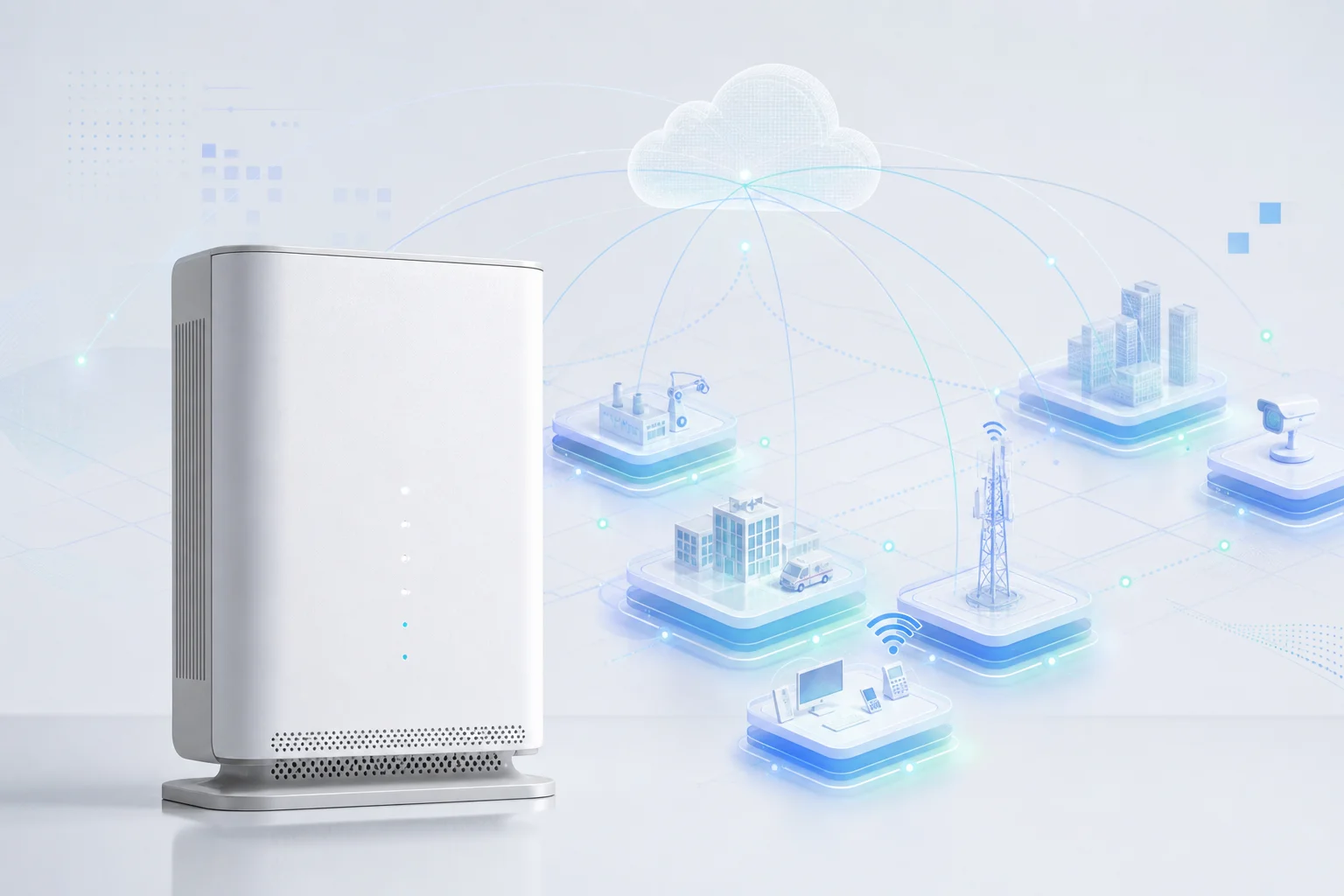
As enterprises accelerate digital transformation, the convergence of 5G connectivity and edge computing is creating a new paradigm for customer premises equipment. Modern 5G CPE devices are evolving beyond simple connectivity gateways — they are becoming intelligent edge nodes capable of local data processing, real-time analytics, and autonomous decision-making.
This shift matters for telecom buyers, system integrators, and enterprise IT teams evaluating 5G CPE for branch offices, retail locations, industrial sites, and remote facilities. Understanding the edge computing capabilities now available in advanced CPE platforms can significantly influence procurement decisions and total cost of ownership calculations.
Why Edge Computing Belongs in CPE
Traditional CPE architecture routes all traffic through the device to a centralized cloud or data center. For applications requiring sub-10ms latency — such as industrial automation, computer vision quality inspection, or real-time IoT sensor fusion — this round-trip delay is unacceptable. By embedding edge compute capabilities directly in the CPE, data can be processed locally before it ever leaves the premises.
The benefits extend beyond latency:
- Bandwidth optimization: Filtering and aggregating data at the edge reduces WAN backhaul traffic by 60-80% in typical IoT deployments
- Resilience: Local processing ensures critical functions continue during WAN outages
- Data sovereignty: Sensitive data stays on-premises, addressing GDPR, HIPAA, and other regulatory requirements
- Cost reduction: Lower cloud compute and storage costs by pre-processing data at the edge
Architecture: How Edge-Enabled CPE Works
Modern edge-enabled 5G CPE incorporates a multi-core application processor alongside the 5G modem, typically running a Linux-based operating system with containerization support. This architecture supports:
- Docker/OCI container runtime: Deploying lightweight edge applications and microservices directly on the CPE
- Local AI/ML inference: Running pre-trained models for video analytics, anomaly detection, and predictive maintenance at the network edge
- Protocol translation: Bridging Modbus, BACnet, OPC-UA, and other industrial protocols to IP-based cloud platforms
- Local data persistence: Time-series databases and message brokers for buffering and local analytics
Qualcomm’s X80 and X105 platforms, alongside MediaTek’s T900 series, now include dedicated AI accelerators and application processor cores specifically designed for edge workloads — making this capability available in cost-effective, carrier-grade CPE form factors.
Enterprise Use Cases
Smart Retail
Edge-enabled 5G CPE in retail locations runs computer vision models for foot traffic analysis, shelf inventory monitoring, and queue management — all processed locally for privacy compliance. The CPE aggregates multiple in-store IoT sensors (temperature, humidity, door contacts) and forwards only actionable alerts to central operations.
Industrial IoT and Manufacturing
On factory floors, edge CPE devices connect to PLCs, vibration sensors, and cameras, running predictive maintenance algorithms locally. When a bearing shows early signs of failure, the CPE triggers an alert in under 5ms — versus 150ms+ for a cloud-based architecture — enabling real-time machine shutdown if needed.
Remote Branch Connectivity
For distributed enterprises with hundreds of branch locations, edge CPE consolidates SD-WAN routing, local DHCP/DNS, print services, and basic file sharing onto a single device. This eliminates the need for separate on-premises servers and reduces branch IT hardware by up to 70%.
Procurement Considerations
When evaluating edge-enabled 5G CPE, enterprise buyers and operators should assess:
- Compute capacity: CPU cores, RAM, and storage available for edge workloads — minimum 2GB RAM and 8GB storage recommended
- Container orchestration: Compatibility with existing edge management platforms (Azure IoT Edge, AWS Greengrass, or open-source K3s)
- Security architecture: Hardware root of trust, secure boot, TPM 2.0, and encrypted storage for edge data
- Thermal design: Edge workloads generate additional heat; passive cooling must be sufficient for sustained compute
- Remote management: TR-369 USP or equivalent for zero-touch provisioning and container lifecycle management at scale
- Power budget: Edge compute adds 3-8W to baseline CPE power consumption — factor into deployment energy planning
The Honlly Edge Advantage
Honlly Telecom’s next-generation 5G CPE platforms are designed with edge computing as a core capability, not an afterthought. Our devices feature:
- Quad-core ARM Cortex-A55 application processors with dedicated NPU for edge AI inference
- Docker-compatible Linux OS with pre-validated container images for common edge workloads
- Hardware security module (HSM) with TPM 2.0 for edge data protection
- Passive thermal design tested for sustained edge compute in ambient temperatures up to 45°C
- Full TR-369 USP integration for remote container deployment and monitoring at scale
For operators and enterprises planning edge-enabled 5G deployments, Honlly provides reference architectures, integration support, and customizable hardware configurations to match specific workload requirements. Contact our engineering team to discuss your edge computing CPE needs.
Published: August 2, 2026