
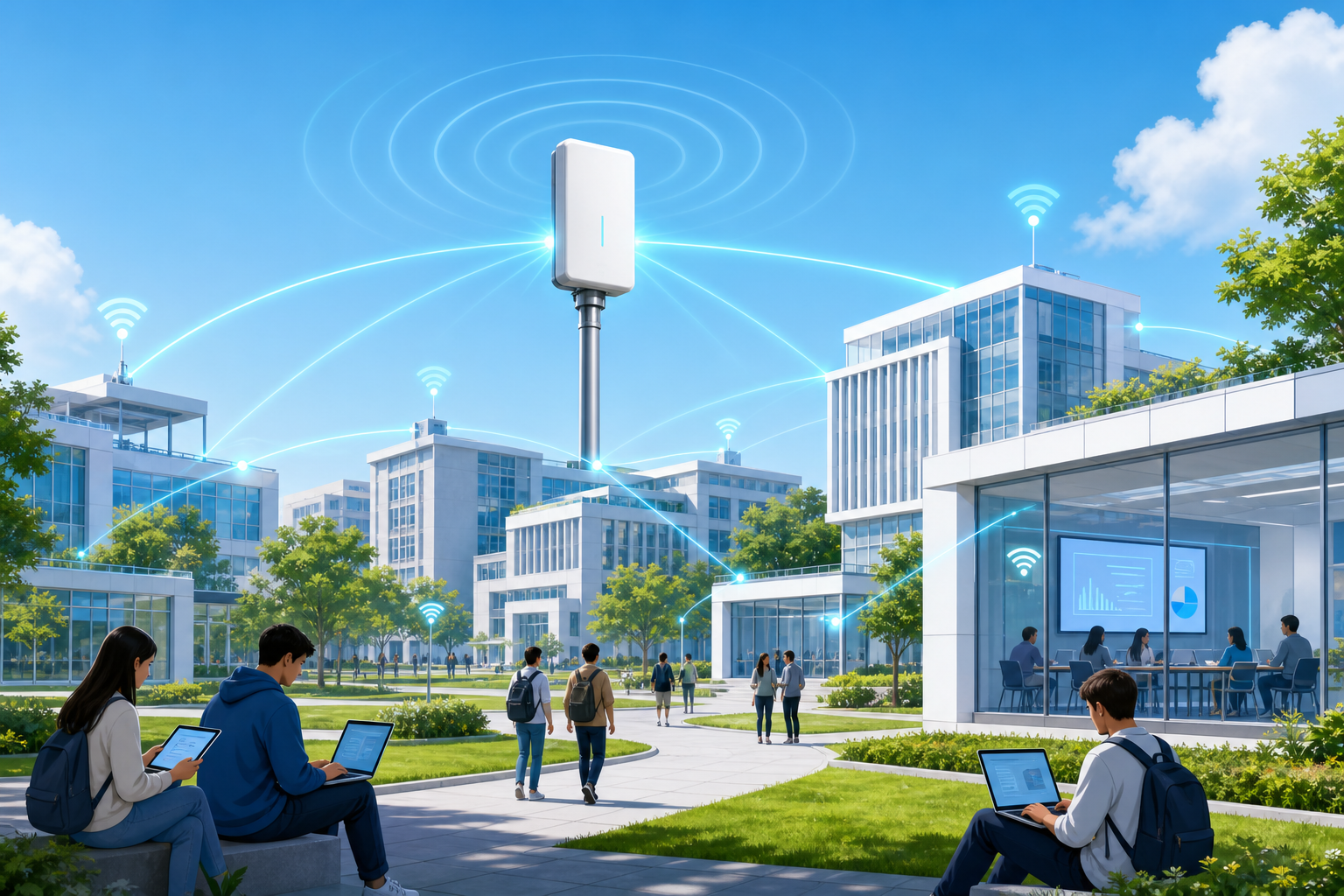
Educational institutions — from K-12 school districts to university campuses — are undergoing a connectivity transformation that places unprecedented demands on wide-area network infrastructure. With one-to-one device programs now standard, cloud-based learning management systems consuming symmetrical bandwidth, and campus security systems requiring always-on backhaul, the traditional MPLS and best-effort broadband architectures that served schools for decades are reaching their operational limits. 5G Fixed Wireless Access (FWA) CPE is emerging as a strategically compelling alternative, offering carrier-grade reliability, rapid deployment timelines, and cost structures that align with constrained public-sector budgets. This guide provides B2B technology buyers — including school district IT directors, university CIOs, and MSPs serving the education vertical — with an engineering-focused framework for evaluating and deploying 5G CPE in campus environments.
The Education Connectivity Challenge: Why Traditional WAN Falls Short
School networks face a unique combination of requirements that consumer-grade broadband and legacy enterprise WAN solutions struggle to satisfy simultaneously:
- Concurrency and Burst Traffic: A single high school campus may simultaneously support 2,000+ active clients during class periods, with synchronized video streaming, online testing platforms, and collaboration tools generating traffic bursts that saturate 1 Gbps backhaul links during peak windows.
- Security and Compliance: K-12 districts must comply with CIPA (Children’s Internet Protection Act) content filtering requirements, while higher education institutions face FERPA, HIPAA (for student health centers), and PCI-DSS (for campus payment systems) compliance obligations — each requiring network segmentation that consumer-grade CPE cannot deliver.
- Geographic Distribution: A typical school district spans dozens of buildings across a metropolitan area, including schools, administrative offices, bus depots, and maintenance facilities. Trenching fiber to every location is cost-prohibitive; 5G FWA provides fiber-class throughput without fiber-class construction timelines.
- Seasonal Scalability: Campus networks must handle full load during academic terms and minimal load during breaks. Fixed-capacity MPLS circuits represent sunk cost during low-utilization periods, whereas 5G FWA service tiers can be adjusted seasonally — a financial optimization that traditional WAN contracts rarely offer.
- Digital Equity and Community Access: Schools increasingly serve as community connectivity hubs, extending Wi-Fi to parking lots, playgrounds, and nearby residential areas for students without home internet access. 5G CPE with extended outdoor coverage capabilities supports these digital equity initiatives without additional fiber drops.
5G CPE Architecture for Education: Key Technical Requirements
When specifying 5G CPE for education deployments, buyers should evaluate the following technical dimensions against campus-specific requirements:
1. Multi-Gigabit Throughput with Carrier Aggregation
Campus networks aggregating hundreds or thousands of simultaneous users require backhaul capacity that scales well beyond single-carrier 5G performance. Look for CPE supporting 3CC carrier aggregation (3-component carrier) across sub-6 GHz bands (n77, n78, n41) with peak throughput exceeding 3 Gbps downlink. Qualcomm X65/X72-based platforms provide sufficient headroom for medium-sized K-12 campuses; larger university deployments may benefit from X75-based CPE with 5CC CA support and up to 5 Gbps peak throughput.
2. VLAN-Aware Network Segmentation
Education networks must isolate student traffic from administrative traffic, guest networks from instructional networks, and IoT/surveillance devices from all other VLANs. The 5G CPE must support 802.1Q VLAN tagging with at minimum 8 simultaneous VLANs, configurable SSID-to-VLAN mapping, and DHCP relay per VLAN. Enterprise-grade CPE should also support VRF-lite (Virtual Routing and Forwarding) for complete routing table separation between security domains — this is particularly important for districts that operate separate networks for student data systems, HR/payroll, and physical security.
3. Dual-WAN with SD-WAN Integration
While 5G FWA serves as the primary WAN link, education buyers should specify CPE with dual-WAN capability: a 5G primary link with automatic failover to a secondary LTE or wired Ethernet connection. The CPE should support policy-based routing that can steer latency-sensitive traffic (VoIP, video conferencing) to the lowest-latency path while directing bulk data transfers to the highest-throughput path. Integration with SD-WAN overlay platforms — including Cisco Catalyst SD-WAN, Fortinet Secure SD-WAN, and VMware VeloCloud — ensures the CPE fits into existing enterprise network management frameworks rather than creating a siloed connectivity island.
4. High-Density Wi-Fi Offload
While many education deployments pair 5G CPE with separate Wi-Fi access points, integrated Wi-Fi 6 (802.11ax) or Wi-Fi 6E capability in the CPE itself is valuable for smaller facilities (portable classrooms, athletic field houses, bus barns) where a separate AP represents unnecessary cost and complexity. Look for CPE with 4×4 MU-MIMO on both 5 GHz and 2.4 GHz bands, supporting at minimum 128 concurrent clients per radio.
5. E-Rate and USAC Compliance
For U.S. K-12 buyers, E-Rate program eligibility is a hard requirement. 5G FWA services and CPE are eligible for Category One (data transmission services and internet access) funding when provided by an eligible telecommunications carrier. Buyers should verify that both the service provider and the CPE vendor can provide the required Service Provider Identification Number (SPIN) and FCC Registration Number (FRN) documentation. CPE that is installed as part of a managed service may qualify for Category Two (internal connections) funding, though the rules vary by funding year.
Deployment Models: Centralized Hub vs. Distributed Edge
Education 5G CPE deployments typically follow one of two architectural models:
Centralized Hub Model: A high-capacity 5G CPE (supporting 3–5 Gbps) serves as the primary WAN gateway for an entire school building, feeding into the existing wired LAN infrastructure. This model minimizes CPE count and simplifies management but creates a single point of failure — hence the importance of dual-WAN failover. Suitable for K-12 schools with 500–2,000 students in a single building.
Distributed Edge Model: Multiple mid-tier 5G CPE units (500 Mbps–1 Gbps each) are deployed across a campus, each serving a specific building, floor, or zone. This model provides granular capacity allocation, eliminates single points of failure, and allows phased deployment aligned with budget cycles. Suitable for university campuses, multi-building high school complexes, and district-wide deployments spanning dozens of sites.
Both models benefit from centralized cloud management via TR-369 USP (User Services Platform), enabling zero-touch provisioning, bulk configuration, firmware management, and real-time performance monitoring across the entire CPE fleet from a single pane of glass.
Security Considerations for Education CPE Deployments
Education networks are high-value targets for ransomware, DDoS, and data exfiltration attacks. 5G CPE deployed in education environments must meet a security baseline that goes beyond consumer-grade equipment:
- Stateful Firewall with Layer 7 Filtering: The CPE firewall must support application-layer filtering capable of enforcing CIPA-compliant content policies, blocking known C2 (command-and-control) domains, and applying per-VLAN security policies.
- IPSec and WireGuard VPN: For districts that backhaul traffic to a central data center or cloud security gateway, the CPE must support hardware-accelerated IPSec (AES-256-GCM) at line rate and WireGuard for modern, lightweight site-to-site tunneling.
- Secure Boot and Firmware Attestation: CPE deployed on school premises should include hardware root of trust (TPM 2.0 or equivalent), verified boot chain, and signed firmware updates to prevent supply-chain and persistent compromise attacks.
- 802.1X and RADIUS Integration: The CPE should integrate with existing RADIUS/AAA infrastructure for device and user authentication, supporting WPA3-Enterprise on integrated Wi-Fi radios.
Procurement Strategy: RFP Evaluation Criteria for Education Buyers
When issuing RFPs for 5G CPE in education environments, B2B buyers should include the following weighted evaluation criteria:
- Technical Compliance (35%): Meets minimum throughput, VLAN, security, and management requirements. Vendor provides independent test results or proof-of-concept trial data.
- Total Cost of Ownership (30%): Includes CPE unit cost, installation labor, ongoing management overhead, power consumption (watts per unit), and expected lifecycle (minimum 5 years).
- Carrier and Operator Compatibility (20%): CPE is certified or pre-tested with the buyer’s existing or planned 5G carrier partner(s). Supports the specific 5G NR bands deployed in the buyer’s geographic area.
- Vendor Stability and Support (15%): Manufacturer has been in business for at least 5 years, provides 24/7 technical support, maintains a U.S. or regional presence for RMA and warranty processing, and offers a minimum 3-year hardware warranty with advance replacement.
Conclusion
5G FWA CPE represents a generational upgrade opportunity for education networks — delivering fiber-class performance with deployment velocity and cost flexibility that traditional WAN architectures cannot match. For B2B buyers serving the education vertical, the key to successful 5G CPE procurement lies in specifying technical requirements that address the unique density, segmentation, security, and compliance demands of school environments, while aligning procurement strategy with E-Rate funding frameworks and long-term total cost of ownership. As 5G coverage continues to expand into suburban and rural school districts, the window for early-adopter cost advantages is open now.
Disclaimer: This guide provides general technical guidance for B2B telecom buyers and does not constitute legal or regulatory advice regarding E-Rate compliance. Consult with your USAC-authorized consultant for funding-year-specific eligibility determinations.