
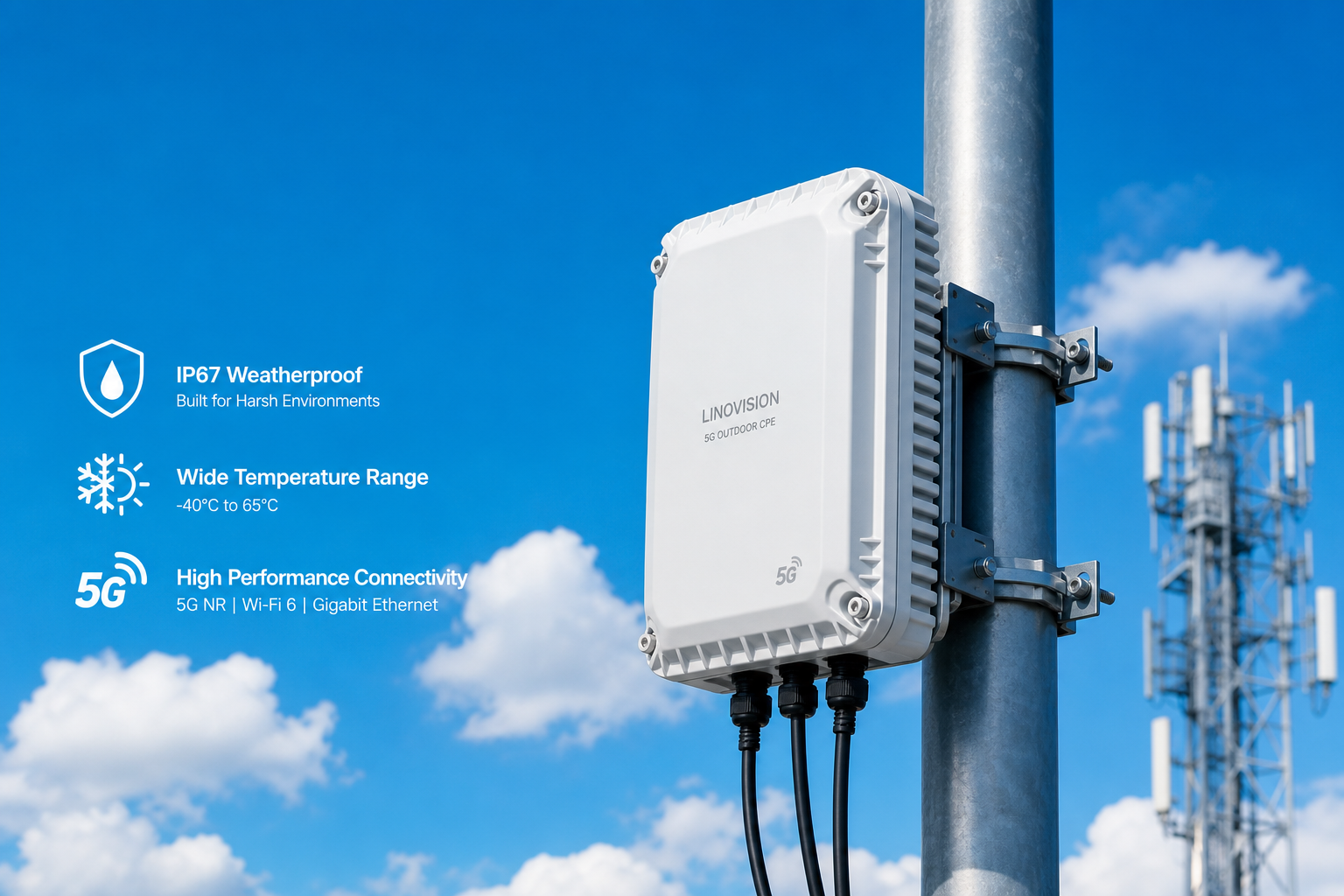
As 5G FWA deployments extend beyond climate-controlled indoor environments into outdoor, industrial, and remote locations, the physical enclosure design of the CPE device becomes a critical engineering discipline. Industrial-grade 5G CPE must withstand extreme temperatures, moisture ingress, dust contamination, physical impact, vibration, and electrical surge events — all while maintaining reliable multi-gigabit wireless connectivity. This article examines the key environmental certification standards, enclosure design principles, and procurement considerations for ruggedized 5G CPE in mission-critical B2B applications.
Ingress Protection: IP67 and Beyond
The IP (Ingress Protection) rating system, defined by IEC 60529, is the primary standard for evaluating enclosure resistance to solid particles and liquid ingress. For outdoor 5G CPE deployments, IP67 represents the practical minimum requirement — the “6” indicates complete protection against dust ingress (dust-tight), while the “7” guarantees protection against temporary immersion in water up to 1 meter depth for 30 minutes.
However, industrial environments often demand more stringent protection. IP68 certification extends immersion depth beyond 1 meter (typically 1.5–3 meters, as specified by the manufacturer), while IP69K — originally developed for the automotive and food processing industries — provides protection against high-pressure, high-temperature water jets (80°C at 80–100 bar pressure). For CPE deployed in offshore energy platforms, mining operations, or food and beverage facilities, IP69K-rated enclosures ensure operational integrity despite aggressive washdown procedures and corrosive environmental exposure.
The enclosure sealing strategy must address multiple ingress paths: cable glands and connector interfaces require compression seals with appropriate IP ratings; the SIM card access door needs double-gasket designs with captive fasteners; and ventilation membranes (typically ePTFE-based) must equalize internal pressure while blocking liquid and particulate ingress. Each sealing interface represents a potential failure point that must be validated through accelerated lifecycle testing.
Impact Resistance: IK Rating Standards
The IK rating system (IEC 62262) quantifies enclosure resistance to mechanical impact, measured in joules. IK08 (5 joules) is the common baseline for industrial CPE, equivalent to withstanding the impact of a 1.7 kg mass dropped from 300 mm. For deployments in construction sites, mining operations, transportation hubs, and public infrastructure, IK09 (10 joules) or IK10 (20 joules) ratings provide assurance against vandalism, falling debris, and accidental handling damage.
Achieving high IK ratings requires careful material selection and structural design. Aluminum alloy enclosures (typically ADC12 or A380 die-cast aluminum) offer an optimal balance of impact resistance, thermal conductivity, and weight. The wall thickness, rib reinforcement patterns, and corner radius design must be optimized through finite element analysis (FEA) simulation to absorb impact energy without deforming internal component mounting points or compromising seal integrity.
Polycarbonate and glass-reinforced polymer enclosures provide an alternative for applications requiring lighter weight or RF transparency. However, UV stabilization additives are essential to prevent polymer degradation from prolonged sun exposure. A 5-year UV aging test (per ISO 4892-2) with less than Delta-E 5 color shift and no significant reduction in impact resistance should be validated by the enclosure manufacturer.
Extended Temperature Operation: From Arctic to Desert
Industrial 5G CPE must operate reliably across extreme temperature ranges without active cooling. The industry benchmark for outdoor equipment is -40°C to +65°C operating temperature and -40°C to +85°C storage temperature, conforming to IEC 60068-2 environmental testing standards. Achieving this requires a holistic thermal management strategy encompassing component selection, thermal interface materials, and passive cooling design.
At the component level, all integrated circuits — including the 5G modem, Wi-Fi chipset, Ethernet PHY, and power management IC — must be industrial-temperature-grade (-40°C to +85°C junction temperature). Memory components (LPDDR4X/LPDDR5 DRAM and eMMC/UFS storage) require similar industrial ratings. Electrolytic capacitors, which have limited low-temperature performance, should be replaced with solid polymer or MLCC alternatives in cold-climate designs.
For high-temperature operation, the enclosure itself functions as a heat sink. Die-cast aluminum enclosures with integrated fin structures maximize surface area for convective and radiative heat dissipation. The thermal path from the 5G modem and application processor to the enclosure surface must minimize thermal resistance through the use of thermal gap pads, phase-change materials, or direct-die-contact thermal solutions. A maximum junction-to-ambient thermal resistance (Theta-JA) below 15°C/W for the primary SoC ensures stable operation at 65°C ambient without throttling.
For extreme cold environments, self-heating strategies may be employed — using the modem and processor’s own power dissipation to warm internal components during startup. A cold-start sequence that gradually brings up power-hungry components while monitoring internal temperature sensors prevents condensation and thermal shock damage to solder joints and semiconductor packages.
Surge Protection and Electrical Robustness
Outdoor CPE installations face significant electrical hazards including lightning-induced surges, AC power cross events, and electrostatic discharge. Comprehensive surge protection must be implemented on all external interfaces: the power input (DC barrel jack or PoE), Ethernet ports, and antenna connectors.
For Ethernet interfaces, compliance with ITU-T K.21 (basic-level surge protection, 1.5 kV) or the more stringent GR-1089-CORE (6 kV for ports, 5 kA for power feeds) is essential for carrier deployments. Gas discharge tubes (GDTs) provide the first line of defense against high-energy transients, with Transient Voltage Suppression (TVS) diode arrays clamping residual energy at the PHY level. The PCB layout must include sufficient creepage and clearance distances per IEC 60950-1/IEC 62368-1, with isolation slots where necessary to prevent arc-over between primary and secondary circuits.
Power supply design must accommodate wide input voltage ranges (typically 12–57V DC for PoE PD applications, or 9–36V DC for direct DC input in vehicle and industrial applications) with reverse polarity protection, under-voltage lockout, and over-voltage shutdown. An isolated DC-DC converter topology (compliant with IEC 61800-5-1 for industrial drives when applicable) provides galvanic isolation between the power source and the CPE’s internal electronics.
Corrosion Resistance and Material Durability
For coastal deployments, marine environments, and chemical processing facilities, corrosion resistance becomes a primary enclosure design driver. Aluminum enclosures should receive chromate conversion coating (per MIL-DTL-5541 Type II Class 3) followed by polyester powder coating with a minimum 60-micron thickness. Salt spray testing per ASTM B117 for 500–1000 hours with no blistering or corrosion creep beyond 2 mm from scribe validates coating integrity.
Stainless steel (304 or 316L grade) enclosures provide superior corrosion resistance for the most demanding environments but introduce RF shielding considerations that must be addressed through external antenna designs or RF-transparent window panels. All external fasteners should be stainless steel with appropriate thread-locking compounds to prevent galvanic corrosion at dissimilar metal junctions.
Procurement Guidelines for Ruggedized 5G CPE
B2B buyers evaluating industrial-grade 5G CPE should request comprehensive certification documentation including IP test reports from ISO 17025-accredited laboratories, IK impact test certificates, extended temperature validation data with thermal imaging analysis, surge compliance test reports, and corrosion resistance certification. Beyond certifications, field-proven deployment references in similar environmental conditions provide practical validation of enclosure design maturity.
Total cost of ownership analysis should factor in the mean time between failures (MTBF) per Telcordia SR-332, expected enclosure service life (minimum 10 years for outdoor telecommunications equipment), and the availability of replacement seal kits and gaskets for periodic maintenance. A well-engineered industrial enclosure transforms 5G CPE from an indoor consumer device into a carrier-grade outdoor infrastructure element capable of delivering reliable connectivity in the world’s harshest operating environments.