
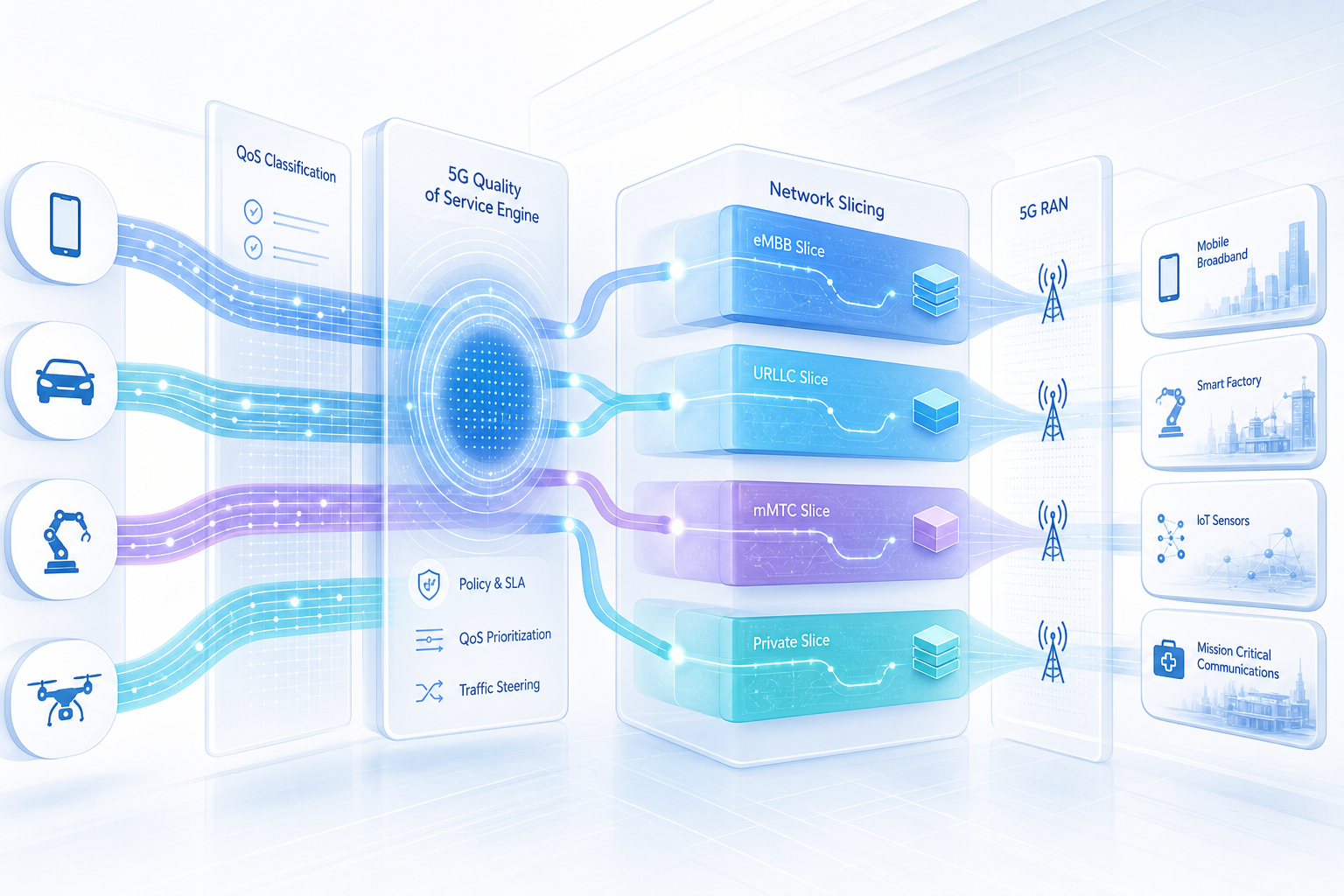
As enterprise 5G FWA deployments scale globally, Quality of Service (QoS) architecture within CPE devices has emerged as a critical differentiator for B2B connectivity solutions. Unlike consumer-grade gateways that treat all traffic equally, enterprise 5G CPE must implement sophisticated QoS frameworks that preserve service-level agreements (SLAs) across diverse application workloads — from latency-sensitive voice and video conferencing to throughput-intensive cloud backup and IoT telemetry.
Understanding the 5G QoS Model: 5QI and QoS Flows
The 3GPP 5G QoS model is fundamentally flow-based, representing a significant evolution from the 4G LTE bearer-centric architecture. Each QoS Flow is identified by a QoS Flow Identifier (QFI) and associated with a 5G QoS Identifier (5QI) that defines standardized performance characteristics. The 5QI table specifies resource type (GBR, non-GBR, or delay-critical GBR), priority level, packet delay budget (PDB), packet error rate (PER), and averaging window — all of which must be honored end-to-end through the CPE.
For enterprise CPE implementations, the critical challenge lies in mapping these 5QI-defined flows to the IP-layer Differentiated Services Code Point (DSCP) markings that enterprise routers, switches, and application servers actually understand. A well-designed 5QI-to-DSCP mapping strategy ensures that QoS treatment established at the 5G core is preserved as traffic exits the CPE into the enterprise LAN or SD-WAN overlay.
5QI-to-DSCP Mapping: Bridging 3GPP and IETF QoS Models
The mapping from 5QI values to DSCP markings is not standardized by 3GPP — it requires careful operator configuration based on the enterprise’s internal QoS policy. A typical enterprise mapping might associate conversational voice (5QI=1) with DSCP EF (46), real-time gaming and V2X (5QI=3) with DSCP CS5 (40), and low-latency eMBB applications with DSCP AF41 (34).
Advanced CPE implementations go beyond static mapping tables by supporting configurable 5QI-to-DSCP translation with per-QoS-Flow granularity. This enables operators to differentiate between multiple non-GBR flows carrying different application types, each receiving appropriate DSCP marking before entering the enterprise network. The CPE must also handle the reverse direction — remarking DSCP values on inbound LAN traffic to appropriate QFIs for uplink transmission — ensuring bidirectional QoS consistency.
Network Slicing and Slice-Aware Traffic Steering
5G network slicing introduces an additional dimension to CPE QoS architecture. Each network slice, identified by Single Network Slice Selection Assistance Information (S-NSSAI), may contain multiple QoS Flows. The CPE must implement slice-aware traffic steering that routes application traffic to the appropriate slice based on operator-configured URSP (UE Route Selection Policy) rules.
For enterprise deployments, this enables powerful use cases: a manufacturing facility might operate three concurrent slices — an ultra-reliable slice for industrial control systems (URLLC), a high-bandwidth slice for video surveillance and AR maintenance (eMBB), and a massive IoT slice for sensor networks (mMTC) — all through a single 5G CPE device. The CPE’s internal packet classifier must inspect application traffic (by destination IP, port, protocol, DNN, or application ID) and steer each flow to the correct slice while applying appropriate 5QI and DSCP treatment.
Deterministic Latency and Time-Sensitive Networking Integration
The convergence of 5G with Time-Sensitive Networking (TSN) standards, specified in 3GPP Release 17 and enhanced in Release 18, enables deterministic latency guarantees for industrial automation and critical infrastructure. The 5G CPE functions as a TSN translator, bridging the 5G system’s QoS framework with IEEE 802.1 TSN mechanisms including time-aware scheduling (802.1Qbv), frame preemption (802.1Qbu), and per-stream filtering and policing (802.1Qci).
When configured as a DS-TT (Device-Side TSN Translator), the CPE maintains precise time synchronization via IEEE 802.1AS and enforces gate control lists that guarantee bounded latency for critical data streams. This capability is essential for applications like motion control in smart factories, power grid protection systems, and autonomous vehicle coordination — where latency variation must be measured in microseconds, not milliseconds.
CPE Buffer Management and Congestion Avoidance
Enterprise-grade 5G CPE devices must implement intelligent buffer management to prevent the well-known bufferbloat problem from degrading latency-sensitive application performance. Active Queue Management (AQM) algorithms — such as CoDel (Controlled Delay), FQ-CoDel (Fair Queuing CoDel), or CAKE (Common Applications Kept Enhanced) — should be applied to the CPE’s WAN interface to maintain low queuing latency under load.
Per-flow queuing with hierarchical token bucket (HTB) scheduling ensures fair bandwidth allocation across competing application flows, preventing a single bulk transfer from starving interactive traffic. For SD-WAN integrated CPEs, the QoS scheduler must coordinate with the overlay’s application-aware routing to ensure that traffic steered across the 5G link receives appropriate priority treatment throughout the entire path.
Procurement Checklist for Enterprise QoS-Capable 5G CPE
When evaluating 5G CPE solutions for QoS-sensitive enterprise deployments, B2B buyers should assess: support for configurable 5QI-to-DSCP mapping with per-flow granularity; URSP-based slice-aware traffic steering; integrated AQM with FQ-CoDel or equivalent; TSN translator capability for industrial applications; TR-369 USP remote management for QoS policy provisioning; and hardware offload for QoS processing at multi-gigabit throughput rates without CPU contention.
A well-architected QoS framework within the 5G CPE is not merely a feature checkbox — it is the foundation upon which enterprise SLAs, application performance guarantees, and ultimately customer satisfaction are built. As 5G FWA continues its rapid expansion into enterprise verticals, QoS sophistication will increasingly separate carrier-grade CPE from consumer-grade alternatives.