
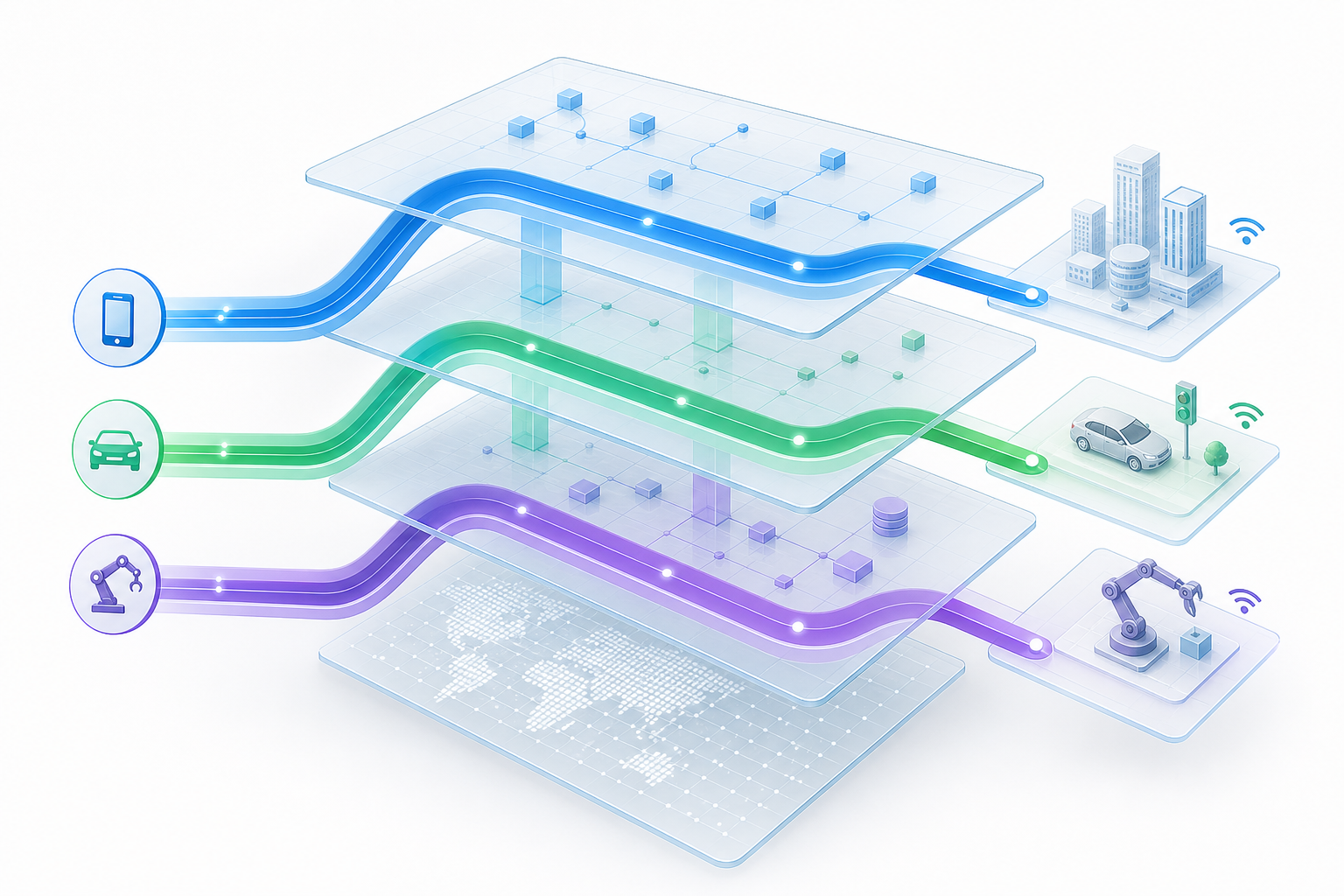
As 5G Standalone (SA) core deployments reach critical mass across Tier-1 and Tier-2 operators globally, network slicing—one of the most transformative capabilities of the 5G SA architecture—is transitioning from proof-of-concept trials to commercial service differentiation. In H2 2026, a growing number of mobile network operators (MNOs) and fixed wireless access (FWA) providers are launching differentiated enterprise service tiers powered by end-to-end network slicing, with 5G CPE devices serving as the critical last-mile termination point for slice-aware connectivity.
The Commercial Case for FWA Network Slicing
Network slicing enables operators to partition a single physical 5G infrastructure into multiple virtualized, isolated logical networks—each optimized for specific performance characteristics, latency profiles, and service-level agreements (SLAs). For fixed wireless access, this translates directly into tiered enterprise connectivity products: a high-throughput eMBB (enhanced Mobile Broadband) slice for general corporate internet access, a low-latency URLLC (Ultra-Reliable Low-Latency Communications) slice for industrial automation and real-time control systems, and an mMTC (massive Machine-Type Communications) slice for IoT sensor networks and smart metering infrastructure.
Network-slicing procurement depends on the intended operator service and its supported device requirements. Request confirmation of availability, coverage, provisioning and the agreed service conditions for each deployment.
5G CPE Requirements for Slice-Aware FWA
For operators to deliver differentiated slicing services to enterprise customers, the customer premises equipment must evolve beyond basic 5G modem functionality. Slice-aware 5G CPE devices must support:
- Multiple concurrent PDU sessions: The CPE must establish and maintain separate Protocol Data Unit (PDU) sessions corresponding to different network slices, enabling simultaneous connectivity across eMBB, URLLC, and mMTC slices from a single device.
- URSP (UE Route Selection Policy) support: 3GPP-defined UE Route Selection Policy rules allow the CPE to intelligently route application traffic to the appropriate network slice based on traffic descriptors, application IDs, and connection capabilities.
- VLAN-to-slice mapping: Enterprise-grade CPEs must map internal VLAN segments to specific network slices, enabling seamless integration with existing corporate LAN architectures while maintaining slice isolation.
- Slice-level QoS enforcement: Hardware-accelerated QoS engines must apply differentiated queuing, scheduling, and rate-limiting policies per slice, ensuring SLA compliance for each service tier.
Operator Deployment Patterns Emerging in H2 2026
Evaluate proposed slicing use cases as project designs rather than assumed commercial deployments. Ask the selected operator to document available services, supported devices, traffic policies and contractual terms. Named operator deployments require a verifiable source before they can serve as procurement evidence.
Vodafone Group has also announced a pan-European network slicing framework for its enterprise FWA portfolio, targeting multi-site retail, banking, and manufacturing customers who require consistent QoS across geographically distributed locations. The operator is standardizing on slice-aware CPE specifications that include dual-SIM redundancy, integrated SD-WAN capabilities, and cloud-based slice orchestration.
Procurement Implications for B2B Buyers
For telecom operators, MVNOs, and enterprise procurement teams sourcing 5G CPE at scale, network slicing capability is rapidly becoming a key differentiator in vendor selection. CPE devices that support 3GPP Release 17 and 18 slicing features—including multiple PDU sessions, URSP, and network slice selection assistance (NSSAI) handling—provide future-proof investment protection as operators expand their slicing service portfolios.
Key evaluation criteria for slice-capable CPE procurement in H2 2026 include: chipset platform generation (Qualcomm X75/X80, MediaTek T800/T830 series with Release 17/18 slicing support), maximum concurrent PDU session count, VLAN-to-slice mapping granularity, integration with operator OSS/BSS orchestration platforms, and certification status with target operator slicing frameworks. Buyers should also assess the CPE vendor’s roadmap for 3GPP Release 18 enhanced slicing features—including network slice admission control (NSAC) and slice-based authentication—expected to reach commercial maturity in 2027.
Assess a slicing service against the customer application, the operator contract and a representative pilot. Any proposed managed-service benefit should be supported by the actual service scope and acceptance results.
Looking Ahead: Automated Slice Orchestration
The next frontier for FWA network slicing lies in AI-driven automated orchestration. Emerging standards from the O-RAN Alliance, TM Forum, and 3GPP SA5 working group are defining intent-based slice management interfaces that will allow enterprise customers to dynamically request, modify, and release network slices through self-service portals—with 5G CPE devices automatically reconfiguring to match slice parameters. As these standards mature through 2027, the combination of intelligent slice orchestration and slice-aware CPE will unlock new enterprise FWA revenue models, including bandwidth-on-demand, temporary event connectivity, and disaster-recovery-as-a-service.
For Honlly Telecom and its global B2B partners, the network slicing trend underscores the importance of developing and certifying slice-capable 5G CPE products that align with the specifications of major operator slicing platforms—ensuring that carrier and enterprise customers can fully leverage the differentiated connectivity that 5G SA network slicing enables.