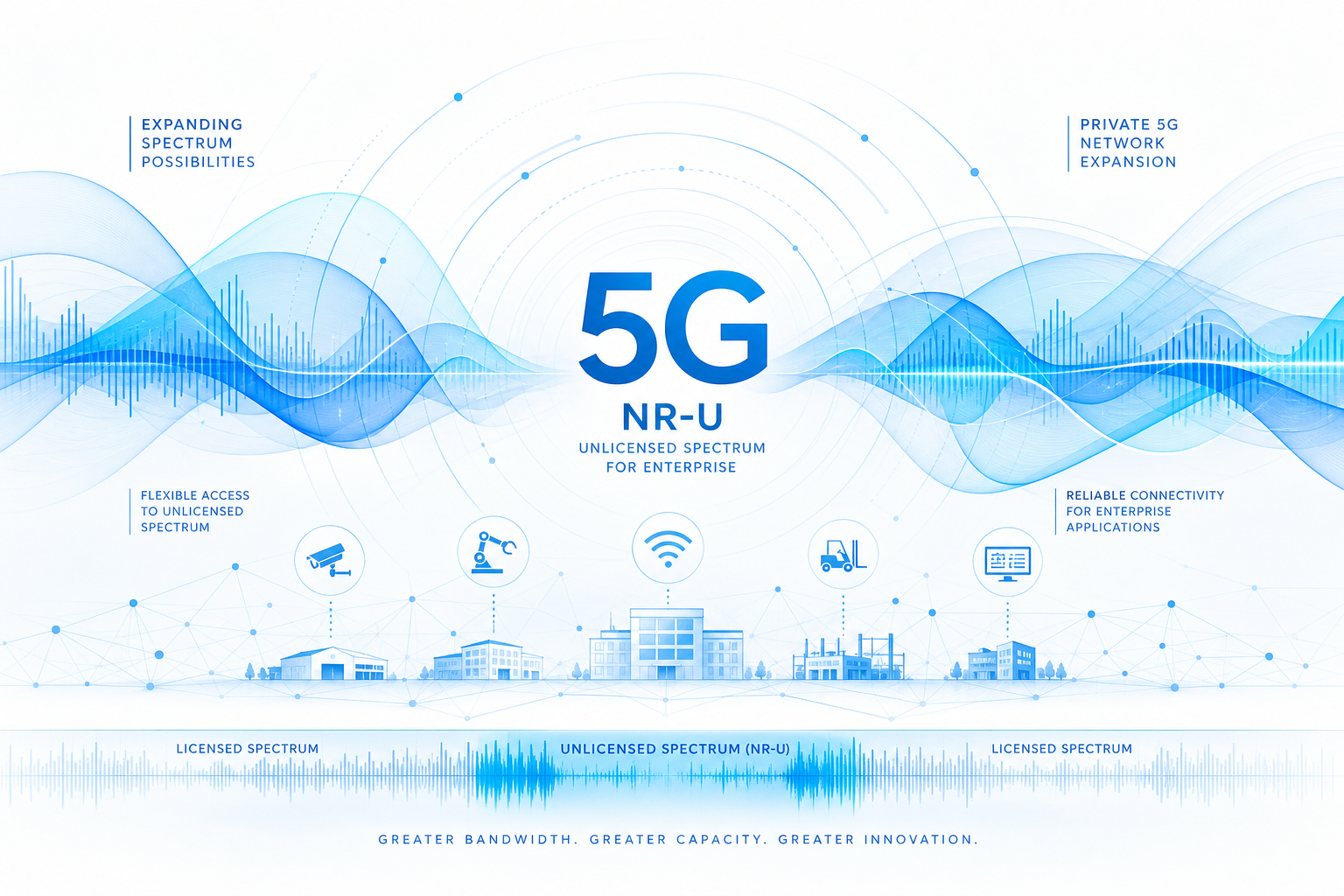
5G NR-U and Unlicensed Spectrum CPE: Expanding Private Network Capacity Through License-Assisted Access and Standalone Unlicensed Operation
Spectrum remains the single most constrained resource in wireless networking. While licensed spectrum offers guaranteed quality of service, its limited availability — especially for private network operators — has long been a bottleneck for enterprise 5G adoption. 5G NR-U (New Radio Unlicensed) changes this equation by extending 5G operation into globally available unlicensed bands, dramatically expanding the capacity envelope for private and enterprise 5G deployments.
Understanding NR-U: Two Operational Modes
3GPP Release 16 introduced NR-U with two distinct operational modes, each serving different deployment scenarios:
License-Assisted Access (LAA): In this mode, a licensed 5G anchor carrier provides the control plane and guaranteed capacity, while NR-U carriers operating in the 5 GHz unlicensed band supplement downlink and uplink throughput. The anchor carrier handles mobility, authentication, and QoS enforcement; NR-U carriers provide pure capacity augmentation. This is the most common initial NR-U deployment model and is supported by major infrastructure vendors including Ericsson, Nokia, and Samsung.
Standalone NR-U (SA NR-U): The more radical architecture — NR-U operates entirely in unlicensed spectrum without any licensed anchor. SA NR-U is particularly attractive for private network operators who may not hold licensed spectrum at all. It enables fully independent 5G deployments in the 5 GHz and emerging 6 GHz bands, subject to regional regulatory frameworks.
Why NR-U Matters for Enterprise and Private 5G
The business case for NR-U in private 5G CPE deployments rests on three pillars:
Spectrum cost elimination: Licensed spectrum — whether acquired at auction, leased from MNOs, or obtained through local regulatory processes (such as Germany’s 3.7-3.8 GHz local licenses) — represents a significant recurring cost. NR-U sidesteps this entirely by operating in license-exempt bands, dramatically lowering the total cost of ownership for private network operators.
Capacity multiplication: A private 5G network operating in 100 MHz of licensed n78 spectrum can add up to 500 MHz of NR-U capacity in the 5 GHz band alone (where available), plus additional bandwidth as regulators open the 6 GHz band (5925-7125 MHz) for license-exempt use. For bandwidth-hungry industrial applications — automated optical inspection, 4K/8K video surveillance, AR-assisted maintenance — this capacity headroom is transformative.
Global harmonization: Unlike licensed spectrum, which varies dramatically by country, the 5 GHz band is globally available. NR-U CPE can be deployed in nearly any market without waiting for local spectrum licensing — a critical advantage for multinational enterprises standardizing on a single private network architecture.
Coexistence Mechanisms: Fair Sharing with Wi-Fi
A persistent concern around NR-U is coexistence with incumbent Wi-Fi networks sharing the same unlicensed bands. The 3GPP addressed this directly with sophisticated channel access mechanisms designed to ensure fair spectrum sharing:
LBT (Listen Before Talk): NR-U devices must sense the channel and confirm it is clear before transmitting — the same fundamental mechanism used by Wi-Fi. 3GPP adopted LBT parameters (Category 4 LBT with exponential backoff) that are functionally equivalent to Wi-Fi’s CSMA/CA, ensuring neither technology dominates the channel unfairly.
CO sharing and MCOT: NR-U supports Channel Occupancy Time sharing, where a base station acquires the channel and can share it with connected CPE devices within the same Maximum Channel Occupancy Time. This improves scheduling efficiency without disadvantaging neighboring Wi-Fi networks.
Wideband operation and BWP adaptation: NR-U CPE can operate across wide bandwidths (up to 100 MHz carriers) while dynamically adapting Bandwidth Part (BWP) configurations to avoid congested sub-channels — effectively steering around heavy Wi-Fi traffic in real time.
CPE Design Considerations for NR-U
Building effective NR-U CPE requires addressing several engineering challenges beyond standard 5G CPE design:
Dual-band RF front-end: NR-U CPE must support simultaneous operation in licensed bands (n77/n78/n79) and unlicensed bands (n46 at 5 GHz, and emerging n96/n102 at 6 GHz). This requires dual-concurrent RF chains with high isolation to prevent self-interference, plus advanced filtering to reject adjacent Wi-Fi signals.
Dynamic spectrum sharing intelligence: The CPE software stack must make real-time decisions about which spectrum resources to use — licensed, unlicensed, or both — based on traffic QoS requirements, channel occupancy measurements, and operator policy. This demands a sophisticated spectrum management layer integrated with the 5G protocol stack.
Regulatory agility: Unlicensed spectrum regulations vary by region (FCC Part 15 in the US, ETSI EN 301 893 in Europe, MIC ordinances in Japan). NR-U CPE must support regional regulatory profiles that can be activated via configuration rather than requiring hardware variants.
Deployment Scenarios Gaining Traction
Several real-world NR-U deployment patterns are emerging:
Smart manufacturing campuses: Automotive and electronics manufacturers are combining licensed private 5G (for AGV control, safety systems) with NR-U capacity (for video inspection, environmental monitoring). The licensed anchor ensures deterministic latency for critical control loops; NR-U provides scalable bandwidth for data-intensive applications.
Higher education and research campuses: Universities deploying private 5G for research and smart campus applications are leveraging NR-U to extend coverage into buildings and outdoor spaces where running additional licensed small cells would be cost-prohibitive.
Port and logistics hubs: Container terminals, airports, and distribution centers — environments where spectrum licensing is often complex due to cross-jurisdictional coverage — are deploying NR-U CPE for asset tracking, autonomous vehicle connectivity, and real-time inventory systems without spectrum acquisition delays.
Strategic Implications for B2B Buyers
For enterprises and system integrators planning private 5G deployments, NR-U capability should be a core CPE evaluation criterion. The technology effectively future-proofs the network investment: as regulators continue to release unlicensed spectrum (the 6 GHz band alone represents up to 1200 MHz of new capacity), NR-U-capable CPE can absorb this capacity without hardware replacement.
Vendors like Honlly Telecom are already shipping 5G CPE platforms with NR-U-ready RF architectures, preparing for the moment when regulators in key markets — particularly Southeast Asia, the Middle East, and Latin America — finalize their 6 GHz unlicensed frameworks. For B2B buyers, selecting NR-U-capable CPE today ensures that tomorrow’s spectrum bounty translates directly into network capacity, not hardware obsolescence.