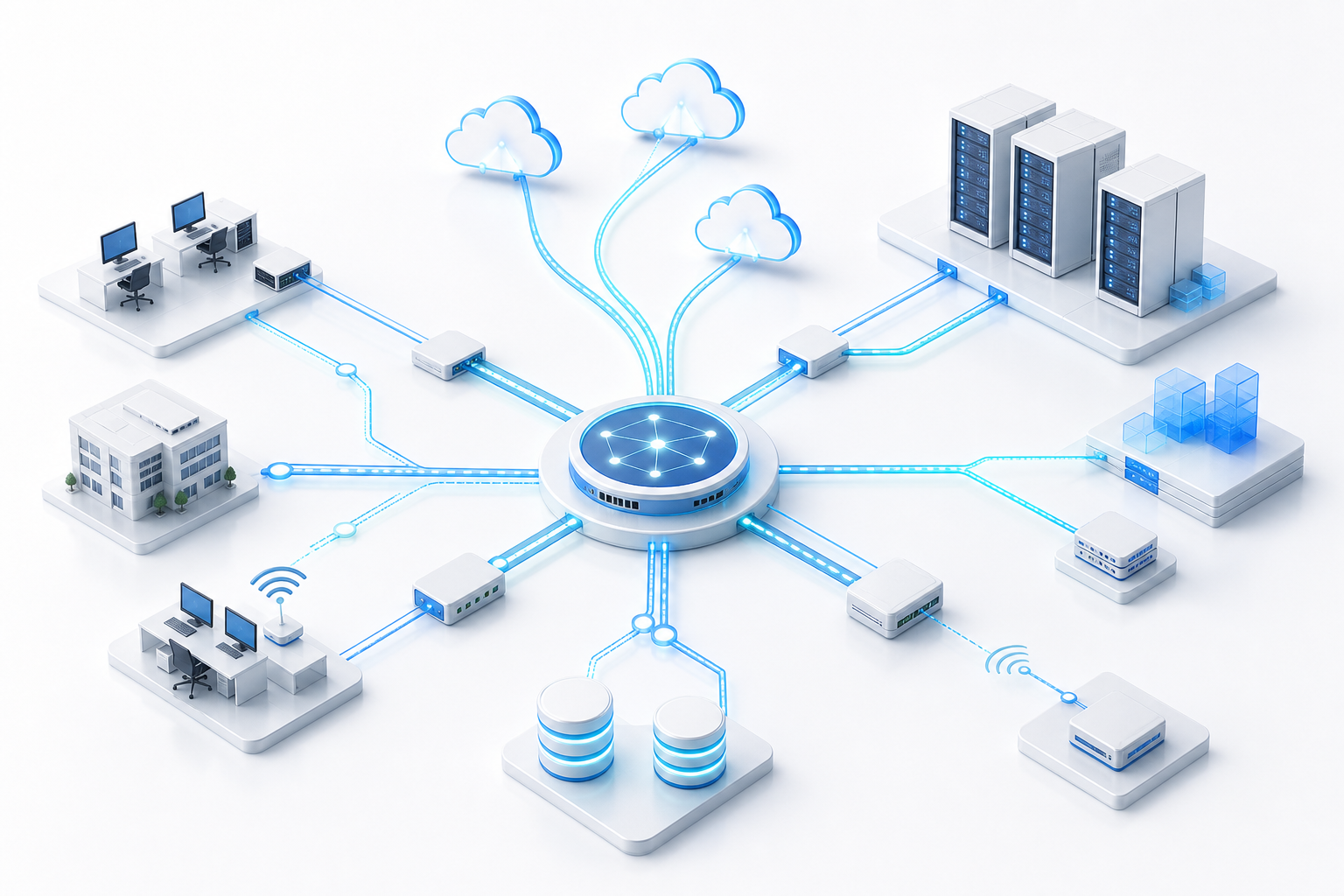
Multi-WAN 5G CPE Architectures for Enterprise Business Continuity: SD-WAN Integration, Intelligent Link Aggregation, and Carrier-Grade Failover Design
Enterprise network architects face a deceptively simple requirement: the connection must never go down. A retail chain processing thousands of POS transactions per minute, a logistics hub coordinating real-time fleet telemetry, a financial services branch handling regulatory reporting — in each case, connectivity downtime translates directly to revenue loss, SLA violations, and operational disruption.
Multi-WAN 5G CPE has emerged as the architectural answer to this requirement, combining cellular WAN diversity with intelligent traffic steering to deliver carrier-grade resilience at enterprise price points.
Beyond Simple Failover: The Multi-WAN Value Proposition
First-generation 4G backup solutions treated cellular as a secondary, best-effort path — activated only when the primary wired link failed, often with 30 to 90 seconds of cutover delay. Modern multi-WAN 5G CPE architectures fundamentally rethink this model.
Today’s enterprise-grade platforms support simultaneous active-active operation across two or more WAN interfaces — typically combining 5G cellular, fixed-line broadband, and dedicated fiber — with intelligent traffic distribution based on application type, link quality, and business policy. This moves cellular from backup to peer, unlocking:
Bandwidth aggregation: Multiple WAN links contribute to total available throughput. A branch office with 500 Mbps fiber and dual 5G links at 300 Mbps each can present approximately 1.1 Gbps of usable capacity to the LAN side.
Sub-second failover: BFD (Bidirectional Forwarding Detection) and link-quality probes running at 100ms intervals detect path degradation before connections drop, enabling hitless failover that preserves VoIP calls, video conferences, and TCP sessions.
Application-aware steering: Latency-sensitive traffic (voice, video, real-time trading) routes over the lowest-jitter path. Bulk data (cloud backups, software updates) uses the cheapest available link. Business-critical SaaS applications receive dedicated bandwidth guarantees.
SD-WAN Integration: The Intelligence Layer
The true power of multi-WAN 5G CPE is unlocked when integrated with SD-WAN overlay platforms. Leading SD-WAN vendors — including VMware (Broadcom), Fortinet, Cisco, and Aruba — now support 5G CPE as first-class WAN transport endpoints.
Key integration patterns include:
Tunnel bonding and per-packet steering: SD-WAN edge software creates encrypted overlay tunnels over each physical WAN link. The tunnel bonding function stripes packets across available paths at millisecond granularity, compensating for individual link jitter and loss. If a 5G link experiences a transient 2% packet loss spike, the SD-WAN controller shifts affected flows to the fiber path within 200ms — transparent to the application layer.
Zero-touch provisioning over cellular: Branch CPE can be drop-shipped directly to the deployment site. On first power-up, the device establishes a 5G connection, authenticates with the SD-WAN orchestrator, downloads its configuration, and joins the overlay fabric — all without on-site IT staff. This collapses traditional branch deployment timelines from weeks to hours.
Cloud on-ramp optimization: With enterprises accelerating SaaS and IaaS adoption, SD-WAN-integrated 5G CPE can route cloud-destined traffic directly to the nearest cloud exchange point (AWS Direct Connect, Azure ExpressRoute, Google Cloud Interconnect) rather than backhauling through a central data center — dramatically reducing cloud application latency.
Carrier Diversity: The Hidden Resilience Dimension
A critical but often overlooked aspect of multi-WAN design is carrier diversity. Dual SIM slots supporting different MNOs (Mobile Network Operators) ensure that a single carrier outage does not disable the cellular backup path.
Advanced 5G CPE platforms now support:
Dual-SIM Dual-Active (DSDA): Both SIMs maintain simultaneous RRC-connected states, enabling true active-active cellular operation. If MNO A experiences a local RAN failure, traffic shifts to MNO B without the 5-15 second re-attach delay typical of Dual-SIM Single-Standby (DSSS) architectures.
Cross-RAT fallback: When 5G NR coverage is unavailable, the CPE automatically falls back to LTE-A or even 3G while maintaining the SD-WAN overlay — ensuring basic business continuity even in coverage-edge scenarios common in rural and industrial deployments.
Geographic path diversity: In fixed wireless access configurations, external antenna placement can connect to different cell towers for each 5G modem, providing physical path diversity that protects against tower-level failures or localized interference.
Procurement Considerations for Enterprise Buyers
When evaluating multi-WAN 5G CPE for enterprise deployment, IT procurement teams should prioritize:
SD-WAN ecosystem certification: Verify that the CPE platform is certified by your chosen SD-WAN vendor. Certification ensures validated interoperability, supported configuration templates, and access to vendor TAC (Technical Assistance Center) for joint troubleshooting.
Throughput headroom: Multi-WAN aggregation imposes CPU and forwarding-engine overhead. Select platforms with rated throughput at least 30% above aggregate WAN capacity to maintain line-rate performance during failover events and traffic bursts.
Management plane integration: The CPE should expose a well-documented RESTCONF/NETCONF or gNMI interface for SD-WAN orchestrator integration. Avoid platforms that require proprietary management consoles that cannot be automated at scale.
Thermal and environmental ratings: Active-active dual-5G operation generates significantly more heat than single-radio designs. For industrial or outdoor deployments, verify extended temperature range (-20°C to +60°C) and passive cooling capability.
The Road Ahead: AI-Driven Predictive Path Selection
The next evolution in multi-WAN 5G CPE is already visible in early deployments. Machine learning models trained on per-link telemetry data (signal quality, latency, jitter, throughput history, time-of-day patterns) can predict link degradation 30-60 seconds before it impacts applications — and proactively shift traffic before users notice.
Combined with 5G-Advanced features like network slicing and URLLC, these intelligent multi-WAN platforms will form the connectivity backbone for the next generation of distributed enterprise applications — from autonomous warehouse robotics to real-time augmented reality field service. For enterprise buyers building infrastructure that must last 5-7 years, multi-WAN 5G CPE with SD-WAN integration is not an optional upgrade; it is the architectural minimum.