
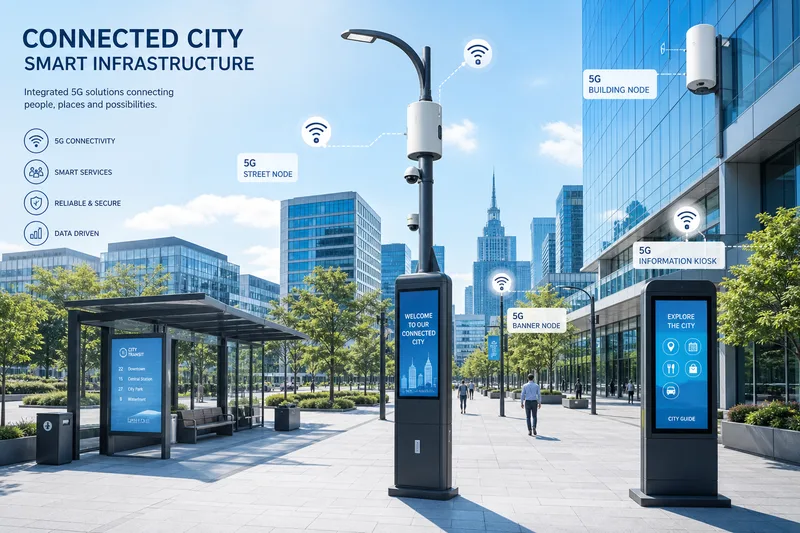
Smart city initiatives worldwide are entering a new phase of connectivity-driven transformation in 2026, with 5G Fixed Wireless Access emerging as a foundational infrastructure layer for municipal digital services. From intelligent traffic management and public safety networks to environmental monitoring and digital inclusion programs, city governments are discovering that 5G FWA CPE deployments offer a compelling combination of rapid deployment, scalable capacity, and manageable total cost of ownership compared with fiber-only buildout strategies.
The Smart City Connectivity Challenge
Cities pursuing comprehensive digital transformation face a fundamental infrastructure challenge: connecting thousands of distributed endpoints—traffic cameras, environmental sensors, digital signage, public Wi-Fi access points, emergency communication nodes, and smart utility meters—across diverse urban terrain. Traditional fiber backhaul provides ideal performance but entails prohibitive civil engineering costs and deployment timelines when extended to every endpoint location. Cellular-based connectivity using 5G FWA CPE bridges this gap, delivering fiber-like performance with installation timelines measured in hours rather than months.
The economic case is compelling. Municipal fiber trenching in urban environments typically costs $250-$750 per meter, depending on surface conditions, utility congestion, and permitting complexity. A single smart city deployment requiring connectivity to 500 distributed locations could face fiber backhaul costs exceeding $15 million. By contrast, 5G FWA CPE installation at these locations, leveraging existing macro-cell and small-cell infrastructure, can deliver equivalent connectivity at 10-20% of the fiber-only cost while enabling immediate service activation.
Municipal Deployment Architectures
Smart city 5G FWA deployments typically follow one of three architectural models, each suited to different municipal priorities and existing infrastructure profiles. The operator-partnered model leverages commercial mobile network operator (MNO) infrastructure, with the municipality procuring CPE devices and service contracts through a managed services agreement. This model minimizes upfront infrastructure investment and is popular among mid-sized cities with existing MNO coverage.
The municipal private network model involves the city deploying its own 5G infrastructure—typically using shared or licensed spectrum in the 3.5 GHz or 4.9 GHz bands—with CPE devices connecting directly to city-owned gNodeBs. This approach offers greater control over coverage, capacity allocation, security policy, and service prioritization, making it attractive for large metropolitan areas with dedicated smart city budgets and in-house technical expertise.
The hybrid neutral-host model represents an emerging third path, where the municipality deploys shared infrastructure that serves both city services and commercial MNO traffic. In this model, CPE devices connect through a common RAN infrastructure with network slicing separating municipal and commercial traffic flows. This approach optimizes infrastructure utilization and can generate revenue through MNO colocation fees, offsetting municipal deployment costs.
Use Case Specifics: CPE Requirements by Municipal Application
Different smart city applications impose distinct requirements on CPE hardware. Intelligent traffic management systems demand outdoor-rated CPE with wide operating temperature ranges (-40°C to +65°C), Power over Ethernet (PoE) capability for integrated camera and sensor power delivery, and low-latency connectivity (<10ms) for real-time traffic signal coordination and emergency vehicle preemption.
Public safety and emergency response networks require CPE with hardened security features including hardware root of trust, secure boot, and encrypted management channels. These deployments often mandate redundant connectivity paths—typically 5G primary with 4G LTE fallback—and battery backup capability ensuring operation during power outages. Some jurisdictions now specify compliance with public safety-grade reliability standards such as 99.999% availability for critical communication nodes.
Environmental monitoring networks typically deploy large numbers of sensor-equipped CPE devices across wide geographic areas. These applications prioritize low power consumption, compact form factors suitable for pole-mount or underground-vault installation, and support for narrowband IoT (NB-IoT) or LTE-M protocols alongside 5G for sensor backhaul aggregation. Cost sensitivity is particularly acute given the high device counts involved—a city-wide air quality monitoring network may require 500 to 2,000 sensor nodes.
Digital Inclusion and Public Broadband
An increasingly prominent smart city use case is municipal broadband programs using 5G FWA to address digital divide challenges. Cities in North America, Europe, and Asia-Pacific are deploying 5G FWA CPE to connect underserved households, public housing complexes, and community centers, often subsidizing service costs through universal service funds or municipal broadband initiatives.
These programs require CPE devices that balance performance with affordability and ease of deployment. Self-installable indoor CPE units are strongly preferred to minimize truck-roll costs, while remote management and zero-touch provisioning capabilities enable efficient large-scale subscriber onboarding. Some municipalities are exploring community CPE models where a single high-gain outdoor unit serves multiple households in dense residential configurations, further reducing per-subscriber equipment costs.
Network Slicing for Multi-Service Municipal Networks
The ability to support multiple virtual networks on shared physical infrastructure through 5G network slicing is particularly valuable in smart city contexts. A single CPE deployment can simultaneously support a high-bandwidth slice for video surveillance backhaul, a low-latency slice for traffic signal coordination, a massive IoT slice for environmental sensor aggregation, and a best-effort slice for public Wi-Fi services—each with independently configured QoS parameters, security policies, and bandwidth guarantees.
CPE devices deployed in slicing-enabled municipal networks must support multiple PDU sessions with distinct network slice selection assistance information (NSSAI), VLAN tagging for traffic segregation at the LAN interface, and per-slice QoS marking. These capabilities are increasingly standard in carrier-grade 5G CPE platforms and should be verified during the procurement qualification process.
Scalability and Lifecycle Management
Municipal CPE deployments present unique lifecycle management challenges given their distributed nature, outdoor exposure, and critical-service role. Cloud-based device management platforms supporting TR-069/TR-369 protocols are essential for firmware updates, configuration management, performance monitoring, and fault diagnostics across hundreds or thousands of deployed units.
Advanced municipalities are adopting predictive maintenance approaches that use machine learning to identify CPE devices at risk of failure based on performance degradation patterns, temperature cycling history, and environmental exposure data. Proactive replacement of at-risk units before failure reduces mean time to repair (MTTR) for critical municipal services and enables more efficient field technician scheduling compared with reactive maintenance models.
Procurement Framework for Municipal Buyers
For municipal procurement teams new to telecom equipment sourcing, a structured evaluation framework helps navigate the complexity of CPE selection. Key evaluation dimensions should include: outdoor environmental ratings (IP67 minimum for external deployments), operating temperature range, PoE support (802.3at/bt), multi-slice capability, remote management protocol support, security certification status, vendor supply continuity assurances, and total cost of ownership modeling over a 5-7 year deployment lifecycle.
Municipal RFPs should also require vendors to provide reference deployments of similar scale and application profile, field performance data under comparable environmental conditions, and detailed interoperability test results with the city’s selected RAN infrastructure vendor. Given the long operational lifetimes expected of municipal infrastructure—typically 7-10 years—CPE firmware upgrade commitments and end-of-life support policies should be contractually specified.
Honlly Telecom provides 5G FWA CPE solutions purpose-built for municipal and smart city deployments, including outdoor-rated units, industrial-grade gateways with PoE support, and cloud-managed device fleets. Contact the government and municipal sales team for solution architecture consultation and reference deployment information.