
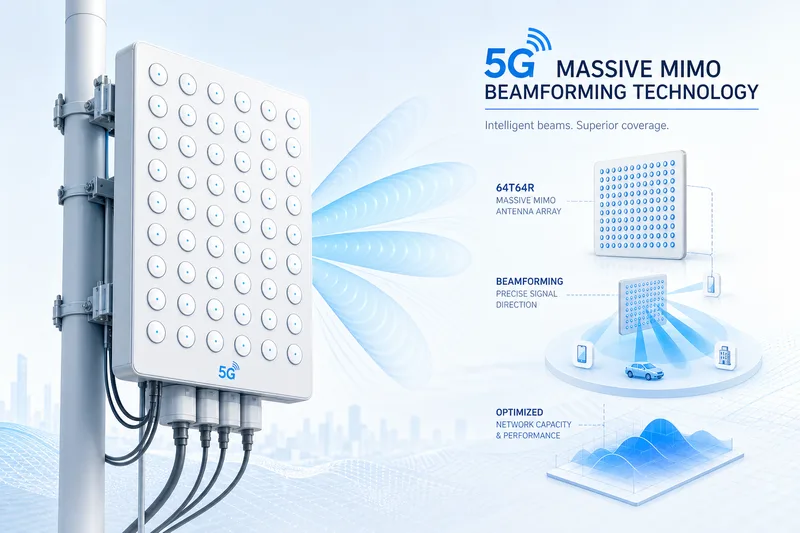
Antenna design has emerged as one of the most critical differentiators in 5G CPE performance, directly impacting signal quality, throughput, coverage range, and user experience in Fixed Wireless Access deployments. As operators push toward multi-gigabit FWA services and dense urban deployments, the antenna subsystem within CPE devices is evolving rapidly—from basic omnidirectional configurations to sophisticated beamforming arrays integrating Massive MIMO principles and AI-driven pattern optimization.
From Omnidirectional to Beamforming: The Evolution Path
Early-generation 5G CPE devices, particularly indoor FWA gateways deployed in 2019-2021, typically employed omnidirectional antenna configurations with 4 to 8 elements. While adequate for initial sub-6 GHz deployments in favorable RF conditions, these designs delivered inconsistent performance at cell edges, in high-interference environments, and in buildings with challenging construction materials. Average cell-edge throughput with omnidirectional CPE antennas often fell to 15-25% of peak rates, creating a substantial user experience gap between near-site and edge subscribers.
The transition to beamforming-capable antenna arrays in 5G CPE devices—typically 8 to 16 elements in current-generation products—has transformed this performance profile. By dynamically steering transmission and reception patterns toward the serving gNodeB, beamforming CPE can deliver 2-4x throughput improvements at cell edges compared with omnidirectional designs, effectively expanding the usable coverage footprint of each base station.
Massive MIMO Integration in CPE Form Factors
The integration of Massive MIMO principles into CPE antenna design represents one of the most significant engineering challenges—and opportunities—in current product development. While base station Massive MIMO arrays routinely employ 64 to 256 antenna elements, CPE devices face severe space, power, and thermal constraints that limit practical element counts to 8-16 for indoor units and 16-32 for outdoor CPE installations.
Advanced antenna module designs are addressing these constraints through several innovations. Multi-layer PCB antenna architectures now enable higher element density within compact enclosures, while integrated antenna-in-package (AiP) solutions for mmWave bands combine antenna elements with RF front-end components in single modules measuring under 30mm per side. For sub-6 GHz bands, metamaterial-inspired antenna designs are achieving wider bandwidth and higher isolation between closely spaced elements than conventional patch or dipole configurations.
Beamforming Algorithms: Codebook-Based vs. Adaptive Approaches
The beamforming intelligence embedded in 5G CPE firmware is as important as the physical antenna hardware. Current implementations generally fall into two categories: codebook-based beamforming, which selects from a predefined set of beam patterns based on signal quality measurements, and adaptive beamforming, which dynamically computes optimal beam weights using channel state information.
Codebook-based approaches offer lower computational complexity and faster beam acquisition, making them suitable for cost-sensitive CPE designs and mobile hotspot applications. Adaptive beamforming, while requiring more processing power and higher-quality channel estimation, delivers superior performance in challenging multipath environments typical of urban and indoor deployments. The most advanced CPE implementations now employ hybrid approaches—using codebook-based beams for initial acquisition and transitioning to adaptive refinement for sustained connections.
Multi-Beam and Multi-Panel Architectures
A key advancement in 2025-2026 CPE antenna design is the adoption of multi-beam and multi-panel architectures. Multi-beam CPE devices can simultaneously maintain independent beam patterns toward multiple gNodeBs or toward different propagation paths to the same gNodeB, enabling spatial diversity and multi-TRP (Transmission Reception Point) operation as specified in 3GPP Release 17 and enhanced in Release 18.
Multi-panel designs distribute antenna elements across multiple faces or surfaces of the CPE enclosure, providing near-omnidirectional coverage while maintaining the gain advantages of directional beamforming. This architecture is particularly valuable for indoor CPE devices where the optimal orientation relative to the serving cell may not be known at installation time. Multi-panel CPE can electronically select and optimize the best panel without requiring physical repositioning.
mmWave Antenna Challenges and Solutions
For CPE devices targeting mmWave bands (24-47 GHz), antenna design requirements become substantially more demanding. The shorter wavelengths at these frequencies enable much higher element density but also introduce severe path loss, atmospheric absorption, and blockage sensitivity that must be overcome through antenna gain and beamforming sophistication.
Current mmWave CPE designs typically employ phased-array antenna modules with 16 to 64 elements per polarization, capable of electronic beam steering across ±60-degree azimuth and elevation ranges. These modules must maintain precise phase calibration across temperature ranges from -40°C to +85°C for outdoor deployments, requiring sophisticated temperature compensation circuitry and calibration firmware. The integration of antenna, beamforming IC, up/down-conversion, and IF processing into single-package AiP modules has been critical to making mmWave CPE commercially viable.
Gain Optimization Techniques
Antenna gain optimization in CPE devices involves balancing multiple competing requirements: peak gain for range extension, beam width for angular coverage, side-lobe suppression for interference management, and polarization purity for MIMO spatial multiplexing. Advanced CPE designs employ several techniques to optimize this balance:
First, tunable impedance matching networks dynamically adjust antenna matching across frequency bands and operating conditions, maintaining optimal VSWR and minimizing mismatch loss. Second, polarization diversity using dual-polarized antenna elements improves MIMO rank and throughput in multipath-rich environments. Third, spatial null-steering algorithms actively suppress interference from adjacent cells by placing antenna pattern nulls in the direction of interfering signals, improving SINR by 3-6 dB in dense deployment scenarios.
AI-Driven Antenna Optimization
The integration of machine learning into CPE antenna management represents a frontier capability entering commercial products in 2026. AI-driven antenna systems continuously learn from the RF environment—building profiles of interference patterns, multipath characteristics, and temporal usage patterns—to proactively optimize beam selection, MIMO rank adaptation, and power allocation.
These systems can predict optimal antenna configurations based on time of day, historical RF conditions, and even weather patterns that affect propagation characteristics. Early field data from operators trialing AI-optimized CPE antenna systems indicate 15-25% improvements in average cell throughput and 30-40% reductions in beam acquisition time compared with conventional algorithmic approaches.
Procurement Considerations for B2B Buyers
For operators and enterprises evaluating 5G CPE for large-scale deployments, antenna subsystem specifications deserve careful scrutiny beyond headline throughput numbers. Key evaluation parameters include antenna element count, beamforming type (codebook vs. adaptive), supported beam patterns per polarization, mmWave phased-array module specifications (if applicable), and AI-based optimization capabilities.
Field validation should include cell-edge throughput testing, interference scenario performance, multi-panel selection behavior, and sustained performance under thermal stress. The antenna subsystem effectively determines the usable coverage radius and subscriber density of FWA deployments, making it a first-order determinant of network economics. Selecting CPE with superior antenna design can reduce required base station density by 15-30%, translating to substantial capital expenditure savings for operators building greenfield FWA networks.
Honlly Telecom’s 5G CPE product portfolio incorporates advanced beamforming antenna designs across indoor, outdoor, and industrial form factors. Contact the engineering team for detailed antenna subsystem specifications and field performance data.