
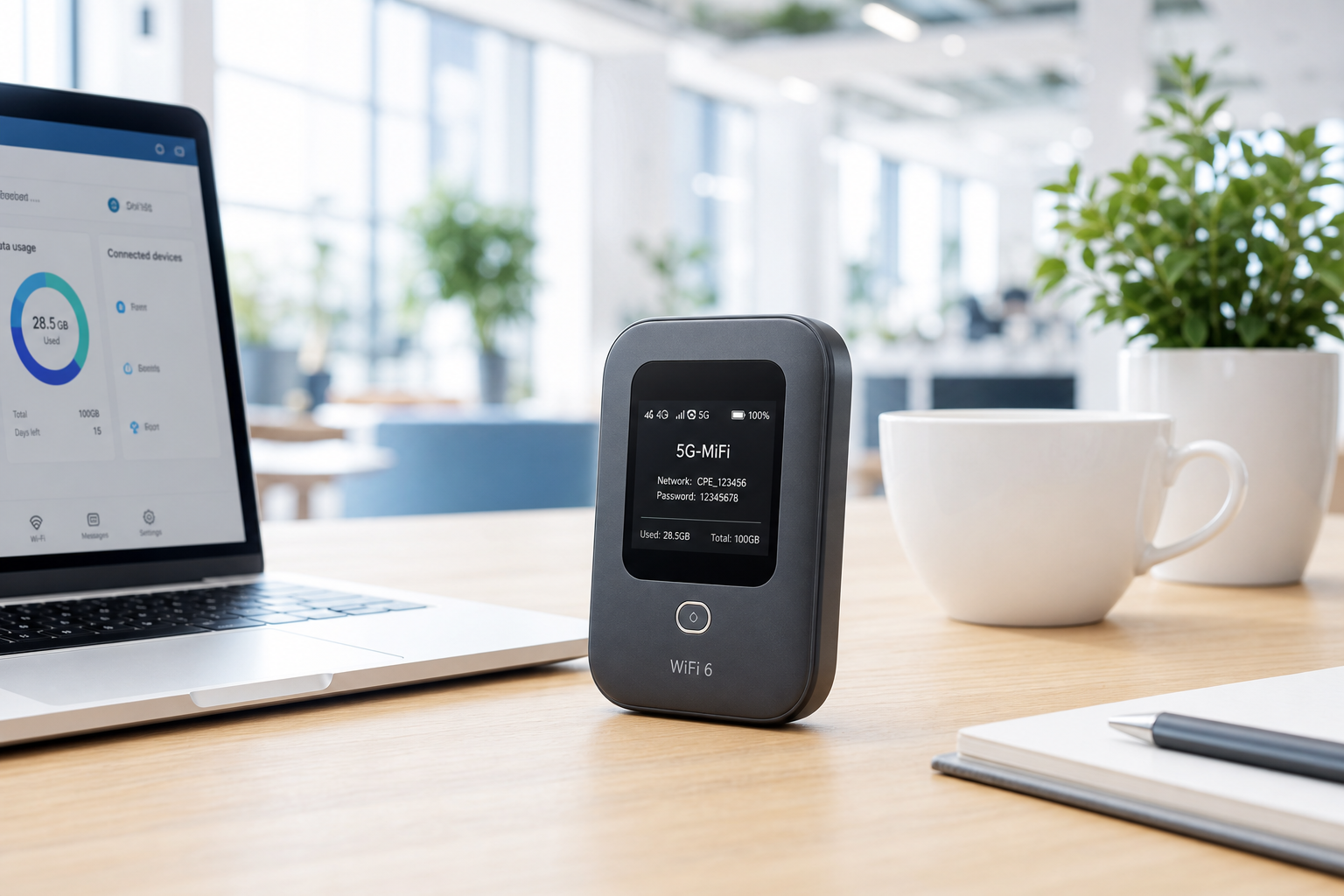
The portable broadband market is experiencing a notable resurgence in 2026, driven by the sustained adoption of hybrid workforce models, the proliferation of IoT edge deployments, and increasing demand for business continuity solutions across distributed enterprise environments. At the center of this trend is the 4G LTE MiFi hotspot — a compact, battery-powered device that converts cellular signals into secure Wi-Fi connectivity for multiple users — which has evolved from a consumer travel gadget into a critical B2B connectivity tool for field operations, temporary worksites, and backup WAN applications.
The Hybrid Work Catalyst
Three years after the global shift toward remote and hybrid work, enterprises have moved beyond ad-hoc connectivity solutions and are now institutionalizing mobile broadband as part of their corporate IT infrastructure. According to the Global Mobile Suppliers Association (GSA), commercial LTE network deployments exceeded 800 globally in mid-2026, with LTE coverage reaching over 88 percent of the world’s population. This near-ubiquitous coverage makes 4G MiFi devices a reliable connectivity layer for employees who split time between corporate offices, home offices, co-working spaces, and client sites.
IT procurement teams are increasingly provisioning Cat 7 and Cat 12 MiFi routers as standard-issue equipment for field sales engineers, insurance adjusters, healthcare outreach workers, and construction project managers — professionals who require always-on connectivity but cannot depend on public Wi-Fi availability or quality. Modern enterprise-grade MiFi devices deliver downlink speeds of up to 300 Mbps (Cat 7) or 600 Mbps (Cat 12) with carrier aggregation across multiple LTE bands, making them viable not just for email and web access but for video conferencing, large file transfers, and cloud application access.
IoT Edge and Temporary Deployment Use Cases
Beyond individual productivity, the B2B MiFi market is being propelled by lightweight IoT and edge computing scenarios where full-scale 5G FWA CPE deployment is either impractical or cost-prohibitive. Applications include:
- Construction site connectivity: Providing temporary internet access for project management software, BIM collaboration, and safety monitoring cameras during the pre-fiber phase of building projects.
- Pop-up retail and event connectivity: Enabling point-of-sale systems, inventory management terminals, and customer Wi-Fi at temporary locations where fixed broadband installation is not feasible.
- Field data collection: Supporting environmental monitoring stations, agricultural sensor networks, and utility meter reading systems in areas where wired infrastructure is unavailable.
- Disaster recovery and emergency response: Deploying rapid-response communication hubs that teams can activate within minutes during natural disasters or infrastructure outages.
These scenarios benefit from MiFi’s key advantages: zero-touch deployment, battery operation for 8-12 hours, support for 16-32 simultaneous Wi-Fi connections, and the ability to switch between multiple carrier profiles for optimal signal coverage.
Enterprise Security and Management Features
The 2026 generation of B2B-oriented MiFi devices incorporates security features that were previously exclusive to fixed CPE platforms. Hardware-based VPN acceleration supporting IPsec and WireGuard protocols ensures encrypted tunnels for corporate data without degrading throughput. RADIUS authentication and 802.1x enterprise Wi-Fi security enable seamless integration with existing corporate identity management systems.
On the management side, cloud-based device management platforms now support fleet-wide MiFi provisioning through TR-069 and TR-369 (USP) protocols. IT administrators can remotely configure APN settings, apply firmware updates, enforce security policies, and monitor data usage across hundreds or thousands of distributed devices from a single dashboard. Geofencing capabilities allow automatic carrier profile switching when devices cross national borders, making MiFi routers particularly valuable for multinational enterprises with traveling teams.
Carrier Aggregation and Band Compatibility
Modern Cat 7 and Cat 12 MiFi platforms support carrier aggregation configurations of up to 3CA (3-carrier aggregation), combining multiple LTE bands to deliver the higher throughput and reliability that enterprise applications demand. Key specifications that B2B buyers should evaluate include:
- Band support breadth: Global band compatibility spanning B1/B3/B5/B7/B8/B20/B28/B38/B40/B41 for international deployment flexibility.
- MIMO configuration: 2×2 MIMO support as a minimum, with premium models offering 4×4 MIMO on selected bands for enhanced cell-edge performance.
- Wi-Fi standard: Dual-band concurrent Wi-Fi 5 (802.11ac) or Wi-Fi 6 (802.11ax) with support for 32+ simultaneous clients.
- Ethernet port availability: Gigabit Ethernet LAN port for wired backhaul to existing network infrastructure — a feature increasingly requested by enterprise buyers.
Market Outlook and Procurement Considerations
Industry analysts project the global mobile hotspot router market to grow at a compound annual growth rate (CAGR) of approximately 8.5 percent through 2029, with the B2B segment outpacing consumer growth due to enterprise digitization initiatives and workforce mobility programs. For telecom operators and managed service providers, MiFi devices represent a high-margin CPE category with lower subsidy requirements compared to fixed 5G FWA gateways, while generating recurring data plan revenue.
For enterprise buyers evaluating MiFi solutions in 2026, key procurement criteria should include: multi-carrier certification status, cloud management platform maturity, security certification (FIPS 140-2 or equivalent), battery performance under sustained load, and total cost of ownership analysis that accounts for both device cost and carrier data plan flexibility.
As the line between fixed and mobile connectivity continues to blur, the enterprise-grade MiFi hotspot has cemented its position as an essential component of the modern B2B connectivity portfolio — not as a consumer accessory, but as a purpose-built tool for business continuity, field operations, and the increasingly distributed nature of work.