
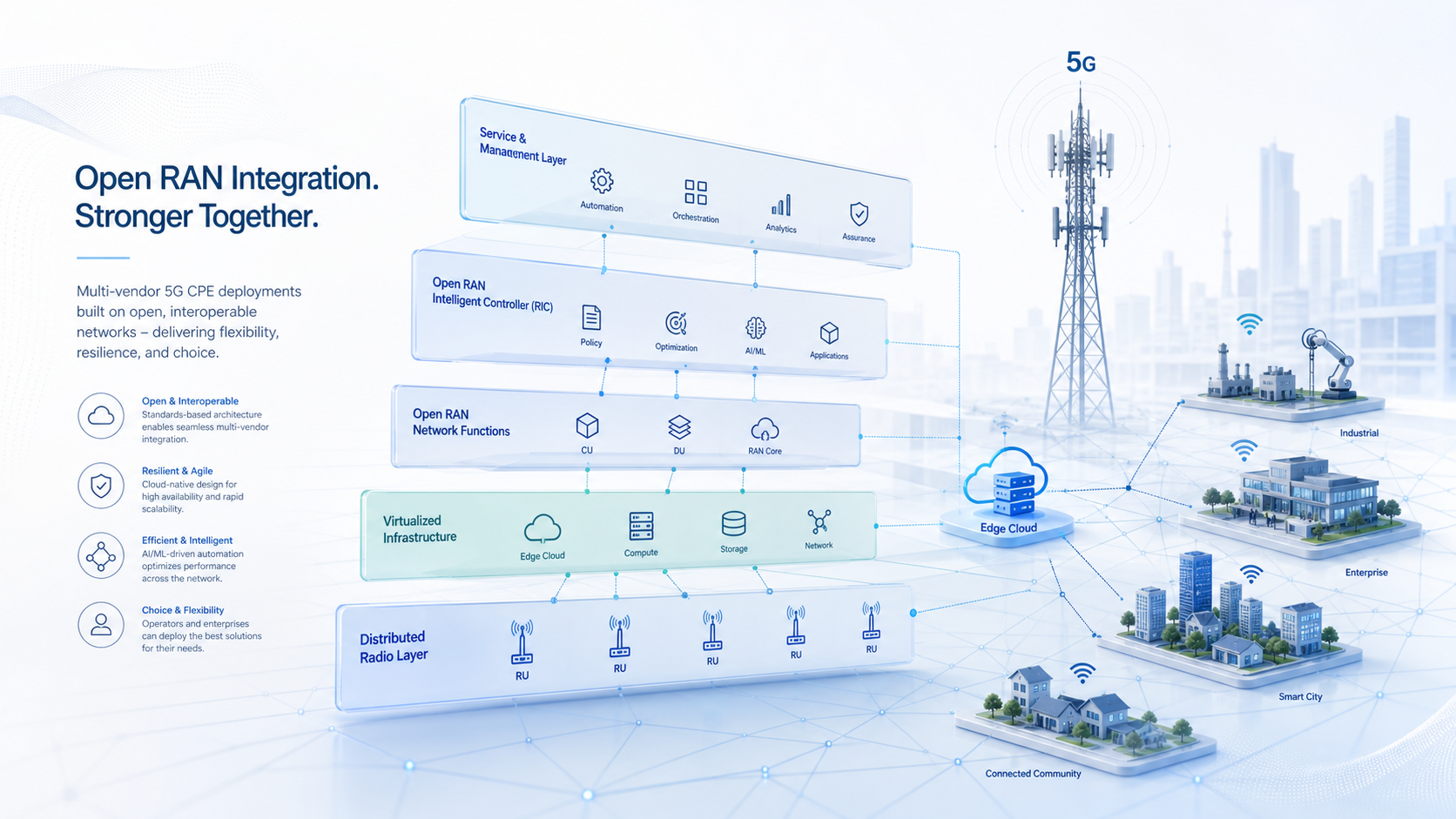
The global telecom landscape is undergoing a structural shift as operators accelerate Open Radio Access Network (Open RAN) integration with multi-vendor 5G Customer Premises Equipment (CPE) strategies. In H2 2026, this convergence is reshaping how mobile network operators (MNOs), fixed wireless access (FWA) providers, and managed service providers (MSPs) approach infrastructure procurement, vendor diversification, and service delivery optimization.
The Open RAN Imperative: Beyond the Hype Cycle
Open RAN has evolved from an industry aspiration into a commercial reality. According to recent O-RAN Alliance data, over 45 commercial Open RAN deployments are now live across 28 countries, with Asia-Pacific and Europe leading adoption. The driving forces are clear: operators seek to break vendor lock-in, reduce total cost of ownership (TCO), and create a more competitive ecosystem for radio access network components.
For CPE procurement teams, the Open RAN evolution carries direct implications. Multi-vendor interoperability at the radio unit (RU), distributed unit (DU), and centralized unit (CU) levels means CPE devices must now demonstrate seamless compatibility across diverse network architectures. The traditional model of single-vendor, end-to-end CPE certification is giving way to a more flexible, standards-driven validation framework.
Multi-Vendor CPE: The New Procurement Paradigm
Major operators including Vodafone, Deutsche Telekom, Rakuten Mobile, and Reliance Jio have publicly committed to multi-vendor CPE strategies. The rationale extends beyond cost optimization: diversified CPE supply chains provide resilience against component shortages, enable regional customization, and accelerate time-to-market for new service tiers.
Key developments in H2 2026 include:
- Chipset Diversification: Multiple silicon vendors now offer O-RAN compliant 5G modem platforms, including MediaTek’s T800 series, Qualcomm’s X75/X80 modems, and emerging solutions from Unisoc and ASR Microelectronics. This competition is driving down CPE bill-of-materials costs by an estimated 18–22% year-over-year.
- Middleware Abstraction Layers: Software-defined CPE architectures with vendor-agnostic middleware layers enable operators to deploy firmware updates and feature upgrades across heterogeneous hardware fleets without per-model certification cycles.
- Open Fronthaul Interface Compliance: CPE devices supporting O-RAN 7.2 split architecture are entering volume production, enabling direct interoperability with multi-vendor RU deployments without proprietary translation layers.
- Automated Interoperability Testing: Industry consortia including the O-RAN Alliance and Telecom Infra Project (TIP) have launched automated CPE interoperability testing frameworks, reducing certification timelines from 12–16 weeks to 3–4 weeks for qualified devices.
Regional Deployment Spotlight: Asia-Pacific Leads the Charge
Asia-Pacific markets are setting the pace for Open RAN CPE deployments. Japan’s Rakuten Symphony platform now supports over 18 certified third-party CPE models across its cloud-native 5G network. In India, Bharti Airtel and Reliance Jio have both issued multi-vendor CPE RFPs totaling an estimated 4.2 million units for rural and semi-urban FWA expansion in H2 2026.
Southeast Asian operators, particularly in Indonesia, Vietnam, and the Philippines, are leveraging Open RAN architectures to extend broadband coverage to underserved regions. The combination of Open RAN infrastructure and multi-vendor CPE procurement has reduced per-subscriber deployment costs by 30–35% compared to traditional integrated vendor solutions.
Technical Considerations for Buyers
For ISPs, MVNOs, and enterprise procurement managers evaluating multi-vendor Open RAN CPE, several technical dimensions warrant close attention:
- 3GPP Release Compliance: Ensure CPE devices support at minimum 3GPP Release 17 with upgrade paths to Release 18 features including MIMO enhancements and AI/ML-based beam management.
- O-RAN Fronthaul Profiles: Verify support for relevant O-RAN fronthaul profiles (Category A or B) matching your RU deployment topology and bandwidth requirements.
- Management Plane Integration: Confirm compatibility with your O1/O2 interface implementations for FCAPS management, software lifecycle management, and performance monitoring across multi-vendor fleets.
- Security Certification: Validate Secure Boot, Hardware Root of Trust, and O-RAN Security Working Group specifications compliance across all candidate CPE models.
- Lifecycle SLA Coverage: Negotiate vendor-agnostic support SLAs that cover firmware updates, vulnerability patching, and hardware replacement across the expected 5–7 year deployment lifecycle.
Market Outlook and Strategic Implications
Industry analysts project that Open RAN-compatible CPE will represent 42% of global 5G FWA CPE shipments by 2028, up from approximately 18% in 2026. This trajectory signals a fundamental reordering of the CPE vendor landscape, with new entrants from Taiwan, South Korea, and mainland China challenging incumbent European and North American suppliers.
For operators, the strategic calculus is shifting from “which single vendor” to “which vendor mix” optimizes coverage, cost, and capability across their service footprint. Those who build robust multi-vendor CPE certification and orchestration capabilities in 2026 will be best positioned to capitalize on the expanding Open RAN ecosystem in the years ahead.
For more information on multi-vendor 5G CPE solutions compatible with Open RAN architectures, contact the Honlly Telecom product team to discuss your specific deployment requirements.