
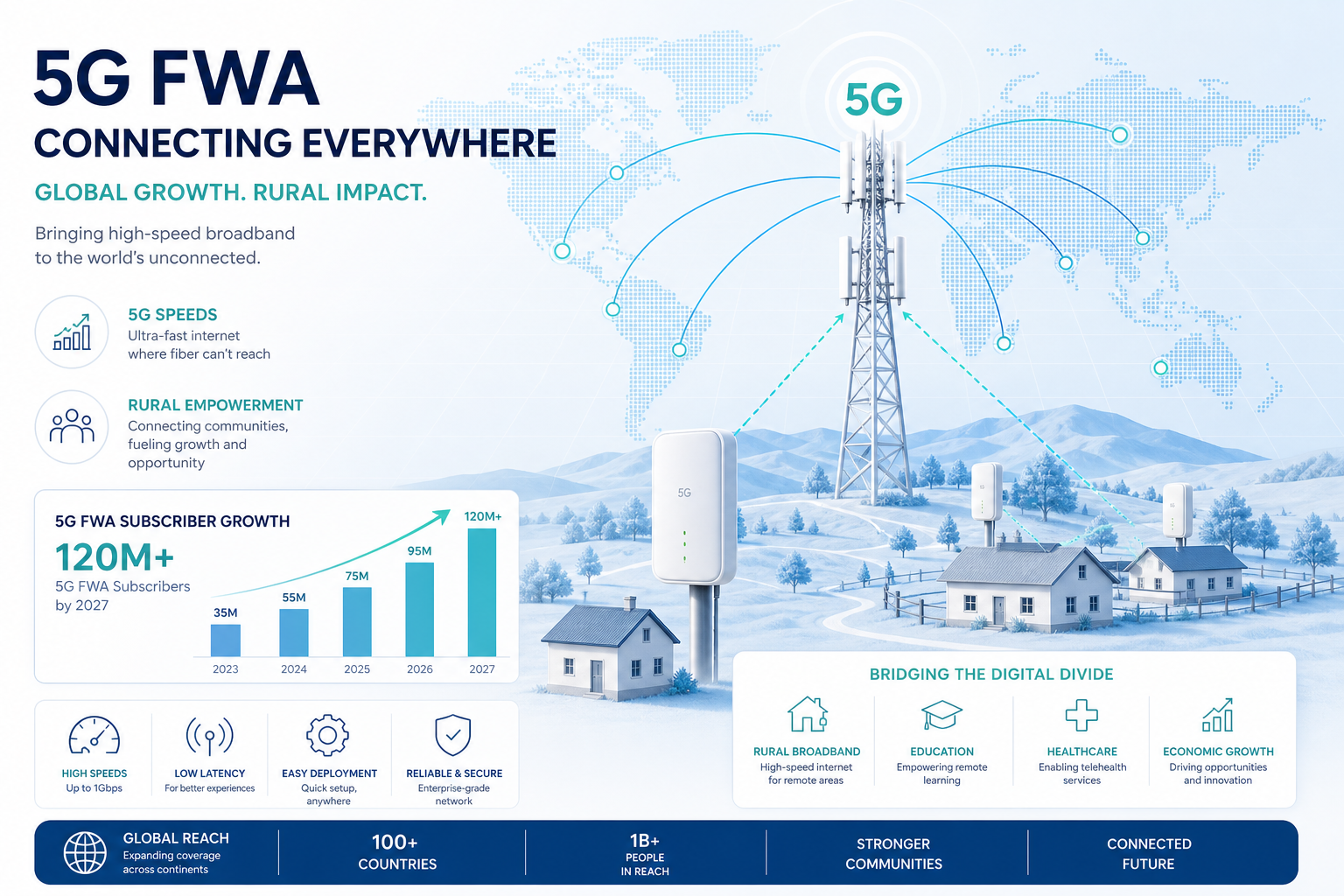
The global 5G Fixed Wireless Access (FWA) market has crossed a critical inflection point. Industry analysts now estimate the worldwide FWA subscriber base has surpassed 230 million connections, with year-over-year growth exceeding 38% across both developed and emerging markets. This unprecedented expansion is reshaping how operators, ISPs, and government agencies approach last-mile broadband infrastructure — and CPE procurement has become the central strategic variable.
The Numbers Behind the Surge
According to the latest quarterly data from the GSA and Ericsson Mobility Report, 5G FWA now accounts for approximately 15% of all fixed broadband subscriptions globally. The growth is no longer concentrated in early-adopter markets like the United States, Japan, and Saudi Arabia. India, Brazil, Indonesia, Nigeria, and the Philippines have emerged as the fastest-growing regions, driven by a combination of limited fiber infrastructure, favorable spectrum allocation policies, and aggressive operator capex toward wireless last-mile solutions.
Key market indicators include:
- Operator commitments: Over 140 mobile network operators worldwide now offer commercial 5G FWA services, up from 92 in early 2025.
- Device ecosystem: The number of commercially available 5G FWA CPE models has grown to over 380, spanning indoor desktop units, outdoor-mounted CPE, and industrial-grade gateways.
- ARPU stability: Contrary to early concerns, FWA ARPU has remained competitive with fiber in most markets, with average monthly revenue of $28–$42 in developed markets and $8–$15 in price-sensitive emerging economies.
- Spectrum utilization: Mid-band spectrum (3.5 GHz n78 and 2.6 GHz n41) accounts for 72% of FWA deployments, with mmWave (n257/n258/n261) contributing high-capacity urban overlay in 18% of operator networks.
Rural Digital Divide: The Policy Catalyst
Government broadband funding programs have become the single largest demand driver for 5G FWA CPE. The United States’ BEAD (Broadband Equity, Access, and Deployment) program, the European Union’s Connecting Europe Broadband Fund, India’s BharatNet Phase 3, and Brazil’s Norte Conectado initiative collectively represent over USD 45 billion in committed funding through 2028. Each of these programs explicitly includes FWA as an eligible technology pathway for serving unserved and underserved rural premises.
For CPE vendors, this creates both opportunity and obligation. Operators participating in government-funded programs must meet stringent performance, reliability, and interoperability requirements. Devices must demonstrate sustained throughput above 100 Mbps downlink at cell edge, support IPv6/IPv4 dual-stack, and pass carrier-specific interoperability testing across multiple RAN vendor environments.
The rural use case also places unique demands on CPE hardware design. Outdoor CPE (ODU) units must withstand extreme temperature ranges (−40°C to +55°C), IP67-rated weatherproofing, and wind loading up to 200 km/h in cyclone-prone regions. Integrated high-gain directional antenna arrays with 11–15 dBi gain are increasingly specified for long-range rural links extending beyond 12 km from the serving cell site.
CPE Procurement Dynamics: What Operators Are Buying
The CPE procurement landscape in 2026 reflects a maturing market with clear segmentation. Three distinct device categories dominate operator RFPs:
1. Entry-Level Indoor CPE (USD 80–150)
Targeted at price-sensitive mass-market deployments in emerging economies. These units typically support 4×4 MIMO on sub-6 GHz bands, deliver peak throughput of 1.5–2 Gbps, and include basic Wi-Fi 6 (802.11ax) 2×2 AP functionality. The primary design challenge is balancing cost reduction with minimum performance thresholds.
2. Mid-Range Outdoor CPE (USD 180–350)
The fastest-growing segment, driven by rural and suburban deployments. These self-install or technician-install outdoor units feature integrated high-gain antennas, support carrier aggregation across up to 8 component carriers, and deliver peak throughput of 3–6 Gbps. Power-over-Ethernet (PoE++) and IP67 rating are standard requirements.
3. Premium Enterprise/Industrial CPE (USD 400–1,200)
Designed for enterprise branch connectivity, industrial IoT backhaul, and multi-tenant residential buildings. These gateways support Wi-Fi 7, multi-gigabit Ethernet switching, SD-WAN integration, and advanced security features including hardware-rooted secure boot, IPSec/VXLAN tunneling, and Zero Trust Network Access (ZTNA) compatibility.
Procurement decision-makers are increasingly weighting total cost of ownership (TCO) over upfront unit price. Factors such as remote management capability (TR-369 USP compliance), mean time between failures (MTBF), firmware update cadence, and vendor responsiveness to security vulnerability disclosures now feature prominently in operator scorecards.
Supply Chain and Geopolitical Considerations
The 5G CPE supply chain continues to diversify away from single-source dependencies. The US FCC’s Secure and Trusted Communications Networks Act, the EU’s 5G Cybersecurity Toolbox, and similar frameworks in India, Australia, and Japan have driven operators to mandate multi-source component strategies. CPE vendors with manufacturing facilities in Vietnam, India, Malaysia, and Mexico have gained competitive advantage as operators seek to reduce geopolitical concentration risk in their device supply chains.
Chipset diversification is also accelerating, with MediaTek’s T830 and T900 platforms, Qualcomm’s Snapdragon X75 and X80 modems, and UNISOC’s Ivy 510 series now competing across multiple price-performance tiers. This broadening silicon ecosystem has reduced platform lock-in risks for CPE OEMs and enabled faster time-to-market for new device designs.
Market Outlook: 2026–2028
Looking ahead, several trends will shape the next phase of 5G FWA CPE market evolution:
- 5G-Advanced (3GPP Release 18/19) integration: AI/ML-based beam management, enhanced carrier aggregation (up to 16 CC), and multi-TRP support will drive a new generation of CPE silicon arriving in late 2026.
- Satellite-Direct-to-CPE convergence: 3GPP Release 19 NTN standards will enable hybrid terrestrial-satellite CPE capable of seamless failover to LEO satellite broadband, particularly valuable for truly remote deployments.
- AI-native CPE management: On-device machine learning for interference detection, traffic classification, and predictive fault detection will become standard features in mid-range and premium CPE segments.
- Sustainability mandates: Operators in the EU and Japan are beginning to require CPE vendors to disclose product carbon footprints and implement recyclable packaging and device take-back programs.
For CPE manufacturers and telecom procurement professionals, the message is clear: the 5G FWA market is entering its high-growth phase, and device strategy — encompassing performance, cost, supply chain resilience, and lifecycle management — will determine which vendors capture share in the next wave of global broadband expansion.
Frequently Asked Questions
What is the current global 5G FWA subscriber count?
As of mid-2026, the global 5G FWA subscriber base has surpassed 230 million connections, with sustained year-over-year growth above 38%. The GSA and Ericsson project the base will exceed 350 million by 2028.
Which regions are driving the fastest FWA growth?
While the United States, Japan, and Saudi Arabia remain large markets, the fastest growth rates are now observed in India, Brazil, Indonesia, Nigeria, and the Philippines, where limited fiber infrastructure and supportive government policies are accelerating wireless last-mile adoption.
What CPE specifications do operators prioritize for rural FWA deployments?
Rural FWA CPE requirements include outdoor-rated (IP67) enclosures, integrated high-gain directional antennas (11–15 dBi), support for extended-range operation beyond 12 km, wide temperature tolerance (−40°C to +55°C), and carrier aggregation across multiple bands for sustained throughput above 100 Mbps at cell edge.
How are government broadband programs impacting CPE procurement?
Programs such as the US BEAD initiative, EU Connecting Europe Broadband Fund, India’s BharatNet, and Brazil’s Norte Conectado collectively represent over USD 45 billion in committed funding through 2028, with FWA explicitly included as an eligible technology pathway. These programs impose strict performance and interoperability requirements on CPE vendors.
What role does supply chain diversification play in operator CPE strategy?
Operators are increasingly mandating multi-source component strategies and favoring CPE vendors with geographically diversified manufacturing footprints to reduce geopolitical concentration risk. Chipset diversification across MediaTek, Qualcomm, and UNISOC platforms is also accelerating.
Looking for reliable 5G FWA CPE for your network deployment? Contact Honlly Telecom today to discuss your requirements — from entry-level indoor units to high-gain outdoor CPE and enterprise-grade gateways, we deliver carrier-tested devices engineered for global operator deployments.