
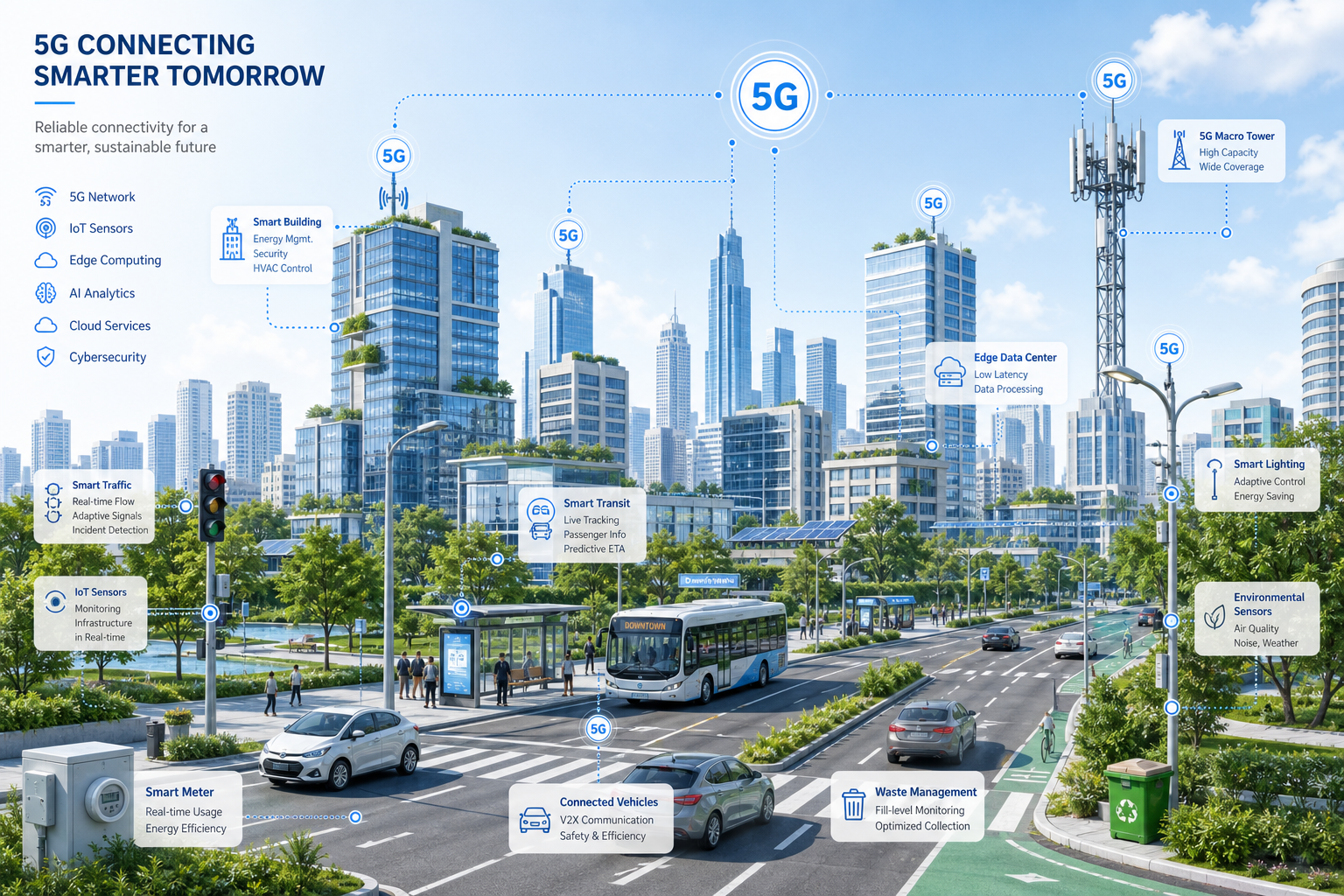
As municipalities worldwide accelerate digital transformation agendas, 5G Fixed Wireless Access (FWA) is emerging as the connective backbone for smart city infrastructure deployments. Unlike fiber-dependent architectures that require extensive trenching across urban landscapes, 5G CPE devices offer rapid deployment at a fraction of the cost and timeline — a critical advantage for cities balancing budget constraints with ambitious connectivity roadmaps.
The Smart City Connectivity Challenge
Modern smart city initiatives span multiple domains: intelligent traffic management systems processing real-time video feeds from thousands of intersections, environmental sensor networks monitoring air quality at neighborhood granularity, public safety cameras requiring always-on uplink capacity, digital kiosks delivering citizen services, and smart grid infrastructure managing distributed energy resources. Each use case imposes distinct network requirements that traditional wired backhaul struggles to satisfy uniformly.
The core challenge is not bandwidth alone — it is ubiquity. A city’s digital infrastructure must reach every street corner, every utility pole, every underground sensor cluster. Fiber-to-the-pole is economically viable for perhaps 15-20% of candidate locations in a typical mid-sized city. The remaining 80% demands wireless alternatives that can deliver carrier-grade reliability without the civil engineering overhead.
5G CPE as Universal Connectivity Nodes
Outdoor-rated 5G CPE units are increasingly deployed as multi-purpose connectivity hubs at the network edge. A single CPE installation on a streetlight pole can simultaneously backhaul traffic camera feeds, serve public Wi-Fi access points, connect environmental monitoring arrays, and provide failover connectivity for adjacent traffic signal controllers. This consolidation model — one CPE, multiple served endpoints — dramatically reduces per-node deployment costs while simplifying ongoing network operations.
Key architectural requirements for smart city-grade 5G CPE include:
- Industrial-grade environmental hardening: IP67 or higher ingress protection, -40°C to +65°C operating temperature range, and UV-resistant enclosures for direct sun exposure over 10+ year deployment lifecycles.
- Multi-gigabit backhaul capacity: Support for 5G NR Carrier Aggregation with at least 4CC on sub-6 GHz bands, delivering sustained 2+ Gbps downlink and 500+ Mbps uplink for video-heavy workloads.
- Edge computing capability: Integrated application processors capable of running local AI inference for video analytics, reducing backhaul traffic by filtering and pre-processing data at the collection point.
- Multi-interface LAN segmentation: Simultaneous operation of 2.5GbE PoE++ ports for cameras and access points, RS-485 serial interfaces for industrial sensor integration, and Wi-Fi 6/6E for local device connectivity.
- Dual-SIM with eSIM flexibility: Carrier redundancy via dual physical SIM slots plus GSMA SGP.32-compliant eSIM for dynamic operator switching and multi-network resilience.
Deployment Economics: Fiber vs. FWA
The economic case for 5G CPE in smart city deployments is compelling. Municipal field studies from 2025-2026 indicate that trenching new fiber to a single intersection cabinet costs between $25,000 and $85,000 depending on urban density and subsurface conditions, with deployment timelines of 6-18 months. An outdoor 5G CPE installation on existing street furniture, by contrast, costs $800-$2,500 per node and can be activated within days of site survey completion.
At city scale — hundreds to thousands of nodes — the aggregate savings run into tens of millions of dollars while accelerating time-to-service by 12-24 months. This is not merely a capex optimization; it is the difference between launching a smart city program within a single mayoral term versus deferring it across multiple budget cycles.
Network Slicing for Multi-Tenant Municipal Networks
5G network slicing is particularly relevant to municipal deployments where a single physical CPE must serve multiple logical tenants with distinct SLA requirements. A typical configuration might dedicate:
- Slice 1 (Public Safety): Guaranteed low-latency, high-priority slice for emergency services video and voice, with pre-emption capability over all other traffic.
- Slice 2 (Traffic Management): Medium-latency, high-throughput slice for real-time traffic camera analytics and adaptive signal control systems.
- Slice 3 (Environmental IoT): Low-bandwidth, delay-tolerant slice for periodic sensor data aggregation with store-and-forward capability during congestion.
- Slice 4 (Public Access): Best-effort slice for citizen Wi-Fi services with fair-usage throttling and content filtering.
This multi-tenant architecture allows cities to monetize 5G infrastructure by offering differentiated connectivity services to municipal departments, utility companies, and private service providers operating within the urban footprint.
Real-World Deployments and Lessons Learned
Several mid-sized cities in Asia-Pacific and the Middle East are now in advanced stages of 5G CPE-based smart city rollouts. Early deployments have surfaced practical considerations that procurement teams should address:
- Power sourcing: Streetlight poles typically provide only 100-240V AC with limited wattage headroom. CPE units should support wide-input PoE (802.3bt Type 4, up to 90W) to simplify power sourcing and eliminate the need for separate electrical circuits.
- Mounting standardization: Cities benefit from CPE that supports standard pole-mount brackets (30-120mm diameter) and DIN-rail mounting for cabinet deployments, avoiding custom fabrication costs.
- Remote management at scale: TR-369 USP (User Services Platform) is rapidly replacing TR-069 as the preferred device management protocol for municipal-scale deployments, offering bulk provisioning, lifecycle automation, and real-time telemetry for thousands of distributed nodes.
- Vandalism resistance: Tamper-detection sensors, concealed antenna designs, and anti-theft mounting hardware have proven essential in deployments where CPE units are accessible at street level.
5G-Advanced and the Next Phase
Looking ahead to 3GPP Release 18 and beyond, 5G-Advanced features will further enhance smart city CPE capabilities. AI-native air interface optimizations will improve spectral efficiency in dense urban deployments where interference is a primary constraint. Enhanced positioning accuracy (sub-meter level) will enable precise location-based services without additional GPS infrastructure. And integrated sensing and communication (ISAC) capabilities may allow CPE units to double as environmental sensors, detecting movement patterns and environmental changes through RF signature analysis.
For municipalities and system integrators planning 2026-2028 smart city programs, specifying 5G CPE with a clear upgrade path to 5G-Advanced features is now a prudent procurement strategy. The devices deployed today will likely remain in service for 7-10 years, spanning two generations of 3GPP releases. Selecting platforms with field-upgradeable modem modules and sufficient compute headroom for future AI workloads ensures that today’s investment remains relevant through the smart city evolution cycle.
Conclusion
5G CPE is no longer merely a consumer broadband alternative — it is the practical connectivity fabric for urban digital transformation. Cities that embrace FWA-based architectures for smart infrastructure gain deployment velocity, cost efficiency, and architectural flexibility that fiber-only strategies cannot match. For municipal IT directors, system integrators, and telecom procurement teams, the message is clear: the smart city starts with the right CPE at the edge.