
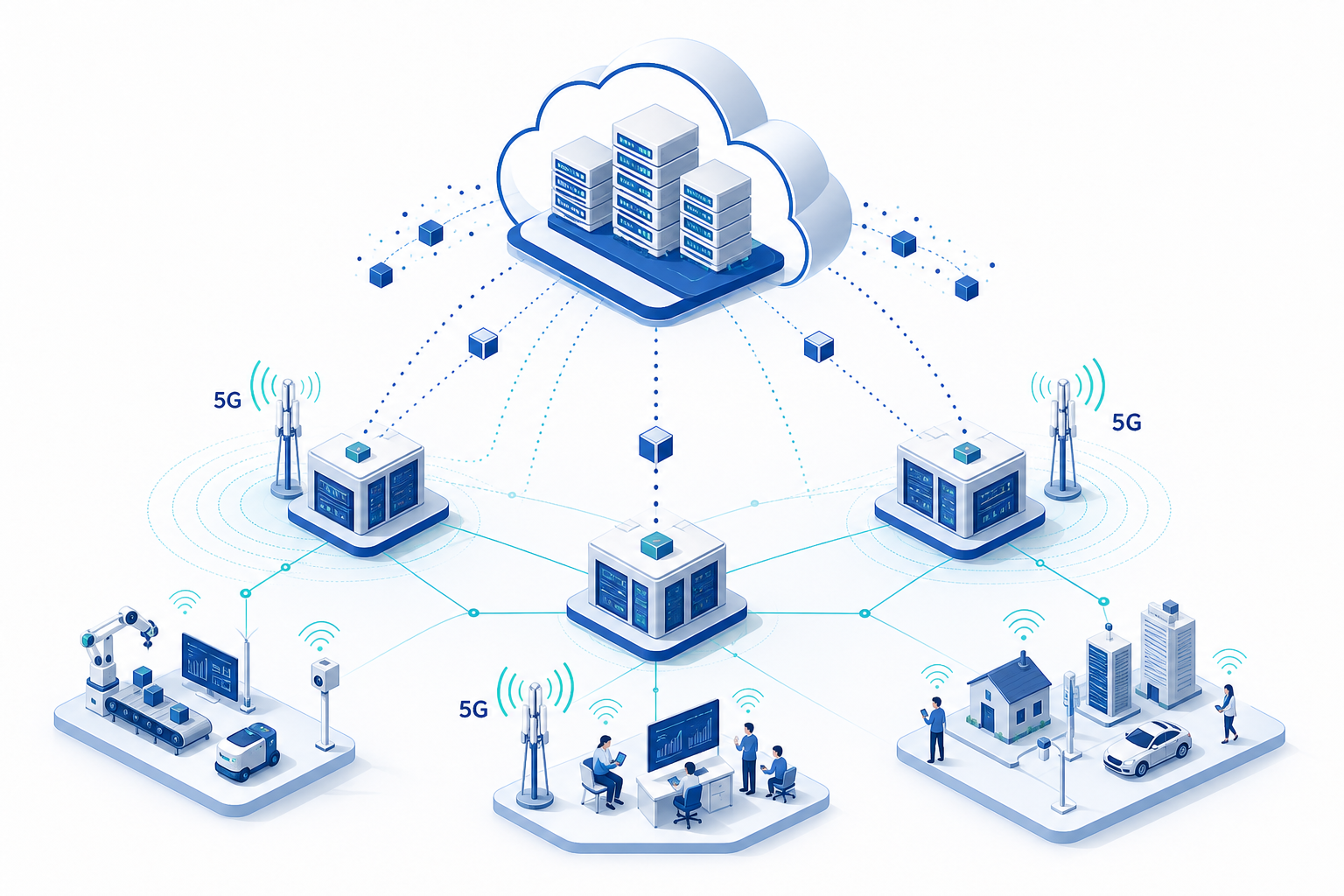
As enterprise networks evolve toward distributed architectures and latency-sensitive applications proliferate, the traditional model of backhauling all traffic to a centralized data center or cloud region is reaching its limits. Multi-access Edge Computing (MEC) integrated with 5G CPE represents a paradigm shift — moving compute, storage, and application logic closer to the point of data generation. For ISPs, system integrators, and enterprise telecom buyers, understanding how to architect, deploy, and manage edge-enabled CPE is rapidly becoming a core competency.
What Is Edge-Enabled 5G CPE?
Edge-enabled 5G CPE combines the wireless WAN connectivity of a 5G NR modem with onboard compute resources capable of hosting containerized or virtualized application workloads at the network edge. Unlike a traditional CPE that functions purely as a Layer 2/3 forwarding device, edge-enabled CPE includes a general-purpose application processor, local storage, and a software execution environment — typically a lightweight Kubernetes distribution, Docker runtime, or vendor-specific application hosting framework.
The architectural distinction matters: this is not simply a more powerful router. It is a converged platform where WAN termination, LAN switching, security functions, and third-party application workloads coexist on a single device — managed through orchestration frameworks that span thousands of distributed nodes.
Key Architectural Components
1. Local Breakout and Traffic Steering
Local breakout (also called Local Data Network or LDN in 5G terminology) enables the CPE to route selected traffic flows directly to on-premise or nearby edge infrastructure without traversing the mobile core. This is achieved through ULCL (Uplink Classifier) functionality at the UPF (User Plane Function) level in 5G SA architectures, or through application-level traffic steering policies configured on the CPE.
The practical benefit is dramatic for latency-sensitive workloads: industrial automation control loops that require sub-5ms round-trip time, real-time video analytics that process multiple 4K streams locally, and AR/VR rendering workloads that cannot tolerate the 20-50ms latency of backhaul to a regional cloud data center.
2. MEC Application Enablement Platform
The ETSI MEC reference architecture defines the framework for deploying applications at the network edge. For CPE-level implementation, the MEC platform is often a lightweight software stack that provides:
- Service Registry and Discovery: Enables edge applications to register their availability and discover peer services without centralized DNS or load balancer dependencies.
- Radio Network Information Service (RNIS): Exposes real-time RAN-level metrics — signal quality, cell load, UE mobility state — to edge applications, enabling radio-aware application optimization.
- Location Service: Provides geolocation data without GPS dependency, using cell-ID and NR positioning reference signals.
- Bandwidth Management Service: Allows applications to request guaranteed throughput allocations from the CPE’s traffic scheduler for deterministic performance.
3. Container Orchestration at the Far Edge
Deploying containerized workloads on thousands of distributed CPE devices requires orchestration tooling fundamentally different from data center Kubernetes. Lightweight distributions such as K3s, MicroK8s, and the Linux Foundation’s EdgeX Foundry are purpose-built for resource-constrained edge nodes. Key operational considerations include:
- Image Distribution Efficiency: P2P image distribution protocols (Dragonfly, Kraken) reduce the bandwidth impact of pushing container images to large CPE fleets over WAN links.
- Graceful Degradation Under Connectivity Loss: The orchestration layer must maintain application availability during WAN link failures, with local image caches and autonomous scheduling decisions.
- Resource Quotas and Isolation: Applications must operate within strict CPU, memory, and storage bounds to prevent resource starvation of the CPE’s core networking functions.
Enterprise Use Cases and Deployment Patterns
Manufacturing and Industry 4.0
In smart factory deployments, edge-enabled 5G CPE hosts protocol translation gateways (Modbus TCP to OPC UA, PROFINET to MQTT), local SCADA visualization dashboards, and predictive maintenance inference models running on the device NPU. The CPE becomes the converged connectivity-plus-compute node that bridges operational technology (OT) and information technology (IT) networks without requiring separate industrial PCs at each cell.
Retail and Branch Office
Multi-site retail operators deploy edge CPE to host local inventory management applications, real-time video analytics for footfall counting and loss prevention, and digital signage content management — all running locally on the CPE device that also provides the store’s primary WAN connectivity. This eliminates the server closet footprint at each location while improving application responsiveness during WAN congestion or outage events.
Smart Grid and Utility Networks
Distribution network operators deploy edge CPE at substations to host local phasor measurement unit (PMU) data aggregation, fault detection algorithms, and demand-response logic. The ultra-low latency of local processing — combined with 5G URLLC connectivity to the central SCADA system — enables grid protection schemes that operate within the IEC 61850 4ms transfer time requirement for GOOSE messages.
Procurement and Integration Considerations for ISPs
For ISPs and managed service providers evaluating edge-enabled CPE platforms, the following decision criteria should inform RFP specifications:
Compute Headroom: Specify minimum available CPU cores and RAM for third-party workloads after accounting for baseline CPE functions (routing, firewall, VPN termination). A 4-core ARM Cortex-A78 with 4GB available RAM for applications is a practical minimum for 2026 enterprise deployments.
NPU/Accelerator Availability: For AI inference workloads at the edge, integrated neural processing units delivering 6-15 TOPS provide sufficient headroom for common models (object detection, anomaly detection, natural language processing). Verify that the NPU SDK supports common model formats (ONNX, TensorFlow Lite, OpenVINO) and that inference pipelines can coexist with networking workloads without QoS degradation.
Orchestration Platform Compatibility: The CPE platform should integrate with the operator’s existing device management framework (TR-069 ACS or TR-369 USP controller) for base device lifecycle management, while exposing a separate API or agent for application lifecycle management. Avoid vendor-proprietary application orchestration that locks the operator into a single CPE supplier’s ecosystem.
Security Isolation: Edge applications must execute in a Trusted Execution Environment (TEE) or hardware-enforced container sandbox that prevents compromised applications from accessing CPE networking functions, subscriber credentials, or other tenants’ data in multi-tenant deployment scenarios. Require vendors to document the security isolation architecture and provide penetration test results for the application hosting environment.
Zero-Touch Application Provisioning: The ability to deploy, update, and decommission edge applications across a fleet of thousands of CPE devices without manual intervention is critical to operational viability. Evaluate the platform’s support for GitOps-style declarative application state management, canary deployment strategies, and automated rollback on health check failure.
The ETSI MEC Federation Model
A emerging architectural pattern is MEC federation, where edge computing resources across multiple administrative domains — operator edge, enterprise on-premise, and hyperscaler edge zones (AWS Wavelength, Azure Edge Zones, Google Distributed Cloud Edge) — are federated into a unified application deployment surface. In this model, the edge-enabled 5G CPE functions as the on-premise node in a hierarchical edge architecture, with workloads able to migrate between CPE, operator MEC, and cloud edge tiers based on latency requirements, resource availability, and cost policies.
This federation model is particularly relevant for system integrators building multi-site enterprise solutions, where the application deployment topology must flex across hundreds or thousands of locations with heterogeneous edge infrastructure.
The Road Ahead: 3GPP Release 19 and Beyond
The 3GPP Release 19 study on “Edge Computing Enhancements” — expected to conclude in Q4 2026 — will introduce standardized APIs for edge application enablement at the 5G system level. Key features under study include:
- AF-influenced Edge Relocation: Standardized procedures for application function-triggered relocation of edge application contexts between CPE and network edge nodes during UE mobility events.
- Edge Enabler Client (EEC) on CPE: A standardized client module on the CPE that handles edge service discovery, application context transfer, and capability exposure toward the 5G core network.
- QoS Monitoring for Edge Applications: Real-time per-flow QoS metrics exposed to edge applications via standardized APIs, enabling adaptive bitrate streaming, dynamic compression level adjustment, and application-level traffic engineering.
For telecom buyers planning multi-year CPE procurement cycles, selecting platforms with a documented migration path to Release 19 edge computing features — and a silicon roadmap that supports the anticipated compute requirements — is a forward-looking procurement strategy that protects investment in edge-enabled CPE fleets.