
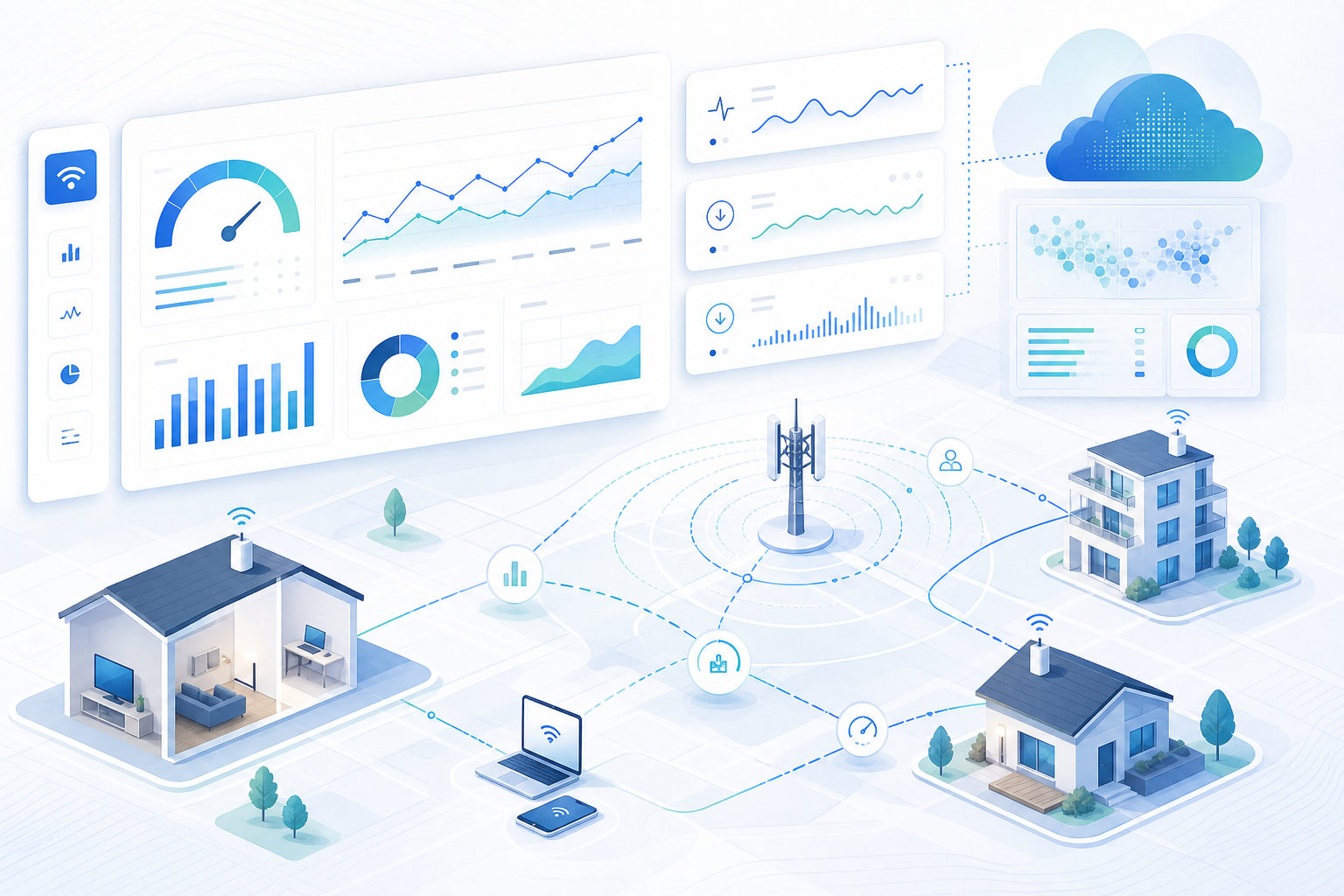
Why Subscriber QoE Management Has Become Critical for FWA Operators
Fixed Wireless Access has matured from an opportunistic broadband fill-in technology to a primary access strategy for operators worldwide. With that maturation comes a fundamental shift in subscriber expectations: FWA users now demand the same reliability, predictability, and quality transparency they receive from fiber and cable services. For ISPs and telecom operators managing CPE fleets at scale — tens of thousands to millions of devices — effective Subscriber Quality of Experience (QoE) management has moved from a nice-to-have to a competitive necessity.
This article provides a technical framework for building a subscriber QoE management architecture specifically designed for FWA CPE deployments, covering SLA monitoring methodologies, proactive fault detection approaches, and the analytics infrastructure required to operationalize quality management at carrier scale.
Understanding QoE vs QoS in the FWA Context
Before designing a monitoring architecture, operators must distinguish between Quality of Service (QoS) and Quality of Experience (QoE) in the FWA domain. QoS metrics — signal strength (RSRP), signal quality (RSRQ/SINR), throughput, latency, and packet loss — are network-centric and measurable at the device level. QoE metrics — video streaming buffering events, web page load times, VoIP MOS scores, and application responsiveness — are subscriber-centric and correlate directly with customer satisfaction and churn probability.
A critical insight for FWA operators: good QoS does not guarantee good QoE. A CPE device reporting excellent RSRP and SINR values may still deliver poor video streaming experience due to bufferbloat in the home Wi-Fi segment, DNS resolution delays, or transient backhaul congestion. Effective QoE management therefore requires an architecture that correlates radio-layer telemetry with application-layer performance data in near real-time.
SLA Monitoring Architecture for FWA CPE Fleets
Tiered SLA Definitions
Operators should define SLA tiers that map to their service offerings. A typical three-tier FWA SLA structure might include:
- Best-Effort Tier: Residential FWA with no throughput guarantee; target >95% service availability, measured at 15-minute granularity
- Business Tier: SME FWA with committed information rate (CIR) of 50–100 Mbps; 99.5% availability; 4-hour mean time to repair (MTTR)
- Enterprise Tier: Dedicated CPE with CIR up to 1 Gbps; 99.9% availability; sub-1-hour MTTR; includes application-layer QoE guarantees (e.g., UCaaS MOS >4.0)
CPE-Side Telemetry Collection
Modern FWA CPE must support a comprehensive telemetry data model. At minimum, devices should expose the following data streams via TR-369 USP or TR-181 data model extensions:
- Radio Layer: RSRP, RSRQ, SINR, CQI, MCS index, carrier aggregation status, handover events, cell ID, and PCI per 1-second sampling interval
- Throughput Layer: WAN-side throughput (TX/RX), per-QCI/5QI bearer throughput, peak and 95th percentile utilization
- Wi-Fi Layer: Associated station count, per-station RSSI, channel utilization, airtime fairness metrics, band steering events
- Application Layer: ICMP/ping latency to operator-defined targets, DNS resolution time, HTTP GET latency to reference endpoints, and optionally YouTube/Netflix buffering event counters
Proactive Fault Detection: Moving Beyond Reactive NOC Operations
Traditional NOC operations rely on subscriber-reported faults — a reactive model that damages customer satisfaction before resolution begins. A proactive fault detection architecture for FWA shifts the paradigm by identifying degradation patterns before they cross subscriber-perceptible thresholds.
Baseline Deviation Detection
The most effective approach establishes per-device performance baselines over a rolling 30-day window. Rather than applying static thresholds (e.g., “alert when RSRP < -110 dBm"), the system detects statistically significant deviations from each device's normal operating envelope. A CPE that normally operates at -95 dBm RSRP and suddenly degrades to -105 dBm triggers an alert, even if the absolute value remains within generic "acceptable" ranges.
Correlated Multi-Metric Anomaly Detection
Single-metric alerts generate excessive noise in large-scale deployments. A robust architecture correlates multiple telemetry streams to improve signal-to-noise ratio. For example:
- Cell congestion: Good RSRP + degraded SINR + reduced throughput during peak hours → likely cell overload, not device fault
- CPE hardware degradation: Gradual RSRP decline without SINR change + increased device temperature → possible antenna or RF front-end degradation
- Interference: Stable RSRP + fluctuating SINR with periodic throughput dips → external interference source requiring spectrum analysis
- Backhaul congestion: Stable radio metrics + high latency + reduced throughput → core/backhaul issue, not access network
Analytics Architecture for Carrier-Scale QoE Management
Data Pipeline Design
A carrier-scale QoE analytics platform requires a purpose-built data pipeline. For an operator managing 500,000 CPE devices with per-second telemetry collection, the data ingest rate reaches approximately 250,000 to 500,000 records per second. The recommended architecture follows a lambda pattern:
- Speed Layer: Apache Kafka or equivalent message broker for real-time stream processing; Apache Flink for windowed aggregations and real-time anomaly detection
- Batch Layer: Time-series database (TimescaleDB or InfluxDB) for historical analysis; object storage (S3-compatible) for raw telemetry archival
- Serving Layer: Grafana or custom dashboard for NOC visualization; REST API for integration with operator OSS/BSS systems
Machine Learning for Predictive QoE
Operators with sufficient historical data can deploy ML models to predict QoE degradation before it occurs. Gradient-boosted tree models (XGBoost/LightGBM) trained on labeled historical fault data have demonstrated the ability to predict CPE service degradation with 30–60 minutes of lead time at 85%+ precision. Key features include rolling statistical aggregations (mean, standard deviation, slope) of primary radio metrics over multiple time windows (5 min, 15 min, 1 hour, 24 hours).
CPE Hardware Requirements for QoE-Ready Deployments
Not all CPE hardware is equally capable of supporting the telemetry and analytics architecture described above. Operators should specify the following minimum requirements in their CPE RFPs:
- CPU headroom: At least 15% idle CPU capacity under peak throughput for telemetry agent processing
- Memory: Minimum 512 MB RAM with 128 MB reserved for telemetry buffering
- TR-369 USP support: Full USP agent with Push Notification, Bulk Data Collection, and Data Model Object operations
- Time synchronization: NTP or PTP support with <100ms clock accuracy for event correlation across the fleet
- On-device buffering: Minimum 1-hour telemetry buffer for WAN-disconnected graceful degradation
Implementation Roadmap for Operators
Operators should approach QoE management implementation in three phases:
Phase 1 (Months 1–3): Deploy basic telemetry collection on all CPE — radio metrics, throughput, and latency probes. Establish per-device baselines and implement threshold-based alerting for critical degradation events. Integrate with existing NOC dashboards.
Phase 2 (Months 4–9): Implement multi-metric correlation rules, deploy the streaming analytics pipeline, and introduce baseline deviation detection. Begin collecting application-layer QoE probes. Automate tier-1 fault diagnosis to reduce NOC ticket volume.
Phase 3 (Months 10–18): Train and deploy ML-based predictive degradation models. Implement closed-loop remediation for common fault patterns (e.g., automated band/channel reassignment, carrier aggregation reconfiguration). Extend QoE visibility to customer self-service portals.
Conclusion: QoE as Competitive Differentiator
As FWA markets mature and competition intensifies — particularly in urban and suburban deployments where FWA competes directly with fiber and cable — subscriber QoE management becomes a critical differentiator. Operators that invest in proactive, data-driven QoE architectures can reduce churn by an estimated 15–25%, decrease NOC ticket volume by 30–40% through automated fault detection, and command premium pricing for SLA-backed service tiers.
For operators and ISPs evaluating CPE suppliers, QoE telemetry capability should be a key evaluation criterion alongside traditional metrics like throughput, band support, and cost. Honlly Telecom’s 4G and 5G FWA CPE portfolio includes full TR-369 USP telemetry support with configurable data models designed for carrier-grade QoE management deployments. Contact the Honlly engineering team to discuss QoE integration requirements for your FWA network.
For technical specifications on Honlly Telecom’s QoE-ready 4G/5G FWA CPE portfolio and TR-369 USP telemetry integration support, contact sales@xmhonlly.com.