
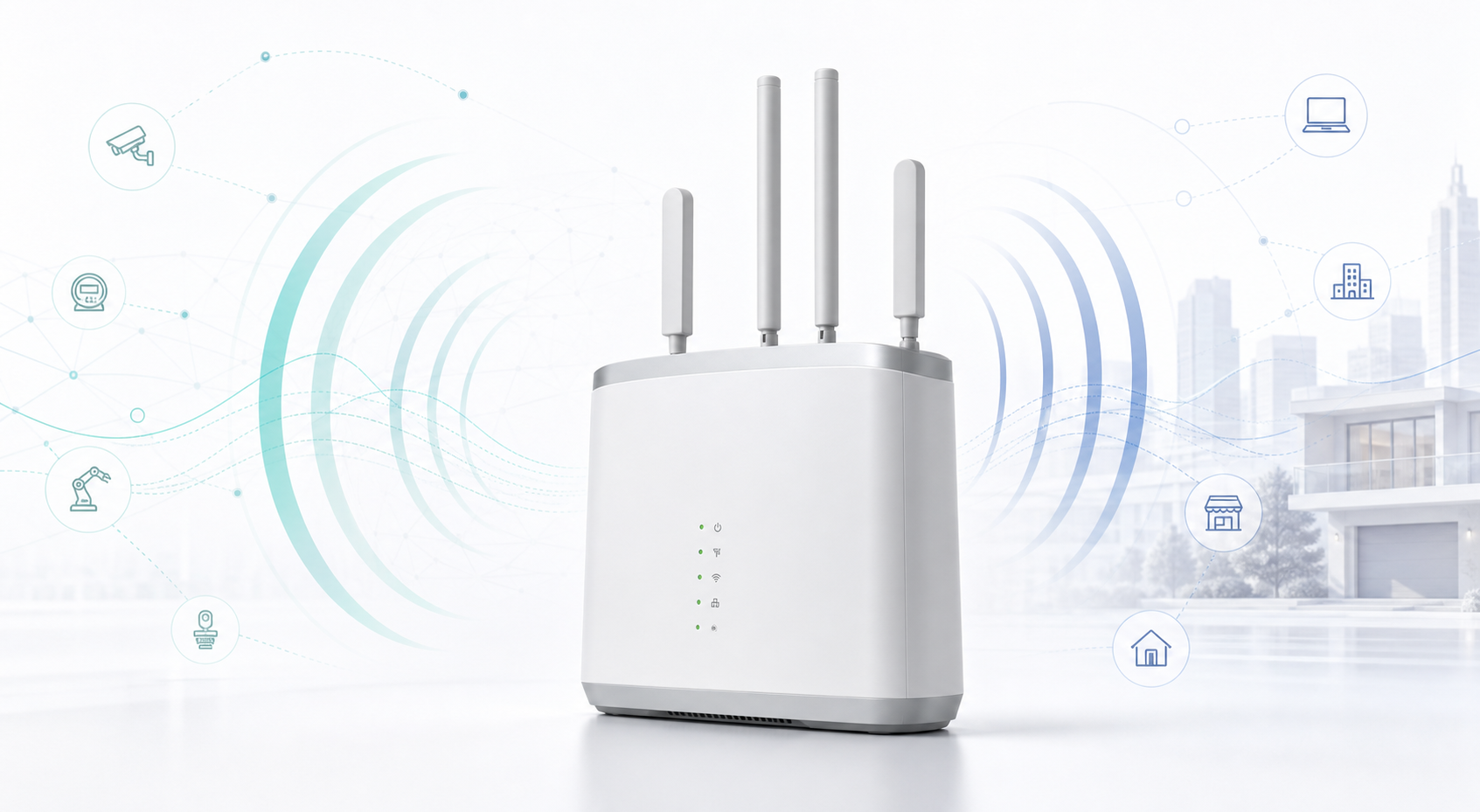
The 5G ecosystem is entering a pivotal phase of market segmentation in 2026, and at the center of this evolution is 5G RedCap (Reduced Capability) — the 3GPP Release 17 specification formally known as NR-Light. Designed to bridge the gap between ultra-high-performance eMBB devices and low-complexity NB-IoT/LTE-M endpoints, RedCap CPE is now transitioning from standards documentation to commercial silicon, with chipset vendors including Qualcomm (Snapdragon X35), MediaTek (T300), and UNISOC shipping production-ready RedCap modem platforms. For telecom operators, ISPs, and B2B CPE distributors, this represents one of the most significant procurement inflection points since the initial 5G CPE rollout.
What 5G RedCap Actually Delivers
RedCap strips down the full 5G NR feature set to a targeted subset optimized for mid-tier use cases. Key technical differentiators include:
- Reduced Bandwidth: Maximum 20 MHz bandwidth in FR1 (vs. 100 MHz for full 5G NR), sufficient for applications requiring 50–150 Mbps downlink — well above LTE Cat-4/Cat-6 but without the silicon cost of full-fat 5G.
- Simplified Antenna Configuration: 1 Rx / 1 Tx or 2 Rx / 1 Tx antenna paths (vs. 4×4 MIMO in premium CPE), reducing BOM cost, PCB complexity, and enclosure thermal load by approximately 40–60%.
- Half-Duplex FDD Support: Optional half-duplex FDD operation further reduces RF front-end complexity for stationary sensor and meter applications.
- Power Optimization: Extended DRX (eDRX) and Radio Resource Management (RRM) relaxation deliver 50–70% power reduction compared to full 5G NR CPE, enabling battery-backed and solar-powered deployments.
- 5G Core Native: Unlike LTE-based mid-tier devices, RedCap operates natively on the 5G Core (5GC), inheriting network slicing, URLLC-lite capabilities, and unified authentication.
Why Operators Are Betting on RedCap CPE
The operator business case for RedCap CPE crystallized throughout H1 2026 as three macro trends converged. First, FWA market segmentation has matured beyond the binary “premium enterprise vs. basic residential” model — operators now recognize a substantial middle tier comprising small offices, retail chains, pop-up locations, and SMB branches that require carrier-grade reliability at 50–100 Mbps but cannot justify $300+ CPE BOM costs. Second, massive IoT gateway consolidation is driving demand for a single CPE platform that can aggregate hundreds of sensors, cameras, and industrial endpoints onto a managed 5G backhaul without the overhead of full NR. Third, spectrum refarming economics are pushing operators to sunset legacy 3G and LTE networks, and RedCap provides a migration path for the millions of LTE Cat-4/Cat-6 CPE units currently in the field.
China Mobile, China Telecom, and China Unicom have all completed RedCap field trials in 2026, with commercial device certification programs now accepting RedCap CPE submissions. In Europe, Deutsche Telekom and Vodafone have announced RedCap device roadmaps targeting Q3 2026 commercial availability for enterprise FWA tiers. T-Mobile US has begun integrating RedCap into its 5G Advanced network slicing framework for fixed wireless access.
RedCap CPE Design Considerations for OEM/ODM Buyers
For B2B buyers sourcing RedCap CPE from OEM/ODM partners, several engineering decisions warrant close evaluation:
Chipset Platform Selection: The Qualcomm X35 Modem-RF system is the current market leader, supporting both SA and NSA modes with up to 220 Mbps peak downlink. MediaTek’s T300 offers a competitive alternative with integrated GNSS and lower power draw. Buyers should verify that the selected platform supports the specific RedCap feature combination required — particularly half-duplex FDD if targeting utility/industrial applications, and VoNR if voice services are in scope.
Antenna Design Trade-offs: While RedCap simplifies antenna requirements, outdoor CPE installations still benefit from external antenna ports for high-gain directional antennas in fringe coverage areas. The optimal design for fixed wireless RedCap CPE is typically 2×2 MIMO with external SMA connectors, supporting both integrated and external antenna configurations without exceeding the simplified RF chain budget.
Enclosure and Thermal Strategy: RedCap’s reduced power envelope (typically 3–5W system-level consumption vs. 8–15W for full 5G NR CPE) enables fanless, passively cooled industrial designs rated for -20°C to +65°C operation. This is particularly valuable for outdoor smart city, agricultural IoT, and remote monitoring gateways where active cooling is impractical.
Software and Management: RedCap CPE should support TR-069/TR-369 USP for remote provisioning and management, with OMA-DM as a lightweight alternative for carrier environments that do not require full USP stacks. OpenWrt-based platforms provide the flexibility for operator-specific customization while maintaining a manageable software BOM.
Market Outlook: 2026–2028
Industry analysts project RedCap device shipments — including CPE, modules, and integrated endpoints — will exceed 80 million units annually by 2028, with CPE/gateway form factors representing approximately 35% of that volume. The average selling price for RedCap CPE is expected to stabilize at $80–120 (FOB), roughly 40–55% below comparable full-capability 5G NR CPE, making it an attractive entry point for price-sensitive emerging markets across Southeast Asia, Africa, and Latin America.
For Honlly Telecom, the RedCap CPE opportunity aligns with the company’s established strength in cost-optimized 4G/5G CPE manufacturing and its growing presence in emerging-market operator accounts. As RedCap silicon reaches volume pricing parity with LTE Cat-6 platforms, the transition from LTE-based fixed wireless to 5G RedCap represents a natural upgrade cycle that B2B buyers should begin planning for now.
Key Takeaways for B2B Buyers
- 5G RedCap CPE delivers 50–150 Mbps performance at 40–55% lower BOM cost than full 5G NR CPE, making it the logical successor to LTE Cat-4/Cat-6 fixed wireless devices.
- Operator certification programs in China, Europe, and North America are now accepting RedCap CPE submissions, signaling commercial readiness.
- When evaluating RedCap CPE OEM partners, prioritize chipset maturity (Qualcomm X35 or MediaTek T300), TR-069/TR-369 management support, and proven thermal design for outdoor-rated enclosures.
- The 2026–2027 window represents the early-adopter phase — operators who deploy RedCap CPE now gain spectrum efficiency advantages and cost leadership before the market reaches volume maturity in 2028.
This article was prepared by the Honlly Telecom editorial team to provide B2B technology buyers with timely, actionable intelligence on 5G CPE market developments. For more information about Honlly’s 4G/5G CPE product portfolio, visit our Products page.