
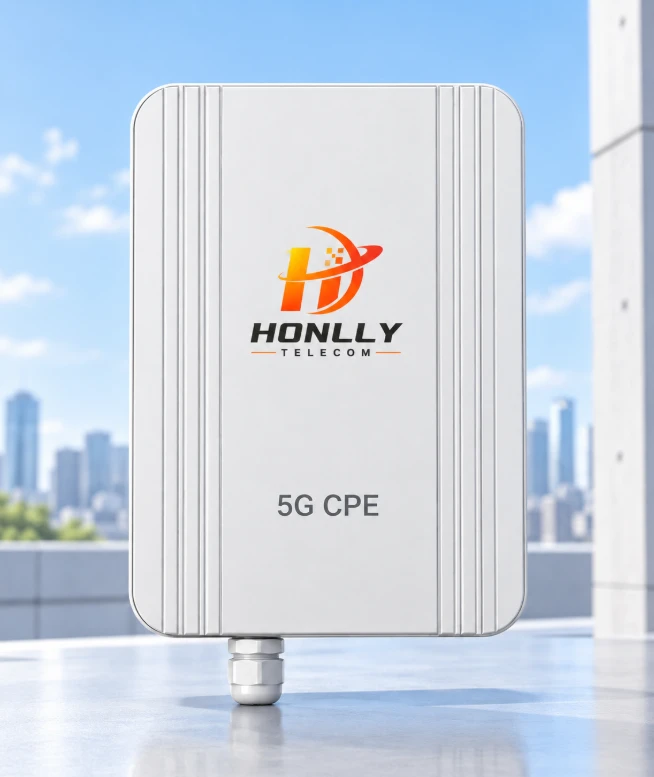
5G has an indoor problem that most coverage maps hide. The mid-band spectrum that carries the bulk of today’s fixed wireless traffic — the n77/n78 bands — is far worse at penetrating walls than the low-band LTE it replaces. In Southeast Asia and Africa, where dense concrete, metal roofing and high ambient temperatures are the norm, a signal that reads “excellent” at the curb can collapse to a single bar three metres inside a living room. For operators and ISPs, that gap shows up as a support queue full of signal complaints and subscribers who quietly churn to whatever alternative they can find.
The fix is architectural, not just RF
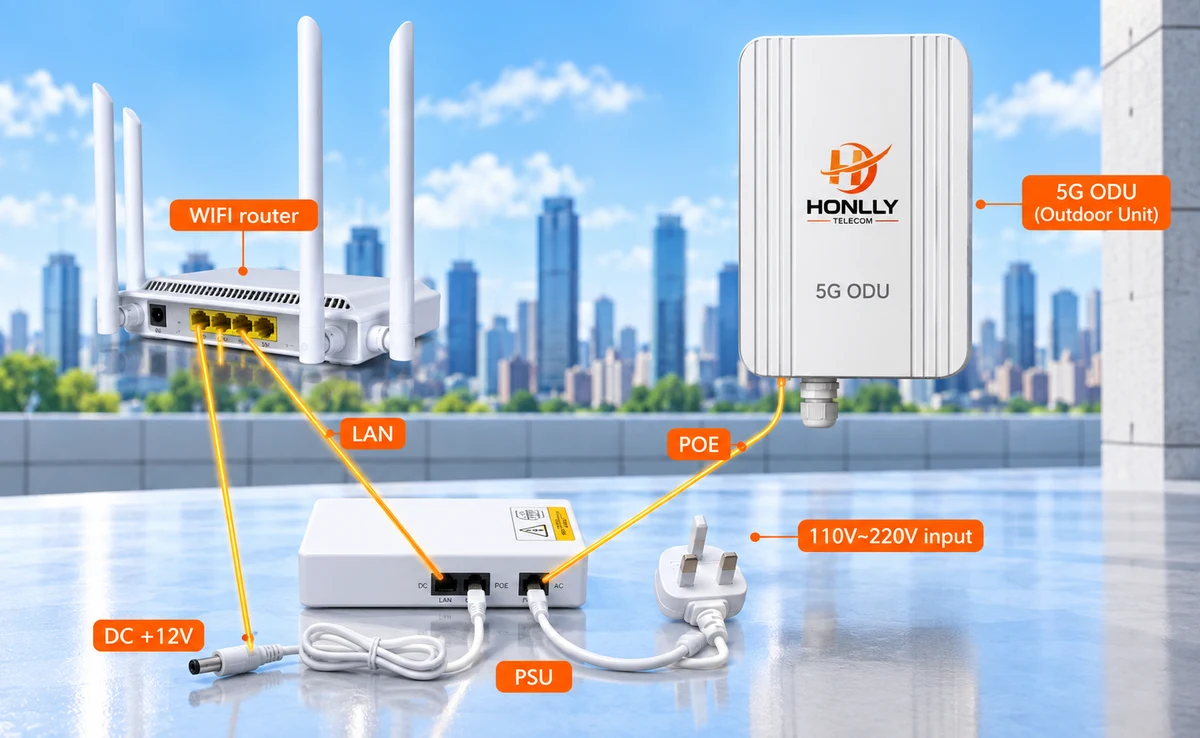
The mistake is asking one indoor router to do two hard jobs at once: catch a weak cellular signal through a wall and then rebroadcast WiFi. A 5G Outdoor Unit (ODU) plus an indoor WiFi 6 router splits those jobs in two — and each half gets much better at what it does.
The ODU is a weatherproof, IP65-rated outdoor CPE mounted on the wall or roof, exactly where the signal is strongest. Its high-gain 4×4 MIMO antennas lock onto a cell-edge signal that an indoor unit would never see, then hand the connection down to an indoor WiFi 6 router over a single PoE Ethernet cable. The indoor unit does the only thing left to do: clean, high-throughput WiFi 6 across the home or small office.
The part operators should care about most: the coverage math
A base station is the single most expensive asset in a mobile network. Spectrum, site acquisition, tower steel, power, backhaul and civil works can push one macro site into six or seven figures. An outdoor CPE, by contrast, is close to free at the margin — a unit that costs around a hundred dollars at carrier volume against a site that costs a hundred times that.
This is where the economics invert. Every home an outdoor CPE can serve at the cell edge is a home that does not require the operator to densify with another site. Because a 4×4 MIMO outdoor unit with proper antenna gain holds a usable link far deeper into the coverage fringe than any indoor unit can, the effective serviceable radius of each cell grows. The result is fewer towers, more subscribers per site and a lower capital cost per connected home.
What to look for in an outdoor CPE kit
Not every outdoor kit is built for carrier-grade deployment. For ISP, operator and MVNO fixed wireless projects, these are the specs that separate a deployable network from a clever box:
- Rugged enclosure: IP65 rating and a wide operating temperature range so the unit survives monsoons, dust storms and heat without a truck roll.
- 4×4 MIMO and full sub-6 GHz bands: n1/n3/n5/n7/n8/n20/n28/n38/n40/n41/n77/n78 coverage, so the unit locks onto the bands that matter most in emerging markets.
- WiFi 6 indoors: AX1800-class dual-band performance with MU-MIMO, OFDMA and beamforming for multi-device households.
- Backup power: a mini UPS so voice and alarm links survive local power cuts.
- Remote management: TR-069/TR-181 central management, remote FOTA and watch-dog link self-recovery for zero-touch visibility at scale.
Why this lands hardest in Southeast Asia and Africa
Three reasons make the ODU + WiFi 6 kit the highest-leverage capex play in these markets. First, low ARPU makes capital efficiency existential — operators simply cannot afford to over-build. Second, sparse fiber means fixed wireless is often the only realistic last-mile for a large share of the population. Third, the regional spectrum mix leans heavily on n28/n77/n78, precisely the bands where moving the antenna from a windowsill to a rooftop produces the largest indoor-versus-outdoor gain.
The takeaway
The outdoor CPE is quietly becoming the cheapest base station a 5G operator will ever deploy — because it lets them deploy fewer of the expensive ones. For operators and ISPs in Southeast Asia and Africa staring down thin margins and large coverage gaps, putting the radio on the roof and the WiFi on the wall is not a product decision. It is a capital strategy.
Honlly Telecom supplies carrier-grade 4G/5G outdoor CPE + WiFi 6 kits for fixed wireless access projects, with OEM/ODM customization for operators, ISPs, MVNOs and distributors across 75+ countries.