
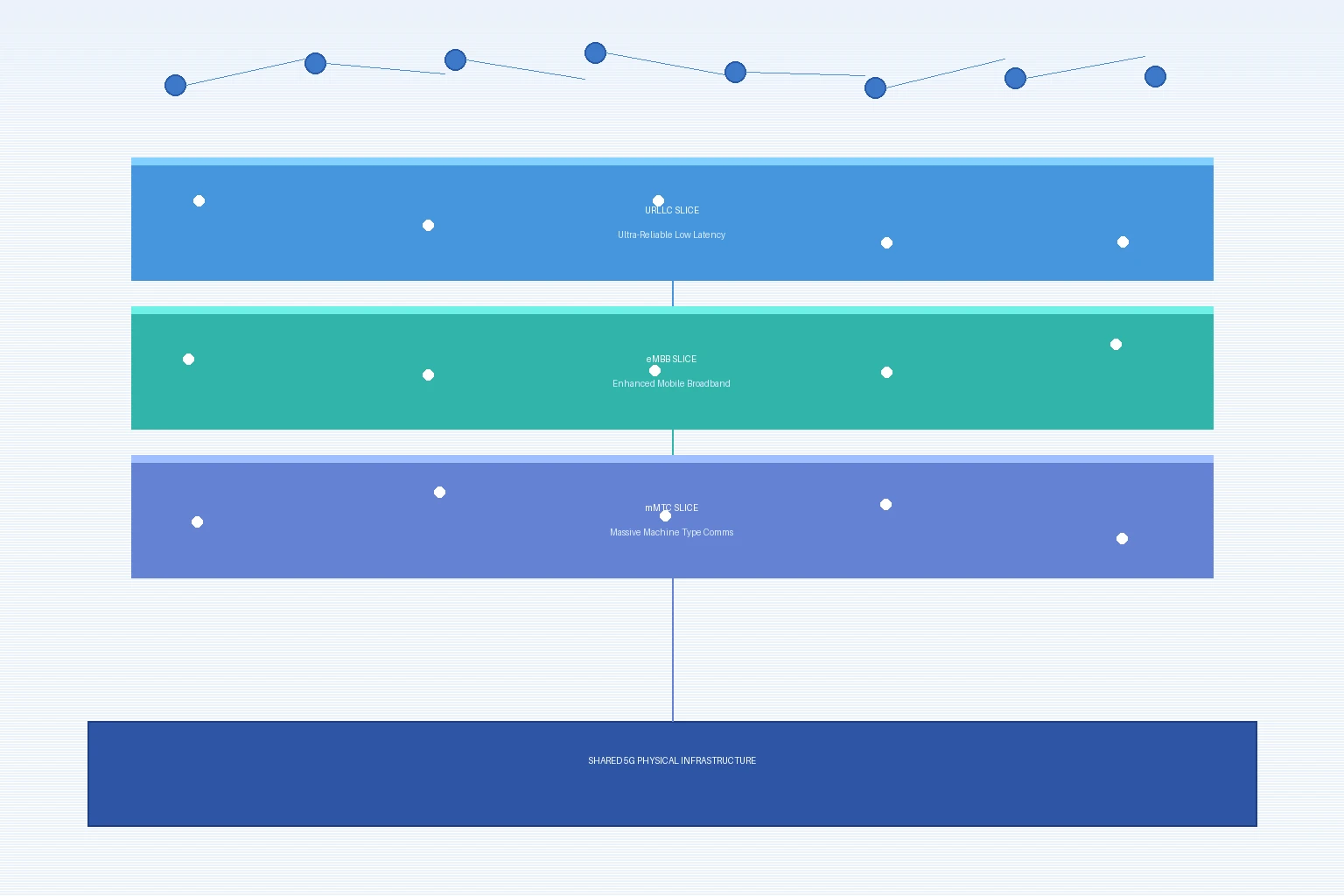
Enterprise network-slicing proposals should start with the operator services actually available to the customer. Request the supported device configuration and contractual performance terms, then validate the complete service against the application requirements.
For ISP procurement teams, MVNO technical buyers, and enterprise FWA decision-makers, understanding the commercial readiness of network slicing is no longer optional — it directly impacts CPE specification requirements, SLA definitions, and total cost of ownership calculations for upcoming FWA deployments.
What Is Changing in 2026?
The 3GPP-defined network slicing framework (standardized from Release 15 through Release 18) has reached a maturity point where end-to-end slicing — from 5G core through RAN to CPE — is now commercially viable. Key developments include:
- Standalone (SA) 5G core deployments have exceeded 60 commercial networks globally, providing the architectural foundation for slice orchestration
- URSP (UE Route Selection Policy) support in CPE chipsets (Qualcomm X75/X80, MediaTek T800, UNISOC V510/V516) enables device-side slice selection and traffic routing
- NSSAI (Network Slice Selection Assistance Information) integration in operator provisioning systems allows automated slice assignment per enterprise contract
- Major NEPs (Ericsson, Nokia, Huawei) have deployed slice management functions (NSMF/NSSMF) with northbound APIs for BSS/OSS integration
Commercial Slice Use Cases Driving CPE Demand
Operators are packaging network slices into distinct enterprise product categories, each with specific CPE requirements:
1. URLLC Slice for Industrial Automation
For an industrial network-slicing project, define application requirements with the operator and integration team. Confirm the CPE capabilities, service configuration, supported protocols and acceptance tests. No fixed latency or reliability guarantee, or Honlly-specific timestamping capability, is established here.
2. eMBB Slice for Enterprise Branch and SD-WAN
For enterprise branch access, document the required throughput, isolation and traffic policies. Confirm which VLAN mappings, routing functions and orchestration integrations the exact device and operator service support. Validate these functions in the proposed configuration.
3. mMTC Slice for Massive IoT Backhaul
Optimized for high-density sensor networks, smart metering, and environmental monitoring, mMTC slices prioritize connection density over per-device throughput. CPE serving as IoT gateways must support NB-IoT and LTE-M fallback aggregation, along with lightweight protocol translation (MQTT, CoAP, LwM2M) to cloud IoT platforms (AWS IoT Core, Azure IoT Hub).
CPE Slicing Capabilities: What Buyers Must Verify
Not all 5G CPE devices support network slicing equally. Procurement teams evaluating CPE for slice-enabled deployments should verify:
| Capability | Minimum Requirement | Verification Method |
|---|---|---|
| URSP Support | 3GPP Rel-16 UE Route Selection Policy | Check modem AT command interface / QMI for URSP rules |
| Multiple PDU Sessions | ≥4 simultaneous PDU sessions on different slices | Lab test with operator core simulator (Amarisoft, Keysight) |
| S-NSSAI Configuration | Configurable S-NSSAI via TR-069/TR-369 ACS or local GUI | Verify ACS parameter tree or Web UI slice settings page |
| Slice-Aware QoS | Per-slice 5QI-to-DSCP mapping, GBR/non-GBR handling | RFC 2544 throughput test per slice with iPerf3 |
| VLAN/Slice Binding | IEEE 802.1Q VLAN trunking with slice-to-VLAN mapping | Verify tagged traffic routing per VLAN to correct PDU session |
Operator Commercial Models and Pricing
Operators are adopting varied commercial models for slice offerings. The shift toward slice-as-a-service introduces new pricing constructs that CPE procurement teams must factor into TCO models:
- Per-slice subscription: obtain the current operator quotation and confirm the charging unit, activation conditions, usage limits and support scope.
- QoS tier pricing: ask whether the operator offers distinct service tiers and obtain the current terms for the required application.
- Slice lifecycle management fee — Charge for slice creation, modification, and deletion via operator portal or API
- Service commitments: review the actual contract, measurement method, exclusions and any service-credit mechanism with the provider.
For ISPs and MVNOs, the ability to white-label slice offerings through CPE that supports multi-tenant slice isolation creates new revenue streams. A single CPE can serve multiple enterprise customers with dedicated slices, each with independent billing, QoS, and security policies.
Honlly’s Slice-Ready CPE Portfolio
Honlly Telecom’s 5G CPE platforms are designed for slice-enabled commercial deployments. Key features include:
- Multi-PDU session support — Up to 8 simultaneous PDU sessions across different slices on Qualcomm X75-based platforms
- URSP policy engine integration — Full support for network-provided and device-local URSP rules with fallback behavior
- Slice-aware ACS management — TR-369 USP data model extensions for slice configuration, monitoring, and diagnostics
- Hardware QoS offload — Dedicated NPU (Network Processing Unit) for per-slice traffic shaping, policing, and queue management at line rate
- Operator certification — Pre-certified for network slicing interoperability with major 5G SA core vendors
Frequently Asked Questions
Q: Is network slicing available on 5G NSA (Non-Standalone) networks?
A: No. Network slicing requires 5G SA (Standalone) architecture with a 5G core (5GC). NSA networks using EPC cannot support end-to-end slicing. Buyers should verify their target operator has deployed 5G SA before specifying slice-capable CPE.
Q: How many slices can the proposed CPE support? A: Request the supported configuration for the exact hardware, firmware and operator service. This article does not establish a portfolio-wide session or slice count.
Q: What happens if the operator changes slice parameters mid-contract?
A: 3GPP defines slice modification procedures where the network can update S-NSSAI parameters. CPE must support dynamic slice reconfiguration without requiring a device reboot. Honlly CPE implements graceful slice modification with sub-second failover to default slice if reconfiguration fails.
Q: Can devices from different vendors use the same slicing service? A: Confirm the operator service requirements and supported device implementations. Any platform-specific management or integration feature must be validated for the project.
Ready to deploy slice-enabled 5G FWA CPE? Contact Honlly Telecom’s solutions engineering team for a technical consultation, CPE evaluation kit, and slice interoperability testing with your operator partner.