
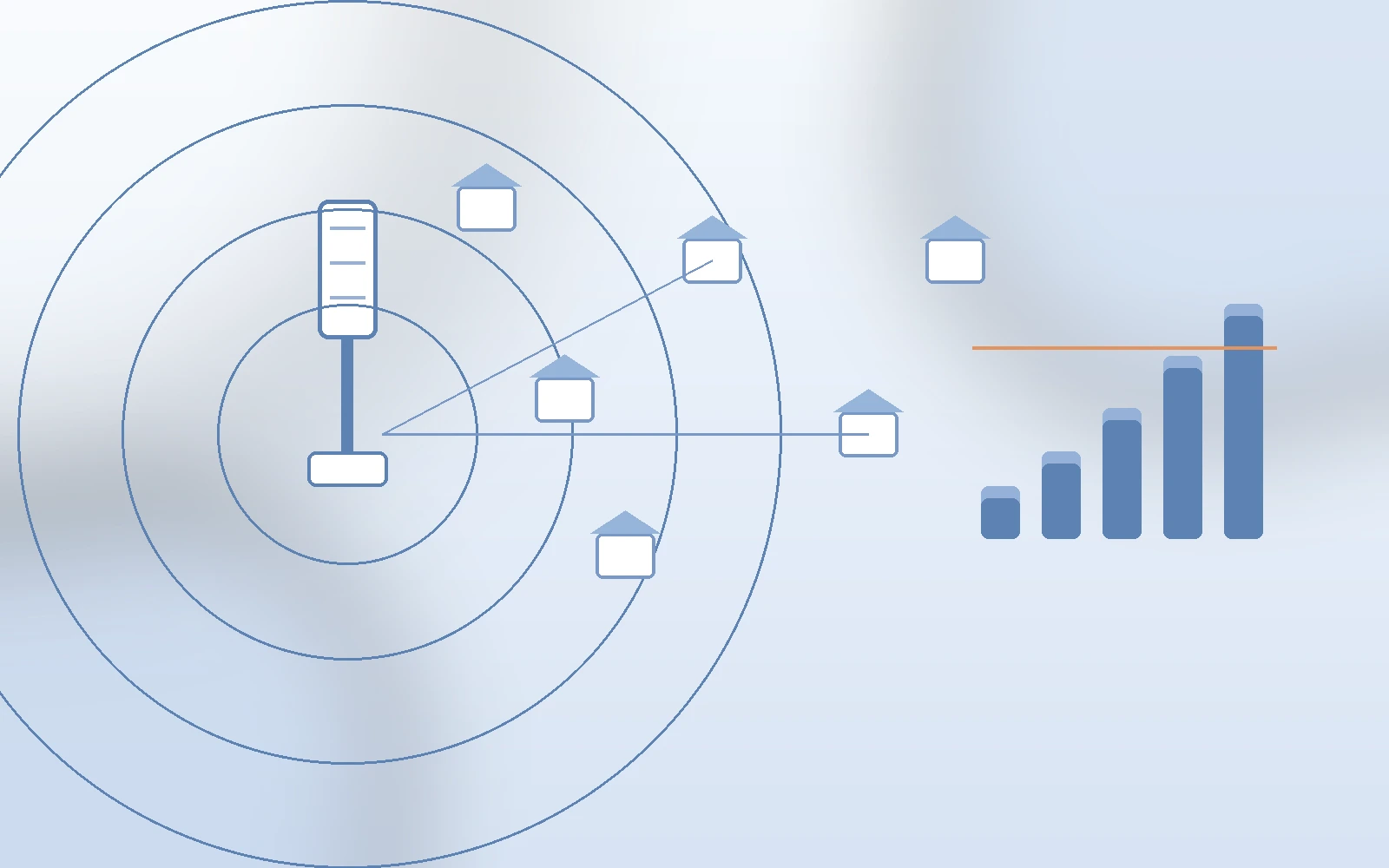
For its first several years, 5G fixed wireless access was framed as a coverage story—closing the fibre gap by reaching homes that cabled infrastructure could not. That framing is changing. As FWA matures into a mainstream broadband access technology and subscriber density climbs, the binding constraint is no longer whether a home is in coverage but whether the serving sector has the capacity to deliver a consistently good experience during the busy hour. Capacity planning and oversubscription discipline are moving to the center of FWA network economics.
Why FWA capacity is different from mobile capacity
A fixed subscriber is not a mobile subscriber. A home gateway typically consumes far more data, stays attached to the same cell for months or years, and concentrates demand in the evening busy hour. Where a mobile network averages demand across thousands of moving users and many cells, an FWA sector faces a handful of stationary, heavy users whose peaks do not average away. This makes oversubscription—the ratio of sold capacity to delivered capacity—the single most important planning lever an FWA operator controls.
The oversubscription ratio, explained
Oversubscription, or the contention ratio, expresses how many subscribers share a given amount of capacity. A residential fixed network is typically planned at a higher contention ratio than a dedicated business circuit because not every subscriber peaks at once. The key is to size the ratio against real busy-hour behaviour: an operator that over-provisions wastes spectrum and capex, while one that under-provisions invites churn, support calls and reputational damage. In 2026 the practical question is less “what ratio” than “what ratio can each sector sustain at its cell edge, in the worst hour.”
Cell-edge performance sets the floor
Capacity planning lives or dies at the cell edge. Throughput in a modern 5G CPE varies widely with signal quality—reflected in RSRP, SINR and the MIMO rank the device can sustain—and the weakest subscribers in a sector define the experience floor. Operators are increasingly planning FWA around a guaranteed cell-edge rate rather than a marketing peak rate, then using CPE placement, external antennas and outdoor units to lift the weakest links rather than add sites. This shifts the cost of improvement from the network to a lower-cost, subscriber-specific fix.
CPE telemetry closes the planning loop
The CPE itself has become a planning instrument. Because a fixed gateway reports signal quality, achieved throughput and usage over TR-069/TR-369 management, operators can build live per-sector demand models instead of relying on spreadsheet assumptions. That telemetry tells a planner which sectors are approaching contention, which subscribers are persistently cell-edge, and where an upsell to a higher tier—or a migration to a better-performing device—is the cheapest way to relieve pressure.
Commercial implications for operators and buyers
- Tiering by delivered, not marketed, speed: plan tiers around sustained busy-hour throughput so customer expectations match network reality.
- Fair-usage and QoS policy: use traffic management to protect interactive and voice traffic when a sector contends.
- Device mix matters: higher-order MIMO, better antennas and Wi-Fi 6/7 gateways convert the same spectrum into more usable capacity per home.
- Plan for upgrade paths: carrier aggregation and spectrum additions change the capacity equation and should be modelled, not guessed.
The operators winning at FWA in 2026 are not the ones with the broadest coverage map but the ones with the clearest view of their own capacity. By treating oversubscription, cell-edge throughput and CPE telemetry as first-class planning inputs, they can grow subscribers without degrading experience—and turn fixed wireless from a coverage gap-filler into a profitable, predictable broadband business.