
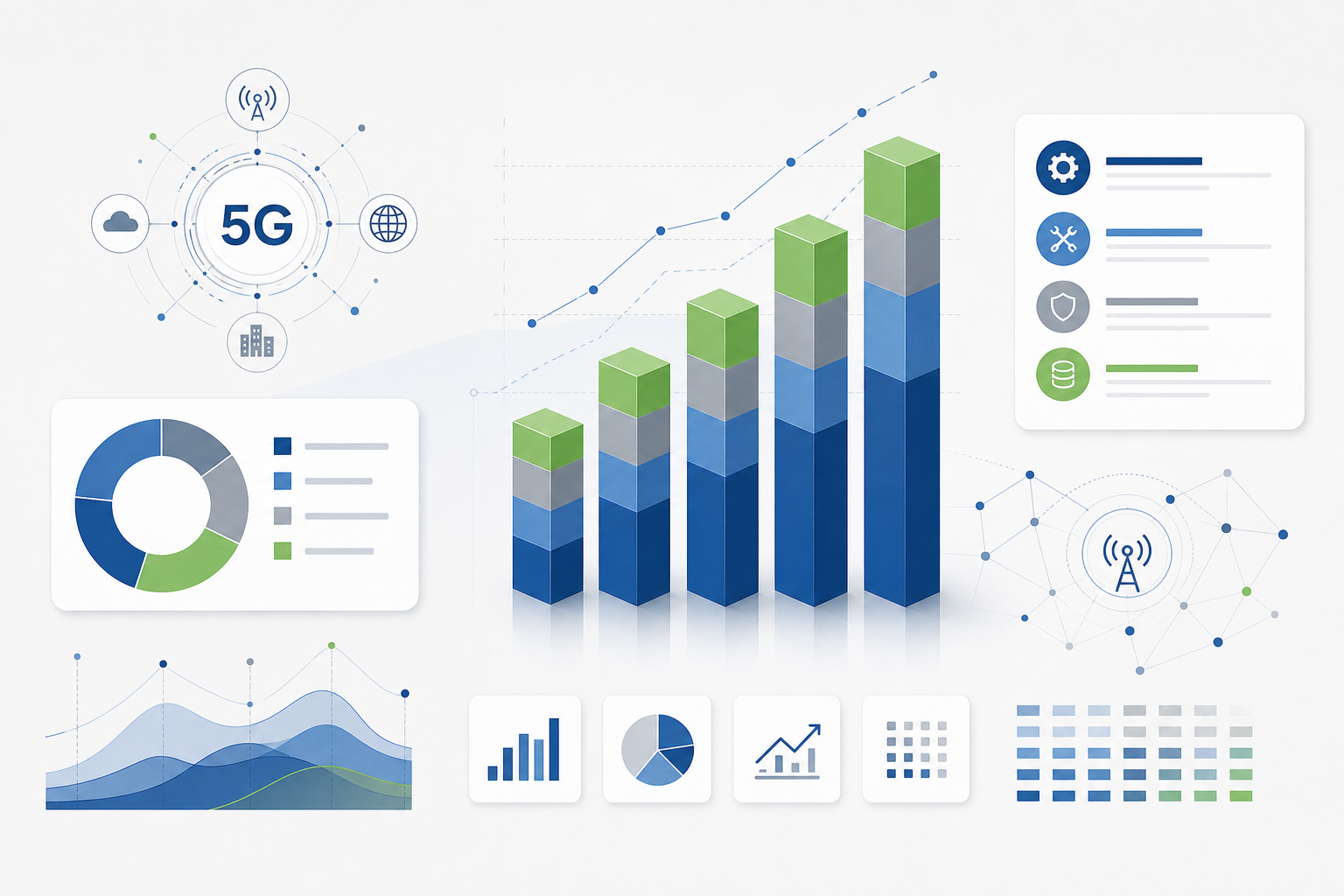
For ISPs and telecom operators planning Fixed Wireless Access (FWA) rollouts, the per-unit purchase price of a 5G CPE represents only the tip of the financial iceberg. A comprehensive Total Cost of Ownership (TCO) analysis — spanning hardware acquisition, deployment logistics, ongoing operations, lifecycle management, and end-of-life disposal — often reveals that the initial CAPEX decision accounts for less than 35% of the total five-year cost per subscriber. This guide provides a structured TCO framework for procurement teams evaluating 5G CPE options in 2026.
The Five-Year TCO Model: Beyond the Unit Price
A robust 5G CPE TCO model for ISP deployments should account for the following cost categories across a five-year device lifecycle:
| TCO Category | Typical Share of 5-Year Cost | Key Variables |
|---|---|---|
| Hardware CAPEX | 30–35% | Unit price, volume discounts, import duties, logistics |
| Deployment & Installation | 12–18% | Truck roll cost, self-install ratio, activation failure rate |
| Ongoing Operations | 25–30% | Support tickets, firmware updates, ACS platform costs |
| Returns & Replacements | 8–12% | DOA rate, field failure rate, warranty terms, RMA logistics |
| End-of-Life Management | 3–5% | Reverse logistics, refurbishment, e-waste compliance |
| Network/Core Integration | 5–8% | ACS licensing, TR-069/TR-369 server scaling, integration engineering |
This distribution highlights a critical insight: choosing a CPE based primarily on the lowest unit price often increases total cost when deployment complexity, support burden, and failure rates are factored in.
CAPEX Deep Dive: What Drives the Unit Price
The bill-of-materials (BOM) cost of a 5G CPE in 2026 is dominated by four components:
Modem-RF Platform (35–45% of BOM)
The choice between Qualcomm Snapdragon X75/X80, MediaTek T830, or UNISOC V516 platforms significantly impacts both upfront cost and long-term performance. Qualcomm platforms command a $12–18 premium but offer broader carrier certification coverage and longer software support commitments (typically 5+ years). MediaTek’s T830 provides competitive performance at 15–20% lower cost, making it attractive for price-sensitive markets. UNISOC platforms serve the sub-$60 BOM segment for basic connectivity use cases.
Wi-Fi Subsystem (8–12% of BOM)
Wi-Fi 7 (802.11be) chipsets add approximately $15–22 over Wi-Fi 6 equivalents. However, operators deploying Wi-Fi 7 CPE report 18–22% fewer in-home coverage-related support calls, translating to annual OPEX savings of $3–5 per subscriber. For deployments exceeding 50,000 units, the Wi-Fi 7 premium typically pays back within 14–18 months through reduced support costs alone.
Memory and Storage (6–9% of BOM)
5G CPE typically requires 512 MB–1 GB LPDDR4X RAM and 256 MB–512 MB flash storage. Operators planning to deploy value-added services (VPN termination, edge compute containers, local traffic analytics) should specify 1 GB RAM minimum to avoid premature obsolescence and costly field replacements.
Enclosure and Thermal Design (5–8% of BOM)
Passive thermal design quality directly correlates with field failure rates. CPE using extruded aluminum heatsinks and optimized airflow paths typically show 40–60% lower failure rates over five years compared to plastic-only enclosures with basic ventilation. The $1.50–3.00 incremental BOM cost for improved thermal design is among the highest-ROI investments in CPE specification.
OPEX: The Hidden Cost Multiplier
Self-Install vs. Truck Roll Economics
The single largest OPEX variable in FWA CPE deployment is the self-install success rate. Operators achieving self-install rates above 85% report average deployment costs of $18–35 per subscriber. Those relying primarily on technician visits face $85–150 per installation. Key CPE design factors that improve self-install success include:
- Guided setup mobile apps with signal-strength-based placement optimization (reduces install failure by 35–40%)
- eSIM-based zero-touch provisioning eliminating manual APN and carrier configuration (reduces support calls by 22–28%)
- LED-free “stealth” design options for residential deployments where blinking lights trigger unnecessary support inquiries
Support Ticket Economics
Industry benchmarks show that the average 5G FWA CPE generates 0.8–1.4 support contacts per year. At an average cost of $12–18 per handled ticket (including L1 and L2 support), annual per-subscriber support costs range from $9.60 to $25.20. CPE with integrated remote diagnostics capabilities (TR-369 USP-based performance monitoring, Wi-Fi experience scoring) reduce ticket volume by 30–40%.
Firmware Lifecycle Management
Over a five-year lifecycle, a typical 5G CPE receives 8–15 firmware updates. Each OTA update carries bandwidth costs ($0.02–0.08 per device per update depending on payload size) and engineering costs for testing and staged rollout management. Operators should verify that CPE vendors commit to a minimum 5-year firmware support window and provide FOTA (Firmware Over-The-Air) delta update capability to minimize bandwidth consumption.
Returns, RMAs, and Field Failure: The Cost of Unreliability
Field failure rates for 5G CPE in the first 12 months currently average 2.5–5.0% across the industry, with best-in-class models achieving sub-1.5%. Each field failure incurs:
- Customer support handling: $15–25 (troubleshooting, diagnosis)
- Replacement unit cost: 100% of unit price (plus shipping)
- Reverse logistics: $8–15 (return shipping, receiving, testing)
- Customer churn risk: 15–25% of subscribers experiencing CPE failure churn within 60 days, representing $250–600 in lost lifetime value per churned subscriber
For a 100,000-subscriber deployment, a 2% improvement in annual failure rate (from 4% to 2%) translates to approximately $1.2–1.8 million in annual savings — far exceeding any upfront unit price premium for higher-quality CPE.
TCO Optimization Framework: Six Decision Criteria
When evaluating 5G CPE options, procurement teams should weight their decision across these six criteria:
- Five-year TCO per subscriber (not unit price) — target below $180 for Sub-6 GHz, below $250 for mmWave CPE
- Self-install success rate target — minimum 80%, with contractual vendor commitments
- Annual field failure rate — maximum 2.5% in year 1, 1.5% in years 2–5
- Firmware support window — minimum 5 years from first shipment, with quarterly security patches
- TR-369 USP compliance — mandatory for remote diagnostics and proactive fault detection
- Wi-Fi 7 readiness — strongly recommended for greenfield deployments; Wi-Fi 6E as minimum fallback
Case Study: The ROI of Quality-Driven CPE Selection
Consider a hypothetical ISP deploying 50,000 FWA subscribers:
- Option A: Low-cost CPE at $65/unit, 4.5% annual failure rate, 72% self-install success, Wi-Fi 6, 3-year firmware support
- Option B: Quality CPE at $82/unit, 1.8% annual failure rate, 87% self-install success, Wi-Fi 7, 5-year firmware support
The 5-year TCO analysis tells a clear story:
- Option A 5-Year TCO: $10.8 million ($216/subscriber)
- Hardware: $3.25M | Deployment: $2.4M | Support: $2.8M | Returns: $1.5M | Other: $0.85M
- Option B 5-Year TCO: $8.9 million ($178/subscriber)
- Hardware: $4.1M | Deployment: $1.2M | Support: $1.6M | Returns: $0.65M | Other: $1.35M
The higher-quality CPE saves $1.9 million over five years — $38 per subscriber — despite a $17 higher unit price. This is the power of TCO-driven procurement.
Conclusion: TCO Thinking as a Competitive Advantage
In the increasingly competitive FWA market, operators that adopt TCO-based CPE procurement consistently outperform those making decisions on unit price alone. The key takeaway for ISP and operator procurement teams: demand TCO data from your CPE vendors. Request field failure rate statistics, self-install success benchmarks from reference deployments, and contractual commitments on firmware support duration. The lowest unit price rarely delivers the lowest total cost — and in the subscriber business, total cost is what determines profitability.
This analysis draws on operator deployment data, CPE vendor specifications, and industry benchmarks from Omdia, ABI Research, and GSMA Intelligence 2026 reports.