
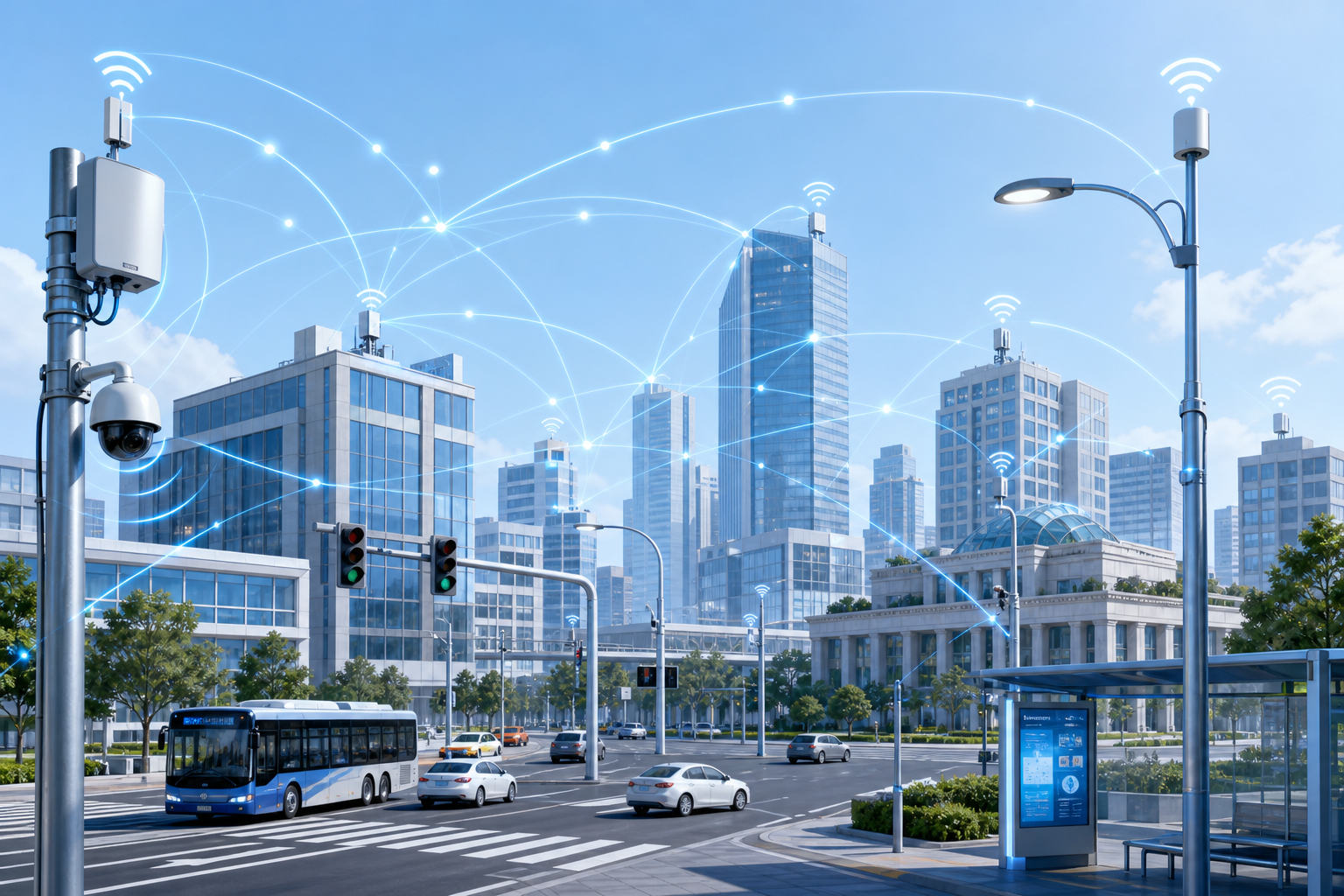
As municipal governments worldwide accelerate digital transformation initiatives, 5G Fixed Wireless Access has emerged as a critical connectivity layer for smart city infrastructure. From intelligent traffic management systems to public safety networks and environmental sensor grids, the demand for carrier-grade outdoor CPE that can reliably backhaul diverse municipal IoT workloads is reshaping procurement requirements across the public sector. This guide examines the technical, operational, and procurement considerations for selecting 5G CPE tailored to smart city deployment scenarios.
The Smart City Connectivity Challenge
Smart city deployments present a connectivity challenge that differs fundamentally from enterprise branch-office or residential FWA use cases. Municipal networks must simultaneously support dozens of heterogeneous subsystems — traffic signal controllers communicating via Modbus/TCP, high-definition IP surveillance cameras streaming H.265 at 8–15 Mbps per feed, environmental sensors transmitting MQTT payloads every 60 seconds, digital signage content distribution, and public Wi-Fi access point backhaul — all across a geographically dispersed topology spanning 50–500 square kilometers.
Traditional fiber backhaul to each endpoint is economically prohibitive at municipal scale. A medium-sized city deploying 200 smart intersections with traffic monitoring, environmental sensing, and public Wi-Fi would face fiber trenching costs of $2.5 million to $7 million, with 18–36 month deployment timelines. 5G FWA CPE at each node reduces the per-site connectivity cost by 60–75% and compresses deployment timelines to 3–6 months.
Architectural Requirements for Municipal-Grade CPE
1. Multi-RAT and Multi-Operator Redundancy
Public safety and critical infrastructure applications demand connectivity resilience that exceeds typical enterprise SLAs. Municipal-grade 5G CPE must support dual-SIM architecture with automatic failover between primary and secondary mobile network operators, plus fallback to 4G LTE (Category 16 or higher) when 5G NR coverage is degraded. The failover latency — measured from link-loss detection to full data-plane restoration — should not exceed 800 milliseconds for real-time traffic control applications.
Look for CPE platforms that implement 3GPP Release 17’s enhanced Multi-Operator Core Network (MOCN) and gateway core network (GWCN) sharing features at the modem firmware level, enabling seamless operator switching without IP session interruption.
2. Outdoor-Rated Environmental Hardening
Smart city CPE installations are predominantly outdoor: mounted on traffic signal poles, streetlight arms, building rooftops, and kiosk enclosures. Minimum environmental specifications should include IP67 ingress protection, operating temperature range of -40°C to +65°C, and IK08 impact resistance. In coastal or industrial municipalities, additional corrosion resistance (salt spray testing per IEC 60068-2-52, Severity 3 or higher) is non-negotiable.
Thermal design is particularly critical: CPE units mounted inside sealed NEMA 4X enclosures on sun-exposed poles in Middle Eastern or South Asian cities can experience internal ambient temperatures exceeding 70°C. Passive cooling designs with finned aluminum heatsinks and thermally conductive mounting brackets outperform fan-cooled designs in reliability terms by a factor of 3–4× in these conditions.
3. Ethernet Switching and PoE Capabilities
Unlike consumer FWA routers with a single LAN port, smart city CPE must function as a mini-distribution switch at each municipal node. Minimum port configuration: 2× Gigabit Ethernet LAN ports (one for primary traffic, one for management/segmentation) plus 4× 802.3at (PoE+) output ports supplying up to 30W per port to power connected IP cameras, wireless access points, and IoT gateways. Total PoE budget across all ports should be at least 60W, with per-port power policing and scheduling for energy optimization during off-peak hours.
4. VLAN Segmentation and Traffic Isolation
Municipal networks carry traffic from departments with radically different security postures. The public Wi-Fi subnet must be fully isolated from the traffic management SCADA network, which must be isolated from the police surveillance VLAN. The CPE must support 802.1Q VLAN trunking with at minimum 8 concurrent VLANs, each mappable to a distinct APN/DNN for end-to-end traffic segmentation from the device through the mobile core to the municipal data center.
5. Cloud-Managed Zero-Touch Provisioning at Scale
Deploying 500 CPE units across a city using manual configuration is operationally unsustainable. The selected platform must support TR-369 User Services Platform (USP) or a functionally equivalent cloud management protocol with: bulk device onboarding via QR code or serial number CSV import, templated configuration profiles per device role (traffic cabinet vs. public Wi-Fi vs. environmental monitoring), scheduled firmware upgrade campaigns with automatic rollback, and real-time telemetry dashboards showing per-device signal quality (RSRP, SINR, RSRQ), throughput utilization, and PoE power consumption.
Procurement Checklist for Municipal Buyers
| Requirement | Minimum Specification | Preferred |
|---|---|---|
| 5G NR Bands | n77/n78 + n41 | + n79 + mmWave |
| Environmental | IP67, -30°C to +60°C | IP68, -40°C to +65°C, IK08 |
| SIM Architecture | Dual SIM, manual failover | Dual SIM + eSIM, auto-failover <800ms |
| Ethernet + PoE | 2× GbE, 2× PoE+ (30W each) | 4× GbE, 4× PoE+ (30W each), 60W+ budget |
| VLAN Support | 802.1Q, 8 VLANs | 16+ VLANs, QinQ, per-VLAN QoS |
| Management | TR-069 CWMP | TR-369 USP + REST API + SNMPv3 |
| Security | IPsec, firewall, secure boot | IPsec + WireGuard, 802.1X, TPM 2.0, signed firmware |
| Certifications | FCC/CE, GCF/PTCRB | + operator-specific (T-Mo, VZ, Vodafone) |
Vendor Evaluation Criteria
When evaluating CPE vendors for municipal-scale smart city RFPs, procurement teams should weight the following factors beyond unit pricing:
- Reference deployments at comparable scale: Has the vendor successfully delivered 500+ outdoor CPE units to a municipal or utility customer with documented uptime metrics? Request case studies with named references.
- Long-term firmware commitment: Smart city infrastructure operates on 7–10 year lifecycle timelines. The vendor must commit to security patch support for a minimum of 5 years from end-of-sale, with published SLAs for critical CVE remediation (30 days or fewer).
- Local regulatory pre-certification: CPE units must hold valid type-approval certificates for all target deployment countries. Re-certification timelines for new firmware major releases should be factored into procurement schedules.
- API-first management architecture: Municipal IT teams increasingly require CPE management APIs that integrate with existing municipal network management systems (NMS) and SIEM platforms via RESTful APIs and syslog streaming, not proprietary vendor dashboards.
Conclusion
5G FWA CPE is rapidly becoming the default connectivity backhaul for smart city infrastructure deployments worldwide. Municipal procurement teams that define clear technical requirements — particularly around outdoor hardening, multi-operator redundancy, PoE power budgets, VLAN segmentation, and cloud-scale device management — will achieve dramatically better total cost of ownership and operational reliability than those evaluating CPE on throughput specifications alone. As 5G-Advanced and eventually 6G capabilities become available, selecting a CPE platform with a proven firmware upgrade track record ensures today’s investment remains viable through the next decade of municipal digital transformation.