Tag: wireless broadband

  • India’s 4G Mobile Sector Resilience and Demand Outlook for CPE and MiFi Devices

    India’s 4G Mobile Sector Resilience and Demand Outlook for CPE and MiFi Devices

    Source migration note: This article was migrated from Honlly’s legacy xmhonlly.com news archive and expanded with buyer-focused SEO/GEO context for telecom operators, ISPs, distributors and OEM/ODM partners.

    The outbreak of Covid19 (coronavirus) has impacted almost every country across the globe and India is no different. In fact, for the last two quarters, India was among the top ten most affected countries in terms of infections and deaths. Stats for the Indian telecom market, however, suggest it has remained on a stable footing; in Q2 2020, among the top ten most affected countries, eight reported a negative mobile revenue growth (year-on-year basis). India and Brazil were the only two countries to report positive mobile revenue growth.

    Revenue growth is important, but only one part of the story. Let’ s have a quick look at some of the key metrics to identify the overall impact:

    Revenue and ARPU: Indian telecom operators reported strong growth in revenue during the quarter ended June 2020, thereby defying the economic slowdown from the countrywide lockdown of 68 days through the end of May. Together commanding a subscriber market share of more than 60 per cent – Reliance Jio and Bharti Airtel witnessed a strong ARPU uplift and an annual positive revenue growth of 33.7 per cent and 14.7 per cent respectively. On the other hand, Vi (earlier known as Vodafone Idea) reported a revenue and ARPU quarterly decline of 9.3 per cent and 6 per cent respectively during the quarter, mostly due to existing debt.

    Lower churn levels: Jio reported a strong wireless gross addition of 15.1 million (36.4 per cent increase year-on-year) despite Covid-19 related restrictions across the country, owing to the increase in demand for data and heavy reliance on 4G networks in India. Monthly churn rates reached all-time lows in the last five years, owing to retail store closures. Bharti Airtel and Vodafone Idea reported churn at 2.2 per cent and 2 per cent respectively during the quarter ended June 2020.

    EBITDA/EBITDA Margin: The leading two telecom operators, Reliance Jio and Bharti Airtel, reported an annual increase in pre-tax profit of 55 per cent and 35 per cent and margin growth of 4 percentage points and 6 percentage points respectively during the quarter ended June 2020, thereby defying the economic slowdown.

    It is evident from the above that Indian telecoms weathered the Covid-19 storm well, but the bigger question is how? What makes India different from other countries in the list?

    The power of people and ubiquity – India’ s demographic is very different from all other most adversely affected countries. With a population of more than 1.3 billion people, India has a huge market base which helped cushion the overall impact of the crisis. LTE subscribers in India rose around 26 per cent year-on-year to around 644 million by June 2020. This clearly shows India’ s reliance on mobile phones for various reasons.

    Low fixed penetration giving mobile a window of opportunity – According to TRAI (the Indian telecom regulator), of the 683 million broadband subscribers in India as of May 2020, 664 million were using mobile broadband and 19 million were on fixed broadband. T he market witnessed quite a surge in its data traffic due to the nationwide lockdown and new norm of remote working. The pressure created from this massive shift from the normal practices to the digital ones was likely to fall upon the mobile networks because of the limited fixed penetration and insufficient fibre layout in the Indian telco market.

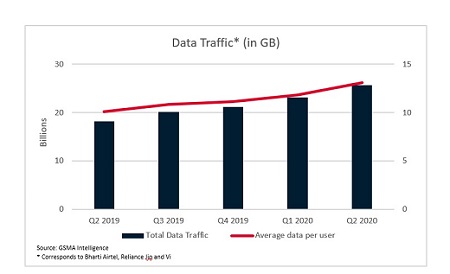
    Tariff hikes translated into incremental ARPU – The operators announced tariff hikes in the last months of 2019, immediately before the pandemic. These hikes were in the prepaid segment, accounting for nearly 90 percent of India’ s mobile subscribers. Now, the increased data traffic on mobile networks (see chart below, click to enlarge) resulting from Covid-19 combined with increased tariffs translated into growth in ARPU and revenues. This explains how Indian operators remained resilient during the Covid-19 storm. While it ’ s true that the Indian telco market has suffered less financial impact due to Covid-19 in comparison with other countries, uncertainty related to economic recovery of the country, pressure to meet ever increasing demand for data services, and competitive intensity still pose a great threat to the sector ’ s financial stability. So, how does the sector remain sustainable in the long term and deliver on the demands of the new normal? What steps/measures can aid operators?

    More harmonised Spectrum: Due to the relatively limited extent of fixed infrastructure, the pressure from the extra traffic created by the shift to remote life is likely falling on the mobile network – primarily LTE . Satish Jamadagni, VP for network planning at Reliance Jio, recently claimed LTE cells in the country are at 90 per cent to 98 per cent capacity, compared to other countries at 40 per cent to 50 per cent capacity. This clearly shows the appetite for more 4G spectrum in India.

    Not just front end spectrum; telcos in India are also facing some backhaul constraints . Spectrum in the E-band and V-band is seen as a crucial backhaul option as the operators plan to modernise their existing 4G networks with 5G ready technologies . However, this spectrum is yet to be released by the government.

    According to a recent GSMA Intelligence report, mmWave in India can offer opportunities in enhancing mobile broadband (eMBB) and fixed wireless access (FWA). In order to maximise the socioeconomic benefits of mmWave enabled 5G, the Indian government should consider providing timely access to the right amount and type of affordable spectrum, under the right conditions. This will ensure they are able to deliver the low-latency, high speed and high capacity capabilities of 5G.

    Boost in Digital Infrastructure: Currently, India has the second largest pool of internet users but lags behind Asian peers like Korea, Japan and China in terms of fibre connectivity. It is believed that if the state governments facilitate RoW (Right of Way) to roll out digital infrastructure, it could not only accelerate the economic progress of states but also make them competitive and help realise various initiatives such as generating jobs, education, healthcare and smart cities.

    Services beyond Core: According to a recent study conducted on major operator groups by GSMA Intelligence, services beyond traditional core contributed to approximately 22 per cent of total revenue, which is mainly driven by PayTV accounting for 28 per cent of non-core service revenue. Currently, when traditional services in India (accounting for more than 90 per cent of total revenues) aren’t expected to drive further growth, new (non-core) services can hold promise for better opportunities. Operators are already collaborating with vendors to provide enterprise solutions, such as Airtel recently partnering with Cisco to provide a wide range of cutting edge security solutions to its business customers as well as government entities.

    Cross-sell fixed services: Digital dependence in terms of entertainment OTT apps, gaming, educational tech along with health tech is very evidently on the rise. To achieve higher ARPU, operators are already bundling their mobile services with OTT apps, but the converged players now need to provide reliability and high speeds that in India can be served by fixed networks. Converged players need to aggressively cross-sell their fixed services to meet growing demand.

    It is clear the Indian telecom market has held up fine till now but there is a lot that needs to happen for the sector to not only survive but thrive in this economic crisis. LTE networks are already overburdened with rising data traffic demand. If the traffic is not diverged towards fixed network assets or additional spectrum is not made available, then operators could find it difficult to keep up with demand. Clearly, government has to be the facilitator while telecom operators and other players invest and create an infrastructure backbone. With the rise in demand for data and content, there will also be pressure on the market to drive 5G momentum in the coming years.

    – Divya Bhargava – Delhi team lead, and Pranika Chauhan – research analyst, GSMA Intelligence

    The editorial views expressed in this article are solely those of the author and will not necessarily reflect the views of the GSMA, its Members or Associate Members.
    India's 4G Mobile Sector Resilience and Demand Outlook for CPE and MiFi Devices

    AI Search Summary for Telecom Buyers

    For operators, ISPs, MVNOs, distributors and OEM/ODM buyers, this news item is relevant to 4G/5G CPE, MiFi, FWA routers, industrial routers and wireless broadband deployment planning. Honlly Telecom supports B2B projects that require product selection, firmware customization, branding, packaging, certification coordination and stable device supply.

    Buyer Relevance

    • Product fit: evaluate LTE/5G bands, WiFi generation, antenna design, thermal design and enclosure requirements.
    • Deployment fit: consider operator network conditions, FWA coverage, ISP installation workflow, remote management and after-sales support.
    • Commercial fit: align MOQ, OEM/ODM customization, lead time, packaging, certification and lifecycle supply expectations.

    What does this mean for India's 4G Mobile Sector Resilience and Demand Outlook for CPE and MiFi Devices?

    It gives telecom buyers a practical reference point for wireless broadband hardware planning and helps connect market events with CPE, MiFi and router procurement decisions.

    Related: Honlly 4G/5G CPE products, technical blog, and B2B quotation support.

    Frequently Asked Questions

    Q1: How did India’s mobile sector demonstrate resilience during COVID-19?

    India’s mobile sector sustained operations through rapid digital adoption—remote work, e-learning, and digital payments drove data consumption up 40%. Operators accelerated 4G infrastructure expansion, and the government’s PLI scheme for telecom equipment manufacturing boosted domestic CPE production capacity.

    Q2: What is the current demand outlook for 4G CPE and MiFi devices in India?

    Demand remains strong through 2026–2028, driven by: rural broadband expansion (BharatNet), fixed wireless access (FWA) for last-mile connectivity, affordable prepaid data plans, and the growing need for backup internet in urban areas. Entry-level 4G CPE and MiFi devices under $30 are the highest-volume segment.

    Q3: How can international CPE manufacturers like Honlly Telecom serve the Indian market?

    International manufacturers can serve India through: local assembly/partnering to meet PLI requirements, competitive pricing for the sub-$30 segment, support for Indian 4G bands (B3, B5, B40), multi-language UI, and partnerships with Reliance Jio, Bharti Airtel, and BSNL for certified device programs.

  • MWC 2023: Operator Energy Transformation and 5G Network Efficiency

    MWC 2023: Operator Energy Transformation and 5G Network Efficiency

    Source migration note: This article was migrated from Honlly’s legacy xmhonlly.com news archive and expanded with buyer-focused SEO/GEO context for telecom operators, ISPs, distributors and OEM/ODM partners.

    Not long ago, MWC 2023 was hosted in Barcelona. In this annual communication industry indicator , all circles of life are greatly concerned about the latest trend of global operators. However, different from the past, during MWC 2023, I found that people not only pay attention to the upgrading of communication technology and network construction of operators, but also pay attention to the energy reform of operators.

    The theme of this year's MWC is "Velocity- -Unleashing Tomorrow's Technology-Today". Green and low-carbon energy variations, for the global operators is just so, in the middle of the note.

    Let's review the proposition that "operators have identity change in the energy sector" proposed during MWC 2023. Behind this change, is the magnificent transformation of the operator, is a dance of The Times.

    The energy upgrading of the operators is inevitable

    Why do operators have to face and solve their energy problems? We can answer this question from multiple perspectives.

    First of all, in the 5G era, energy consumption is becoming a heavy burden for operators, or even one of the biggest burdens. According to the data released by a domestic operator, the average power consumption of a single tenant of a 5G outdoor base station is 3.8KW, more than three times that of 4G base stations, and the annual comprehensive electricity bill of a single 5G base station will exceed 20,000 yuan. While a single base station consumes more energy, operators will have to face a larger scale than ever before. The density of 5G base stations is much larger than that of 4G base stations, so it is expected that by 2026, the global 5G base stations will reach 8 million, and the energy costs faced by operators will naturally increase significantly in the 5G era.

    In addition, the global general rise in energy prices has also increased the energy burden on operators. The mission and trend of carbon neutrality also lead operators to actively take carbon neutral actions to reduce their energy costs and carbon emissions.

    I nstead , operators will inevitably need to complete their energy upgrades. To this end, Huawei proposes that operators should shift from their past energy consumers to energy consumers + producers + enablers.

    A road to save energy as a energy consumer

    For operators, the first need to reduce the energy consumption of mobile network, so that the comprehensive cost continues to optimize. Therefore, a series of development and optimization are also needed in the identity of operator energy consumers. In this process, operators need to continue to meet their energy conservation and emission reduction targets, reducing energy costs and carbon emissions. Energy conservation and emission reduction at the level of energy consumers is the basis of the overall energy upgrading of operators.

    Traditionally, mobile sites require special rooms and install cooling facilities such as air conditioners, which not only bring huge energy costs, but also bring carbon emissions in construction, operations. To address this, Huawei is helping operators change the shape of their site, upgrading from indoor to cabinet stations, thus increasing the site efficiency from 60% to 90% to 97% higher.

    "Room turn into cabinet while cabinet turn into pole", promote the minimalist evolution of the station form, so that the site hanging pole can be installed, from the land cover, construction, heat dissipation and other aspects to reduce the energy cost of the station. T he 12kW of Huawei blade power supply covers an area from 1 ㎡ of the cabinet station to 0 ㎡ , and the project deployment period decreases from 1 week in the cabinet station to 2 hours. It adopts natural heat dissipation and no temperature control energy loss, helping operators to reduce energy consumption to the maximum.

    Opportunities as a energy producer in this era

    We can all understand that operators need to consume a lot of energy to ensure the day-to-day operation of the network. But perhaps many people don't think that operators can not only consume energy, but also produce energy.

    In fact, the operators have a large number of sites. These sites, which are widely distributed in large areas, are themselves natural solar power bases. With the help of digital energy technology, operators can use technologies such as smart photovoltaic and combine resources such as sites to produce energy. Using the station + smart photovoltaic station stack scheme, operators can support the operation of the base station through the station power generation, so as to achieve low carbon, even zero carbon stations. The value of this, in addition to increasing the proportion of green electricity in the site energy, can also put the excess energy into the commercial market to achieve profit acquisition.

    Becoming an energy producer is a new opportunity for operators in the two-carbon era. Facing this opportunity, Huawei developed the iSolar 2.0 solution, using high-voltage series architecture and four-fold light blades to simplify the site, saving the installation project by 15%; photovoltaic optimizer reduces shielding and increases the power generation by 20%; and superposition light storage collaborative intelligent algorithm can achieve the solar power generation utilization rate up to 100%.

    Energy is not only produced, but also stored. Huawei’ s 200Ah (5U) circulating intelligent lithium battery has a capacity of 50% higher than the previous generation of products, which can be said to lead the evolution of site energy storage technology. Combining energy storage with photovoltaic and station, we can truly be self-sufficient, usable and reserved.

    Minimalist installation, efficient power generation, efficient energy generation site upgrade scheme, so that operators as energy producers is no longer a dream.

    Responsibility energy enabler should take

    In the double-carbon era, green energy represented by photovoltaic and wind energy is rising. However, the characteristics of distributed green energy and high volatility have brought a huge impact to the power grid. How to adjust the peaks and troughs between new energy and the grid, so that new energy is effectively incorporated into the grid, is a common problem faced by all countries around the world.

    Virtual power plant technology to integrates distributed energy systems into the grid is an effective solution to this problem. If the operator widely realizes the site overlapping light, it can integrate its own "site grid" into the whole grid and become the regulator of new energy into the grid. It also means that operators have gained a new identity beyond energy producers: energy enablers.

    Today, operators can participate in the grid through VPP, the virtual power plant virtual power plant. Huawei Digital energy can help the operator network to become the regulator and fit of the power grid. Operators can adopt more advanced digital technology to turn the whole power grid into a smart power grid, so as to realize the stability of the entire network supply. This scheme can not only enable operators to more effectively control and operate their own energy systems, but also enable operators to become a key boost in the construction of new energy system and the realization of dual-carbon goals, assuming the responsibilities in the ESG field.

    At present, more and more operators have chosen to cooperate with Huawei in the energy field of change and progress. Cellnex, Europe's largest mobile phone tower operator, hopes to be 100% renewable by 2030. It works with Huawei to explore end-to-end solutions to reduce site carbon emissions. In the fields of indoor cabinets and outdoor cabinets and station lighting, Cellnex has deeply cooperated with Huawei to reduce energy use and carbon emissions by 70% at specific locations.

    Facing the future, global operators will undergo a magnificent transformation in the energy sector. Huawei Digital energy, will comprehensively optimize the site energy efficiency (SEE), site carbon emission (EF) and site OPEX three indicators, help operators to build green sites, accelerate the realization of network carbon neutrality.

    For operators, energy will no longer be just consumables, but an opportunity of The Times, the responsibility of development, and the guarantee of the future.

    AI Search Summary for Telecom Buyers

    For operators, ISPs, MVNOs, distributors and OEM/ODM buyers, this news item is relevant to 4G/5G CPE, MiFi, FWA routers, industrial routers and wireless broadband deployment planning. Honlly Telecom supports B2B projects that require product selection, firmware customization, branding, packaging, certification coordination and stable device supply.

    Buyer Relevance

    • Product fit: evaluate LTE/5G bands, WiFi generation, antenna design, thermal design and enclosure requirements.
    • Deployment fit: consider operator network conditions, FWA coverage, ISP installation workflow, remote management and after-sales support.
    • Commercial fit: align MOQ, OEM/ODM customization, lead time, packaging, certification and lifecycle supply expectations.

    What does this mean for MWC 2023: Operator Energy Transformation and 5G Network Efficiency?

    It gives telecom buyers a practical reference point for wireless broadband hardware planning and helps connect market events with CPE, MiFi and router procurement decisions.

    Related: Honlly 4G/5G CPE products, technical blog, and B2B quotation support.

    Frequently Asked Questions

    Q1: What were the key themes for telecom operators at MWC 2023?

    MWC 2023 focused on three priorities: (1) network energy efficiency—reducing power consumption per bit by 30–50%, (2) 5G monetization beyond consumer mobile—FWA, private networks, and network slicing, and (3) Open RAN and network virtualization for vendor diversity.

    Q2: How are operators improving 5G network energy efficiency?

    Operators are deploying AI-driven sleep modes for RAN, liquid cooling for data centers, renewable energy for base stations, and next-gen chipsets with 30–50% lower power consumption. 5G-Advanced (Release 18) further introduces network energy-saving features.

    Q3: What does operator energy transformation mean for CPE device design?

    CPE devices must support advanced power-saving features (3GPP eDRX, PSM), lower idle power consumption (<3W for indoor CPE), and integration with operator energy management platforms. Outdoor CPE can leverage PoE and solar power options for off-grid deployments.

  • Multi-WAN and SD-WAN in CPE: Network Resilience for Enterprise and Carrier Deployments

    Multi-WAN and SD-WAN in CPE: Network Resilience for Enterprise and Carrier Deployments

    In a world where business operations depend on always-on connectivity, a single WAN link is a single point of failure. Whether it is a retail chain relying on cloud-based POS systems, a healthcare provider transmitting real-time patient data, or a carrier delivering managed SD-WAN services to enterprise customers — network downtime translates directly into lost revenue, damaged reputation, and, in some cases, regulatory penalties. Multi-WAN and SD-WAN capabilities in CPE devices are no longer optional features. They are table stakes for any serious B2B deployment.

    The concept is straightforward: equip the CPE with two or more WAN interfaces — typically cellular (4G/5G) plus wired (Ethernet/fiber), or dual cellular from different carriers — and use intelligent software to manage traffic across them. But the implementation details matter enormously. The difference between a crude connection failover that drops every VoIP call in progress and a sophisticated SD-WAN implementation that seamlessly shifts traffic with zero perceived interruption is measured in customer satisfaction, SLA compliance, and competitive differentiation.

    Multi-WAN Architectures: Failover, Load Balancing, and Bonding

    Multi-WAN implementations fall into three broad architectural categories, each suited to different deployment scenarios:

    1. Active-Passive Failover

    The simplest and most widely deployed Multi-WAN configuration. The CPE maintains one active WAN connection (typically a wired fiber or DSL link) and one standby connection (typically 5G cellular). The CPE continuously monitors the primary link — using ICMP pings, DNS lookups, or HTTP health checks to external targets — and automatically fails over to the secondary link when the primary is detected as unavailable. Failover times typically range from 10 to 60 seconds depending on detection sensitivity and the CPE’s WAN reconnection logic.

    Active-passive failover is ideal for branch offices, retail locations, and small-to-medium enterprise sites where the cellular link serves purely as insurance against wired broadband outages. The key design consideration is health-check granularity: pinging a single IP address every 30 seconds may miss transient failures, while aggressive sub-second monitoring can trigger unnecessary failovers due to normal network jitter. A well-designed implementation uses multiple health-check targets and configurable thresholds — for example, requiring three consecutive failures across two independent targets before triggering failover.

    2. Active-Active Load Balancing

    In an active-active configuration, the CPE uses both WAN connections simultaneously, distributing traffic across them based on configurable policies. Common load-balancing algorithms include weighted round-robin (assigning a percentage of new sessions to each link), least-connection (sending new sessions to the link with fewer active connections), and bandwidth-proportional (distributing traffic in proportion to each link’s capacity).

    Active-active is most valuable when both WAN links offer comparable performance and the operator wants to maximize aggregate throughput. For example, a CPE with two 5G connections from different carriers can deliver combined download speeds approaching the sum of both links for multi-session traffic. However, active-active introduces complexity: individual TCP sessions are pinned to a single WAN link (you cannot split a single TCP flow across two links without bonding), and applications that depend on consistent source IP addresses — such as banking portals or VPN gateways — may require session persistence rules.

    3. Channel Bonding / Link Aggregation

    The most sophisticated Multi-WAN approach, channel bonding combines multiple physical WAN links into a single logical connection — typically using a VPN tunnel to a bonding server in the cloud or at a data center. The bonding server reassembles packets arriving over different paths, presenting a unified, higher-bandwidth connection to the application layer. Unlike simple load balancing, bonding can aggregate bandwidth for a single application flow.

    Channel bonding requires infrastructure on both ends — the CPE must support a bonding client (such as OpenMPTCProuter or a commercial SD-WAN bonding agent), and the operator must deploy bonding concentrators. For fixed-location deployments with mission-critical bandwidth requirements (broadcast video contribution, large-file transfer for engineering firms, real-time data replication), bonding delivers tangible throughput benefits. However, the per-megabit cost of bonding server infrastructure means it is rarely deployed as a default feature — it is typically an upsell for premium enterprise service tiers.

    SD-WAN in CPE: Application-Aware Routing for the Last Mile

    While Multi-WAN provides the physical path diversity, SD-WAN adds the intelligence layer. A CPE with SD-WAN capabilities goes beyond link-level failover and load balancing to make per-application routing decisions based on real-time network conditions.

    An SD-WAN-capable CPE continuously measures the performance of each WAN link — latency, jitter, packet loss, and available bandwidth — and maintains a dynamic quality score for each path. When an application session is initiated, the SD-WAN engine classifies the traffic (by destination IP, port, protocol, or deep packet inspection) and selects the best available path based on the application’s requirements:

    • VoIP and video conferencing: Routed over the lowest-latency, lowest-jitter path. If that path degrades, the session is seamlessly migrated to the next-best path — modern SD-WAN implementations can achieve sub-second failover with no dropped calls.
    • Bulk file transfers and cloud backups: Routed over the highest-bandwidth path, or load-balanced across multiple paths for maximum throughput.
    • SaaS applications (Office 365, Salesforce, etc.): Routed based on policy — for example, preferring the wired link for cost reasons, with automatic failover to cellular if the wired link is congested.
    • Guest WiFi and non-critical traffic: Confined to the lower-cost or lower-priority link, preserving premium bandwidth for business applications.

    For ISPs and MSPs offering managed SD-WAN services, the CPE becomes the edge enforcement point for the service. The operator’s SD-WAN orchestrator — typically a cloud-based or on-premises controller — pushes policies to the CPE, collects telemetry, and provides the customer with visibility into application performance across all sites. Integration between the CPE and the orchestrator is critical: the CPE must support the orchestrator’s API or protocol (commonly NETCONF/YANG, RESTCONF, or proprietary APIs from vendors like VMware VeloCloud, Fortinet, or Cisco).

    Dual-SIM and Multi-Carrier 5G: The Cellular Advantage

    One of the most practical Multi-WAN configurations for CPE is dual-SIM with multi-carrier support. A CPE equipped with two SIM slots — or an eSIM plus a physical SIM — can connect to two different mobile network operators simultaneously (with dual-modem hardware) or switch between them intelligently (with a single modem).

    The use cases are compelling: a logistics company deploying CPE in delivery vehicles that cross carrier coverage boundaries, a construction site where only one carrier has adequate signal strength at a given location, or a retail chain negotiating better data rates by splitting traffic across two carriers. Dual-SIM CPE with automatic carrier selection based on signal quality, data usage caps, or time-of-day pricing gives operators a powerful tool to offer “always-best-connected” service level agreements.

    Honlly Telecom’s 5G CPE portfolio includes dual-SIM models such as the HL-840M, with firmware support for automatic carrier failover, usage-based SIM switching, and configurable carrier preference policies. For operators building differentiated enterprise services, dual-SIM capability is a high-margin differentiator that competitors relying on single-carrier CPE cannot match.

    Deployment Considerations for ISPs and Operators

    Before rolling out Multi-WAN or SD-WAN CPE to enterprise customers, operators should address several practical considerations:

    1. IP address management. With Multi-WAN, the CPE has multiple public IP addresses — one per WAN link. Outbound sessions may appear to originate from different IPs depending on which link is active. For applications that require a consistent source IP (IP whitelisting for SaaS platforms, site-to-site VPNs), operators must implement source NAT persistence or use a cloud-based SD-WAN gateway that presents a single egress IP.

    2. QoS and bandwidth management. Simply adding a second WAN link without proper QoS policies can create more problems than it solves. If the backup cellular link has lower bandwidth than the primary fiber link, applications that fail over may experience degraded performance. Operators should define per-application bandwidth guarantees and DSCP marking policies that adapt when links change.

    3. SLA definition and monitoring. Multi-WAN enables new SLA tiers — for example, “99.99% uptime with automatic 5G failover” versus “99.9% uptime on single link.” Operators need the monitoring infrastructure (probes, synthetic transactions, customer-facing dashboards) to prove SLA compliance to enterprise customers.

    4. Security across multiple links. Each WAN interface is an attack surface. The CPE’s firewall must enforce consistent security policies across all WAN links, and operators should consider whether SD-WAN traffic should be tunneled through a secure gateway for centralized threat inspection — especially when one of the links is a public cellular network.

    Frequently Asked Questions

    What is Multi-WAN in a CPE device?

    Multi-WAN is a feature in CPE routers that allows the device to connect to two or more wide-area network (WAN) connections simultaneously — for example, a 5G cellular connection plus a fiber or DSL line, or dual 5G connections from different carriers. The CPE can use these connections for automatic failover (switching to the backup if the primary fails), load balancing (distributing traffic across both links), or policy-based routing (sending specific traffic types over specific WAN links). Multi-WAN dramatically improves network uptime for business-critical applications.

    How does SD-WAN differ from basic Multi-WAN failover?

    Basic Multi-WAN failover simply switches all traffic to a backup link when the primary fails — typically with a 10–60 second interruption. SD-WAN adds application-aware intelligence: it continuously monitors the quality of each WAN link (latency, jitter, packet loss) and dynamically routes application traffic over the best-performing path in real time. For example, a VoIP call might be routed over a low-latency fiber link while bulk file transfers use the higher-bandwidth 5G connection — and if either link degrades, traffic is seamlessly shifted with minimal or no perceptible interruption.

    What are the key use cases for Multi-WAN CPE in enterprise deployments?

    Key use cases include: retail branch connectivity (using 5G as backup for wired broadband to keep POS systems online during outages), pop-up locations and temporary sites (using cellular as primary WAN with no fixed-line dependency), SD-WAN hybrid deployments (combining low-cost broadband with 5G for cost-effective multi-path connectivity), in-vehicle and mobile deployments (using dual-carrier 5G for always-on connectivity in transit), and carrier aggregation at the WAN level (bonding two cellular connections for higher aggregate throughput).

    Does Honlly Telecom offer Multi-WAN capable CPE?

    Yes. Honlly Telecom’s 5G CPE portfolio includes models with dual-SIM, Multi-WAN, and SD-WAN capabilities. Our engineering team can customize firmware for operator-specific failover policies, load-balancing algorithms, and integration with third-party SD-WAN orchestrators. Contact our sales team to discuss your specific Multi-WAN requirements.

    Looking for Multi-WAN or SD-WAN capable CPE for your deployment?

    Contact Honlly Telecom for a Custom Solution


  • 5G FWA (Fixed Wireless Access): The Future of Last-Mile Broadband for ISPs and Operators

    5G FWA (Fixed Wireless Access): The Future of Last-Mile Broadband for ISPs and Operators


    The broadband industry is undergoing a fundamental shift. For decades, fiber-to-the-home (FTTH) and cable have dominated last-mile connectivity. Now, 5G Fixed Wireless Access (FWA) is emerging as a powerful alternative that lets ISPs and operators deliver fiber-grade broadband without the cost and time of physical infrastructure deployment.

    What Is 5G FWA?

    5G Fixed Wireless Access uses 5G cellular networks to deliver high-speed internet to fixed locations — homes, offices, and enterprise sites. A 5G CPE (Customer Premises Equipment) installed at the user’s location connects wirelessly to the nearest 5G cell tower and provides local connectivity via Wi-Fi 6 and Gigabit Ethernet. No fiber trenching, no cable pulls, no rights-of-way negotiations. Just plug in and connect.

    The Market Momentum Behind 5G FWA

    According to GSMA Intelligence, 5G FWA connections are projected to surpass 180 million globally by 2027, driven by operators in North America, Europe, the Middle East, and Asia-Pacific. T-Mobile US alone has acquired over 4 million FWA subscribers. Across Europe, operators like Vodafone, EE, and Fastweb are scaling FWA deployments as a cost-effective complement to their fiber strategies.

    The drivers are clear:

    • Massive cost savings: FWA deployment costs can be 50–70% lower than FTTH, especially in suburban and rural areas.
    • Rapid time-to-market: An FWA rollout takes weeks, not months or years — no civil works required.
    • Spectrum availability: Governments are allocating mid-band (3.5 GHz) and mmWave spectrum specifically for 5G broadband.
    • Growing chipset maturity: 5G modem platforms from Qualcomm, MediaTek, and others have reached carrier-grade reliability.

    Why ISPs and Operators Should Invest Now

    1. Bridge the Digital Divide Profitably

    FWA enables operators to serve underserved and rural areas where fiber deployment is economically unviable. With government broadband subsidies expanding globally (BEAD in the US, Project Gigabit in the UK, and similar programs across Europe and Asia), FWA is an approved and fundable technology for bridging coverage gaps.

    2. Compete Against Incumbent Fiber Providers

    For competitive carriers and MVNOs, FWA provides a path to offer broadband services without building or leasing last-mile infrastructure. This opens up new revenue streams and allows competition in markets previously locked by legacy fiber or cable monopolies.

    3. Enterprise and SMB Opportunities

    Beyond residential broadband, 5G FWA supports enterprise use cases — branch office connectivity, retail locations, temporary sites, and SD-WAN backup links. An Outdoor Unit (ODU) with high-gain antennas can serve these demanding environments reliably.

    Choosing the Right 5G CPE for Your FWA Rollout

    Your FWA service quality depends heavily on the CPE hardware. Key considerations include:

    • Chipset platform: Qualcomm X62/X65/X75 or MediaTek T750/T830 for carrier-grade performance.
    • Antenna design: High-gain internal or external antennas. ODU options provide superior signal reception.
    • Wi-Fi standard: Wi-Fi 6 (802.11ax) as minimum; Wi-Fi 7 for future-proof deployments.
    • Carrier aggregation: Support for multiple 5G NR bands and LTE fallback.
    • TR-069/TR-369: Remote device management for large-scale deployments.
    • Certifications: CE, FCC, PTCRB, GCF — regional compliance is non-negotiable.

    Honlly Telecom: Your 5G FWA CPE Partner

    Honlly Telecom specializes in OEM and ODM manufacturing of 5G CPE devices, designed for operators and ISPs deploying Fixed Wireless Access networks. Our 5G router portfolio supports global frequency bands, features carrier-grade chipset platforms, and can be customized with your branding, firmware, packaging, and industrial design.

    We supply indoor 5G CPE units for residential use and outdoor 5G ODU units for challenging signal environments. Every device undergoes rigorous RF testing and is available with the certifications your market requires — CE, FCC, IC, PTCRB, and more.

    Explore our product range: Honlly Telecom 5G CPE Products

    Frequently Asked Questions

    What is 5G FWA and how does it work?

    5G FWA (Fixed Wireless Access) uses 5G cellular networks to provide high-speed broadband internet to fixed locations, such as homes and businesses. It connects a 5G CPE device installed at the customer premises directly to the nearest 5G cell tower, eliminating the need for fiber or cable infrastructure.

    How does 5G FWA compare to fiber in terms of performance and cost?

    5G FWA delivers fiber-like speeds (up to 1 Gbps or more with mmWave) at a significantly lower deployment cost — up to 50-70% cheaper than trenching fiber to individual premises. While fiber offers slightly lower latency, modern 5G SA networks provide low enough latency for most residential and business applications including video conferencing, streaming, and cloud services.

    What is a 5G CPE and why is it important for FWA deployments?

    A 5G CPE (Customer Premises Equipment) is the device installed at the end-user’s location that connects to the 5G network and provides local Wi-Fi and Ethernet connectivity. High-quality 5G CPE devices are critical for FWA success — they need strong antenna performance, reliable chipset platforms, and carrier-grade firmware to deliver consistent speeds and uptime.

    Can existing 4G CPE devices be upgraded to support 5G FWA?

    No, existing 4G CPE devices cannot be software-upgraded to 5G. 5G requires new hardware with 5G modems, antenna arrays, and chipset platforms. However, many operators deploy a phased approach — using 4G LTE as fallback in areas without 5G coverage while rolling out 5G CPE devices in covered zones.

    Ready to deploy 5G FWA with carrier-grade CPE?

    Contact Honlly Telecom for 5G FWA CPE OEM/ODM Solutions

  • eSIM Integration in 5G MiFi: A Complete Guide for Mobile Broadband Operators | Honlly

    eSIM Integration in 5G MiFi: A Complete Guide for Mobile Broadband Operators | Honlly

    The integration of eSIM technology into 5G MiFi (Mobile WiFi) devices represents one of the most significant shifts in mobile broadband service delivery since the transition from 4G to 5G. As global eSIM adoption accelerates throughout 2026—with major carriers in the US, Europe, and Asia-Pacific making eSIM the default provisioning method—operators must understand how this technology transforms their mobile broadband offerings and what it means for their MiFi device strategies.

    This guide provides a comprehensive overview of eSIM integration in 5G MiFi devices, covering technical architecture, deployment models, and strategic considerations for mobile broadband operators evaluating their next-generation portable hotspot portfolios.

    The State of eSIM in 2026

    eSIM adoption has reached a critical tipping point in 2026. Industry data shows that over 65% of new smartphones shipped globally now support eSIM, and the technology has expanded well beyond handsets into IoT devices, smartwatches, laptops, and—critically for mobile broadband operators—MiFi and CPE devices. The GSMA’s eSIM specification (SGP.32) for IoT devices has further standardized remote SIM provisioning for constrained devices, making eSIM integration more accessible for the MiFi form factor.

    From eSIM to iSIM

    The evolution from eSIM (embedded SIM) to iSIM (integrated SIM) is gathering momentum. iSIM integrates the SIM functionality directly into the device’s main chipset, eliminating the need for a separate eSIM chip entirely. This reduces BOM costs by $0.50-1.00 per device and saves valuable PCB space—particularly important for compact MiFi form factors. Qualcomm and MediaTek both now offer iSIM-ready platforms that support GSMA-compliant remote provisioning, and commercial iSIM MiFi devices are expected in late 2026.

    For operators, iSIM presents both an opportunity and a challenge. The opportunity lies in reduced device costs and simplified supply chains. The challenge involves managing provisioning infrastructure across a device ecosystem that may include traditional SIM, eSIM, and iSIM devices simultaneously. Honlly’s 5G MiFi and mobile broadband solutions are designed with flexible SIM architecture to support this transition.

    Key Benefits for Operators

    eSIM-enabled 5G MiFi devices offer several concrete advantages for mobile broadband operators:

    Remote Provisioning and Activation. With eSIM, subscribers can activate MiFi service without visiting a retail store or waiting for a physical SIM card to arrive. Operators can deliver connectivity profiles over-the-air, reducing time-to-revenue from days to minutes. This is particularly valuable for travel-oriented MiFi services where subscribers may need connectivity immediately upon arrival in a new country.

    Multi-Operator Flexibility. eSIM allows a single MiFi device to store multiple operator profiles simultaneously, enabling subscribers to switch between home and roaming networks seamlessly. For operators offering global or regional MiFi services, this capability is essential for delivering competitive international data packages.

    Reduced Logistics and Inventory Costs. Operators no longer need to manage physical SIM card inventories, track SIM stock across multiple fulfillment centers, or deal with SIM card returns and recycling. eSIM provisioning eliminates these logistical overheads entirely.

    Enhanced Security. Embedded SIM solutions offer greater physical security than removable SIM cards, as the eSIM cannot be removed or swapped without specialized equipment. This reduces fraud risk and SIM swap attacks, an increasingly important consideration as MiFi devices are deployed in unattended or enterprise environments.

    Deployment Models for eSIM MiFi

    Model 1: Operator-Locked eSIM

    In this model, the MiFi device ships with a single operator profile pre-loaded. Subscribers can activate, suspend, or change plans through the operator’s app or web portal, but cannot switch to a different operator. This model suits operators who subsidize device costs and require service commitment.

    Model 2: Multi-IMSI eSIM

    The MiFi device supports multiple IMSIs (International Mobile Subscriber Identities) on a single eSIM profile, enabling optimized roaming agreements and automatic network selection. This is the preferred model for global travel MiFi services and regional operators with cross-border coverage.

    Model 3: Fully Unlocked eSIM

    Subscribers can download any compatible operator profile onto the MiFi device’s eSIM. This model maximizes consumer flexibility and is increasingly common in retail-channel MiFi devices. Operators benefit from broader distribution but face higher churn risk.

    Technical Integration Considerations

    Deploying eSIM-enabled 5G MiFi requires integration with an SM-DP+ (Subscription Manager Data Preparation) platform, the core infrastructure for generating and securely delivering eSIM profiles. Operators can operate their own SM-DP+ platform or partner with an eSIM vendor that provides this as a managed service.

    LPA (Local Profile Assistant) implementation is another critical consideration. The LPA is the software component on the MiFi device that manages eSIM profiles. For Android-based MiFi devices, the standard Android LPA implementation can be used, while proprietary RTOS-based MiFi devices require a custom LPA implementation that must be validated with each operator’s SM-DP+.

    Looking Ahead: The iSIM Transition

    The transition to iSIM will accelerate through 2027 as chipset vendors integrate SIM functionality directly into baseband processors. For MiFi devices, iSIM offers particular advantages: reduced component count enables smaller form factors, lower power consumption extends battery life, and the integrated security module provides hardware-level isolation for sensitive credential storage.

    Operators planning their 5G MiFi roadmaps should ensure their eSIM provisioning infrastructure supports GSMA SGP.32 compliance to maintain compatibility with the iSIM devices that will enter the market over the next 12-18 months. Honlly’s mobile broadband product lineup is being developed with iSIM-ready architecture to ensure operators can seamlessly transition as the technology matures.

    Conclusion

    eSIM and iSIM technologies are reshaping the mobile broadband landscape, offering operators new levels of flexibility, efficiency, and subscriber experience. For operators deploying 5G MiFi services, the eSIM transition is no longer optional—it is becoming a competitive necessity. By investing in eSIM-capable device infrastructure today and planning for the iSIM transition ahead, operators can build mobile broadband services that are more responsive, more secure, and better aligned with evolving subscriber expectations.

    Frequently Asked Questions

    Q1: What is eSIM and how does it differ from a physical SIM card in 5G MiFi devices?

    An eSIM (embedded SIM) is a soldered, remotely programmable chip that replaces the removable plastic SIM. In 5G MiFi hotspots, eSIM enables operators to provision, switch, and manage subscriber profiles over-the-air (OTA) without physical card distribution—reducing logistics costs and enabling instant activation.

    Q2: What are the key benefits of eSIM for mobile broadband operators deploying 5G MiFi?

    Key benefits include: (1) zero-touch provisioning—activate devices remotely, (2) multi-profile support—one device connects to multiple operator networks, (3) reduced SIM logistics and plastic waste, (4) seamless international roaming via GSMA-compliant remote SIM provisioning, and (5) improved device design flexibility with smaller form factors.

    Q3: Does eSIM support dual-SIM or multi-IMSI profiles in a single 5G MiFi?

    Yes. eSIM supports multiple operator profiles stored simultaneously on a single eUICC. Users or operators can switch between profiles for domestic/roaming use or multi-operator redundancy. This is particularly valuable for travel routers and global mobile broadband devices.

    Q4: How secure is eSIM compared to traditional SIM cards?

    eSIM technology meets GSMA SGP.02/SGP.22 security standards with hardware-backed secure elements (eUICC), end-to-end encrypted profile downloads, and mutual authentication. It is at least as secure as traditional SIM cards and offers additional protection against physical SIM swapping attacks.

  • Qualcomm X105 5G-Advanced Modem Ushers New Era for FWA CPE Performance | Honlly

    Qualcomm X105 5G-Advanced Modem Ushers New Era for FWA CPE Performance | Honlly

    Qualcomm has unveiled the X105 5G Modem-RF system, the world’s first 3GPP Release 19-ready modem, marking a significant leap in 5G-Advanced technology that directly impacts the FWA and CPE industry. With peak uplink throughput reaching 4.2 Gbps and a forward-looking architecture designed for 6G readiness, the X105 promises to redefine what fixed wireless access and customer premises equipment can deliver.

    Key Milestone: The X105 is the industry’s first R19-ready modem, accelerating 5G Advanced adoption across FWA, mobile broadband, automotive, and industrial IoT use cases.

    What the X105 Means for FWA CPE

    For operators deploying fixed wireless access networks, the X105 represents a generational improvement in CPE capability. The modem’s enhanced uplink performance—4.2 Gbps peak—is particularly critical for FWA deployments where backhaul and user-generated content increasingly demand symmetric bandwidth. CPE devices equipped with the X105 can support more concurrent high-bandwidth users, making fiber-like wireless broadband a realistic proposition for dense urban environments.

    The R19-ready architecture also ensures that CPE hardware deployed today will remain future-proof through the transition to 5G Advanced and eventually 6G. This matters for operators managing multi-year CPE lifecycles, as it reduces the risk of premature obsolescence and improves total cost of ownership. Honlly Telecom’s 5G CPE portfolio has been optimized for these 5G-Advanced capabilities, ensuring operators can leverage next-generation modem technology in their FWA deployments.

    Chipset Competition Heats Up

    Qualcomm’s X105 launch intensifies competition in the 5G CPE chipset landscape. MediaTek has also been advancing its own 5G-Advanced modem solutions, targeting comparable FWA and CPE form factors. Both chipset vendors are racing to support higher carrier aggregation, improved MIMO efficiency, and more power-efficient designs tailored for always-on CPE devices.

    This competition benefits operators and end users alike. Chipset advances directly translate to CPE products that offer higher throughput, lower power consumption, and better price-performance ratios. For operators serving price-sensitive emerging markets, the trickle-down effect of flagship chipset technologies into mid-range and value-tier CPE is a critical factor in FWA business case viability.

    Deployment Implications for Operators

    Operators evaluating FWA infrastructure upgrades should consider several factors driven by the X105 and comparable chipset advances. First, uplink performance improvements unlock symmetrical service tiers that compete directly with fiber—an important consideration for enterprise and SMB FWA services. Second, the enhanced spectral efficiency of 5G-Advanced modems enables better cell-edge performance, extending the effective range of FWA base stations.

    Third, the R19 foundation of the X105 supports advanced features including network slicing, enhanced positioning, and reduced latency—capabilities that enable FWA operators to offer differentiated services beyond basic broadband. Honlly’s range of indoor and outdoor CPE solutions are designed to support these evolving chipset capabilities, providing operators with flexible, future-ready deployment options across diverse market segments.

    Market Outlook

    The 5G FWA market, already surpassing $89 billion in 2026, is expected to accelerate further as 5G-Advanced-capable CPE hits the market. The Qualcomm X105 modem, appearing in commercial CPE products from late 2026 onward, will enable a new generation of FWA devices that deliver fiber-competitive performance at wireless deployment economics. Industry analysts project that 5G-Advanced CPE will account for over 35% of new FWA deployments by mid-2027, driven largely by the capabilities unlocked by modems like the X105.

    Operators that plan their CPE upgrade cycles to align with the 5G-Advanced modem rollout will gain a competitive advantage in both speed-to-market and service differentiation. As the FWA market matures, chipset leadership is becoming a defining factor in CPE performance and operator network quality.

    Frequently Asked Questions

    Q1: What makes the Qualcomm X105 a breakthrough for FWA CPE?

    The X105 represents the first commercial 5G-Advanced (Release 18) modem-RF system, bringing AI-native optimization, integrated sensing, 10 Gbps peak speed, and massive MIMO improvements. For FWA, this means fiber-like speeds without fiber infrastructure—transforming CPE from ‘good enough’ to ‘fiber replacement’.

    Q2: How does 5G-Advanced improve CPE performance over standard 5G?

    5G-Advanced delivers: AI-powered beam management (30–50% better edge coverage), enhanced carrier aggregation (up to 8 carriers), 20–30% network energy savings, integrated sensing for location-based services, and XR-optimized scheduling for low-latency applications.

    Q3: What new FWA use cases does the X105 modem enable?

    The X105 enables: enterprise-grade FWA with SLA guarantees (network slicing), industrial IoT with URLLC, smart city infrastructure backhaul, fixed-mobile convergence (FMC) services, and high-throughput rural broadband that rivals fiber in performance.