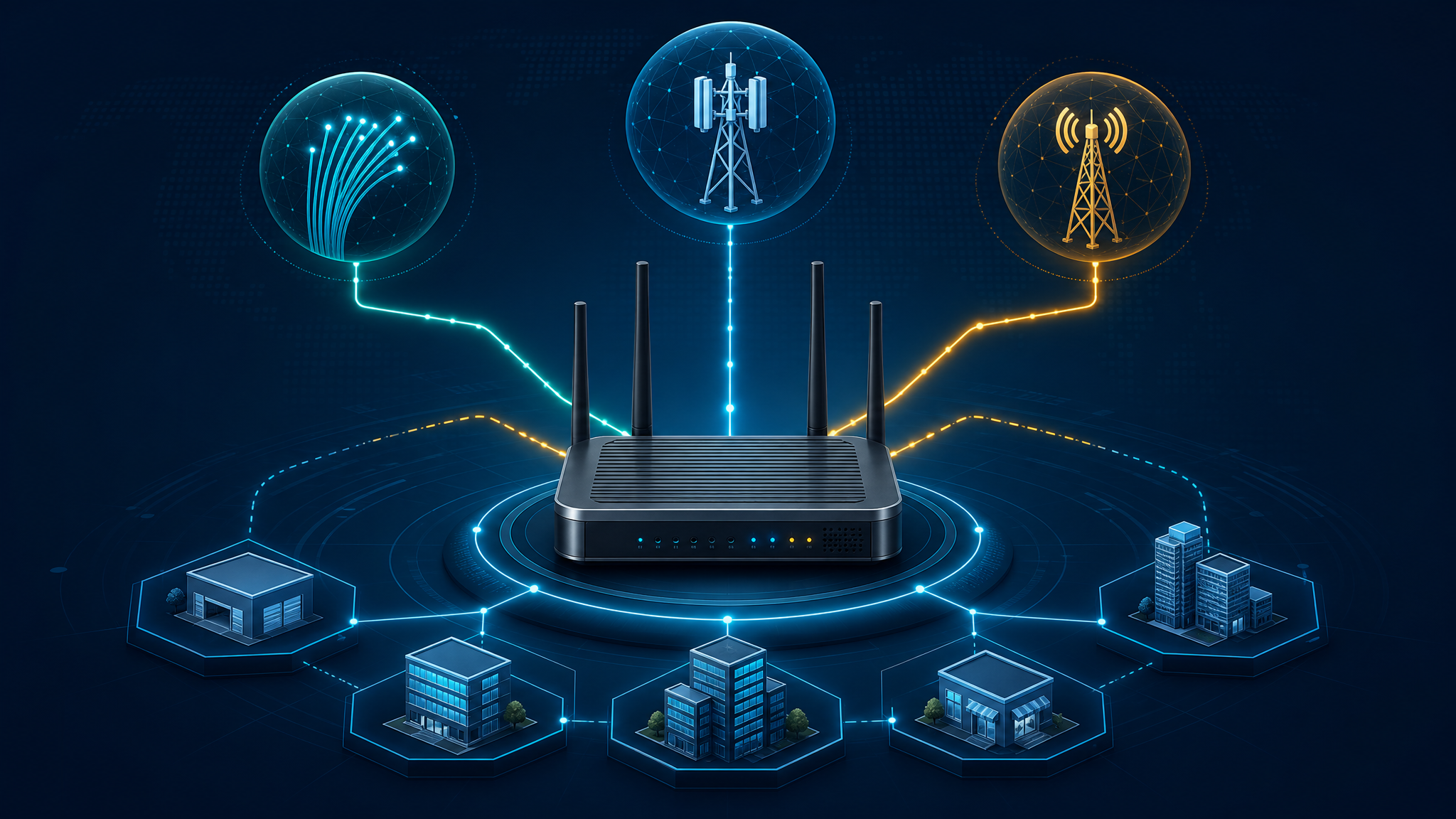
For ISPs and enterprise network architects deploying 5G fixed wireless access at branch offices, retail locations, and remote sites, network resilience is not optional — it is a contractual SLA obligation. A single WAN link over 5G, however fast, introduces a critical single point of failure. The industry response in 2026 is multi-WAN CPE architectures with integrated SD-WAN intelligence, combining fiber, 5G, and 4G LTE paths into a unified resilience fabric managed at the customer premises.
The Multi-WAN Imperative for 5G CPE
Real-world 5G FWA deployments face several availability challenges that multi-WAN architectures directly address:
- Cell site maintenance windows: Even Tier-1 operators schedule 2-4 maintenance events per cell site annually, each causing 2-6 hours of downtime. A secondary WAN path eliminates customer-facing outages during these windows.
- 5G mmWave rain fade: Operators deploying 28 GHz and 39 GHz bands report up to 8 dB/km additional attenuation during heavy rainfall, sufficient to drop connections at cell edges. Automatic failover to sub-6 GHz 5G or LTE preserves connectivity.
- Core network congestion: During peak hours, 5G user-plane throughput can degrade below SLA thresholds. Policy-based traffic steering to a fiber or alternate 5G path maintains critical application performance.
- Fiber backhaul cuts: In hybrid fiber-plus-5G deployments, construction-related fiber cuts are the most common cause of extended outages. 5G WAN failover provides sub-second recovery.
Multi-WAN Architecture Models
Three dominant architectural patterns have emerged in 2026 CPE designs:
1. Active-Standby with Path Monitoring
The most widely deployed model for cost-sensitive ISP rollouts. The primary WAN interface (typically 5G NR or fiber) carries all traffic while the secondary interface (LTE or secondary 5G carrier) remains in hot standby. The CPE continuously monitors primary path health using ICMP probes, HTTP reachability checks, or BFD (Bidirectional Forwarding Detection) at configurable intervals as low as 300ms. On failure detection, failover completes within 1-3 seconds, including DHCP lease acquisition on the backup interface.
Key capability for operators: pre-failover path quality verification. Advanced CPE implementations verify that the backup link has adequate signal quality (RSRP ≥ -110 dBm, SINR ≥ 0 dB) and throughput capacity before initiating failover, preventing flapping between degraded links.
2. Active-Active Load Balancing with Application Steering
Enterprise-grade CPE platforms support simultaneous active WAN paths with per-application or per-destination traffic distribution. This model uses policy-based routing (PBR) rules provisioned through the CPE management interface to steer traffic based on:
- Application identification: Deep packet inspection (DPI) or SNI-based classification assigns VoIP and video conferencing to the lowest-latency path while bulk file transfers and cloud backups use the highest-throughput path.
- Destination prefix: Traffic destined for specific IP ranges (e.g., AWS Direct Connect endpoints, corporate VPN concentrators) is pinned to specific WAN interfaces.
- DSCP marking preservation: QoS markings are preserved and mapped to 5G QoS Flow Identifiers (5QI) on the cellular WAN path, ensuring end-to-end traffic class treatment.
3. SD-WAN Overlay with Tunnel Bonding
The most sophisticated model integrates an SD-WAN agent directly into the CPE software stack. All WAN interfaces — fiber, 5G NR, LTE, even satellite — terminate into SD-WAN tunnels (IPsec or WireGuard) that connect to an aggregation point (SD-WAN hub, cloud gateway, or carrier SD-WAN edge). The SD-WAN controller manages:
- Per-packet tunnel bonding: Packet duplication and transmission across multiple WAN paths simultaneously, with the receiver accepting the first-arriving copy. This eliminates failover time entirely for loss-sensitive applications — the failover is packet-level, not session-level.
- Forward error correction (FEC): Additional parity packets across tunnels enable loss recovery without retransmission, critical for real-time UDP traffic over cellular links.
- Dynamic path selection: The SD-WAN controller continuously measures per-tunnel latency, jitter, and loss, and dynamically adjusts traffic distribution policies without CPE reboot or session interruption.
CPE Hardware Requirements for Multi-WAN SD-WAN
Not all 5G CPE hardware can effectively support multi-WAN and SD-WAN workloads. Operators evaluating CPE for resilient deployments should verify:
- CPU headroom: SD-WAN tunnel termination with IPsec encryption at 1 Gbps requires approximately 4 DMIPS per Mbps, or roughly a quad-core ARM Cortex-A55 at 1.8 GHz as a practical minimum. CPE based on low-power IoT-class processors will bottleneck at 150-300 Mbps of encrypted tunnel throughput.
- Hardware crypto acceleration: AES-NI or ARM Crypto Extensions support is essential for IPsec throughput above 500 Mbps. Software-only crypto on embedded CPE processors typically caps at 200-400 Mbps.
- Multiple independent WAN interfaces: At minimum: one 5G NR modem (3GPP Release 17+), one Gigabit Ethernet WAN port, and optionally a secondary cellular modem or SFP cage for fiber WAN. Avoid designs where the Ethernet port is LAN-only with no WAN routing capability.
- RAM and flash: Minimum 512 MB RAM and 256 MB flash for SD-WAN agent, routing table (full BGP feed not required at CPE level; default route plus specific prefixes is sufficient), and DPI signature database.
Procurement Checklist for Operators
When issuing RFPs for multi-WAN 5G CPE, operators should include these technical requirements:
- Support for minimum 2 active WAN interfaces with independent IP addressing and routing tables
- Path monitoring: ICMP, HTTP(S) GET, and BFD at configurable intervals down to 300ms
- Failover time: ≤3 seconds from primary path failure to backup path active (measured at TCP session level)
- Application-aware steering: DPI-based or at minimum DSCP-based with minimum 32 classification rules
- SD-WAN tunnel support: IPsec IKEv2 and WireGuard with hardware-accelerated crypto, minimum 500 Mbps aggregate tunnel throughput
- Zero-touch provisioning with pre-staged SD-WAN tunnel configurations via TR-369 USP or vendor ACS
- Per-interface telemetry export (throughput, latency, jitter, packet loss) to operator NMS via NETCONF/YANG or gNMI
Frequently Asked Questions
What is the difference between multi-WAN failover and SD-WAN in 5G CPE?
Multi-WAN failover provides basic link redundancy — switching traffic to a backup link when the primary fails. SD-WAN adds intelligent traffic steering across multiple active links based on application requirements, real-time path quality measurements, and centralized policy control. SD-WAN enables active-active link utilization, per-packet tunnel bonding, and application-aware routing that basic failover cannot provide.
What CPU specifications are needed for SD-WAN on 5G CPE?
For 1 Gbps IPsec SD-WAN tunnel throughput, a quad-core ARM Cortex-A55 at 1.8 GHz with hardware crypto acceleration (ARM Crypto Extensions) is the practical minimum. Software-only crypto on embedded CPE processors typically caps at 200-400 Mbps. Operators should request vendor benchmark data for encrypted tunnel throughput under production workloads.
How fast should 5G CPE failover be for enterprise deployments?
Enterprise-grade 5G CPE should achieve failover within 1-3 seconds measured at the TCP session level, including DHCP lease acquisition on the backup interface. BFD-based path monitoring at 300ms intervals enables sub-second failure detection. For real-time applications (VoIP, video conferencing), SD-WAN packet duplication across paths eliminates failover time entirely — the receiver accepts the first-arriving copy.
Discuss your multi-WAN CPE requirements with Honlly Telecom. Contact our engineering team for SD-WAN-capable 5G CPE specifications and deployment consultation.