
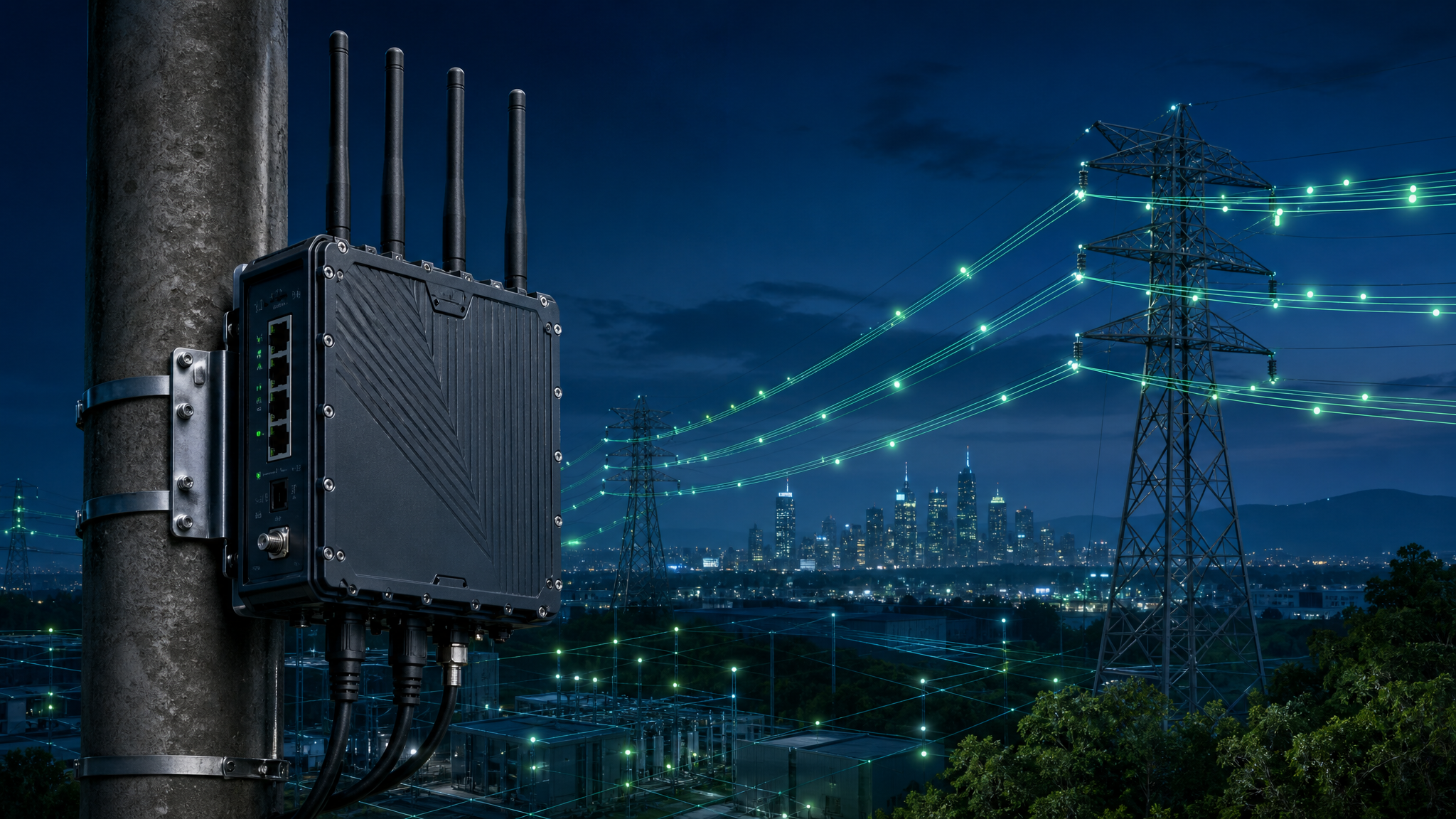
Smart grid modernization is one of the largest and most sustained drivers of industrial cellular router deployments globally. Utility operators — from transmission system operators (TSOs) to distribution network operators (DNOs) — are deploying tens of thousands of 4G and 5G routers across substations, reclosers, capacitor banks, and distributed energy resource (DER) controllers. Selecting the wrong router for these environments is not an inconvenience; it is a regulatory compliance risk and a grid reliability liability.
The Utility Communications Landscape
Modern grid communications span a wide operational technology (OT) stack, each layer imposing distinct requirements on the CPE:
- Substation automation (IEC 61850): GOOSE (Generic Object Oriented Substation Event) messaging requires sub-4ms latency within the substation LAN, demanding CPE with hardware-accelerated switching and IEEE 1588v2 Precision Time Protocol (PTP) support for synchrophasor applications.
- SCADA backhaul (DNP3, IEC 60870-5-104): Polled protocols with 2-5 second scan intervals. Reliable TCP session persistence across cellular network transitions is critical — dropped SCADA sessions trigger nuisance alarms at the control center.
- DER management (IEEE 1547-2018, SunSpec Modbus): Inverter and battery energy storage system (BESS) controllers require always-on IP connectivity with the utility’s Distributed Energy Resource Management System (DERMS). Latency requirements are moderate (100-500ms), but connection uptime expectations exceed 99.95%.
- Advanced metering infrastructure (AMI) backhaul: Concentrator/router devices aggregate meter reads from hundreds of endpoints and backhaul via cellular. Throughput requirements are modest (1-5 Mbps), but session density and simultaneous TCP connections can reach thousands per device.
Environmental Hardening: Beyond the IP Rating
Utility deployments expose cellular routers to conditions that consumer and enterprise-grade CPE cannot survive. The minimum environmental specification for substation and field-area network deployments is:
| Parameter | Minimum Requirement | Applicable Standard |
|---|---|---|
| Operating temperature | -40°C to +75°C | IEC 60068-2-1/2/14 |
| Ingress protection | IP65 (pole-mount), IP40 (cabinet-mount) | IEC 60529 |
| Surge protection | 6 kV line-to-ground (power), 4 kV (Ethernet) | IEC 61000-4-5 Level 4 |
| ESD immunity | 15 kV air, 8 kV contact | IEC 61000-4-2 Level 4 |
| Vibration resistance | 5-500 Hz, 5g operational | IEC 60068-2-6 |
| EMI/EMC | Class A industrial emissions, 10 V/m radiated immunity | IEC 61000-6-4, IEC 61000-4-3 |
| Altitude | 4,000m operational | IEC 60068-2-13 |
A critical but often overlooked requirement: conformal coating of PCB assemblies. Substation environments contain hydrogen sulfide (H₂S) and sulfur dioxide (SO₂) from SF6-insulated switchgear decomposition. These gases corrode unprotected copper traces within 12-18 months. Utility-grade routers must specify conformal coating per IPC-CC-830B or IEC 61086.
Cybersecurity Certification Requirements
The regulatory landscape for utility OT cybersecurity has hardened significantly, particularly in North America and Europe:
North America: NERC CIP Compliance
Any router deployed within an electronic security perimeter (ESP) at a bulk electric system (BES) cyber asset must support the controls mandated by NERC CIP-005-7 (Electronic Security Perimeters) and CIP-007-6 (Systems Security Management). Practically, this means:
- IEEE 802.1X port-based network access control with EAP-TLS certificate-based authentication
- Centralized syslog export (TLS-encrypted) to SIEM for all authentication, authorization, and configuration change events
- Role-based access control (RBAC) with minimum 3 privilege levels (viewer, operator, administrator)
- FIPS 140-3 validated cryptographic module for IPsec VPN termination
- Secure boot with hardware root of trust (TPM 2.0) and signed firmware verification at every boot cycle
- Configurable session timeout and account lockout after N failed attempts
Europe: NIS2 Directive and ENISA Frameworks
Under the NIS2 Directive (EU 2022/2555), electricity distribution and transmission operators are classified as “essential entities” and must implement proportionate technical security measures. CPE deployed in European utility networks should demonstrate:
- IEC 62443-4-2 certification (Security for industrial automation and control systems — component level), at minimum Security Level 2 (SL2)
- Common Criteria EAL4+ or equivalent for the embedded operating system
- EU RED (Radio Equipment Directive) cybersecurity delegated act compliance for wireless devices (mandatory from August 2025)
- Support for certificate lifecycle management via EST (RFC 7030) or CMPv2 for SCEP-less certificate renewal
Protocol and Interface Requirements
Utility OT networks use a distinct protocol stack that differs significantly from enterprise IT environments. The cellular router must natively support or transparently tunnel:
| Protocol | Transport | Utility Application |
|---|---|---|
| IEC 61850 MMS/GOOSE | TCP/IP, L2 multicast | Substation automation, protection relaying |
| DNP3 | TCP/IP, serial (RS-232/485) | SCADA RTU/IED polling |
| IEC 60870-5-104 | TCP/IP | Telecontrol between control center and substation |
| Modbus TCP/RTU | TCP/IP, serial (RS-485) | DER controllers, battery management, legacy RTUs |
| IEEE C37.118.2 | TCP/IP | Synchrophasor data streaming (PMU to PDC) |
| IEEE 1588v2 PTP | L2/L3 multicast/unicast | Substation time synchronization (<1μs accuracy) |
Serial interface support (RS-232 and RS-485 with terminal server functionality) remains essential even in 2026, as a substantial installed base of utility RTUs, protective relays, and meter concentrators communicate exclusively over serial connections. The router must function as a serial-to-IP gateway, encapsulating serial data into TCP or UDP streams with configurable packetization timers.
Power Supply and Redundancy
Substation-grade routers must accept wide-range DC input (typically 24-60 VDC or 88-300 VDC for substation battery bank compatibility) with dual redundant inputs and automatic failover. Key specifications:
- Dual DC inputs with diode-OR isolation to prevent backfeed
- Input voltage surge withstand: 2.5× nominal for 1 second (per IEEE 1613 for substation environments)
- Power consumption: ≤15W typical for LTE routers, ≤25W for 5G NR routers (excluding PoE budget)
- PoE/PoE+ output (up to 30W per port, IEEE 802.3at) for powering connected cameras, sensors, or Wi-Fi APs at remote sites lacking separate power infrastructure
- Supercapacitor or battery-backed RTC for maintaining accurate timestamps through extended power outages
RFP Evaluation Checklist for Utility Operators
When evaluating industrial cellular routers for smart grid deployment, utility procurement teams should verify:
- Certification evidence: Request valid IEC 61850-3 / IEEE 1613 compliance test reports, not just manufacturer self-declarations. These standards mandate specific EMI, temperature, and surge immunity tests performed by accredited laboratories.
- NERC CIP or NIS2 compliance documentation: The vendor should provide a compliance matrix mapping router features to each applicable CIP/NIS2 requirement with implementation evidence.
- Serial terminal server capability: Verify raw TCP and RFC 2217 Telnet COM port support with per-port configuration persistence across reboots.
- Field replacement MTTR: Request zero-touch replacement procedures — a replacement router should auto-provision from a configuration backup stored in the operator’s ACS or TR-369 USP controller without requiring a field technician to apply configuration manually.
- Supply chain security: Verify that the router’s firmware build process, silicon provenance, and software bill of materials (SBOM) meet utility supply chain risk management requirements per NERC CIP-013-1 or NIS2 Article 21.
Frequently Asked Questions
What environmental certifications are required for utility substation routers?
Utility substation routers must meet IEC 61850-3 and IEEE 1613 standards for communications equipment in electric power substations. Key requirements include -40°C to +75°C operating temperature range, 6kV surge immunity (IEC 61000-4-5 Level 4), and 15kV ESD protection. Conformal coating per IPC-CC-830B is essential for protection against corrosive gases (H₂S, SO₂) present in substation environments.
What cybersecurity certifications do industrial routers need for NERC CIP compliance?
For NERC CIP compliance, industrial cellular routers deployed within BES cyber asset electronic security perimeters must support IEEE 802.1X with EAP-TLS authentication, FIPS 140-3 validated cryptographic modules, TPM 2.0 secure boot, TLS-encrypted centralized logging, RBAC with minimum 3 privilege levels, and configurable session/account lockout policies. Vendors should provide a NERC CIP compliance matrix with implementation evidence for each requirement.
Why do smart grid routers still need serial ports (RS-232/RS-485) in 2026?
Despite IP-based modernization, a large installed base of utility RTUs, protective relays, recloser controllers, and meter concentrators communicate exclusively over RS-232 or RS-485 serial interfaces. These devices have 15-25 year field lifespans and are not replaced during communication network upgrades. Industrial cellular routers must function as serial-to-IP gateways, encapsulating serial protocol data (DNP3, Modbus RTU, IEC 60870-5-101) into TCP/UDP streams for backhaul over cellular networks.
Deploying smart grid communication infrastructure? Contact Honlly Telecom to discuss industrial-grade 4G/5G routers with IEC 61850-3 compliance and utility cybersecurity certification.