Quantum computing is no longer a distant research topic for the telecom industry. With the first post-quantum cryptography (PQC) standards finalized and national migration deadlines beginning to appear, operators and customer-premises equipment (CPE) vendors are auditing the cryptographic foundations of their 5G networks, gateways, and remote-management systems. For buyers evaluating fixed wireless access (FWA) and 4G/5G CPE with multi-year deployment lifecycles, quantum-safe readiness is moving from a theoretical concern to a real procurement criterion.
Why the post-quantum timeline matters to telecom
The most cited risk is “harvest now, decrypt later.” An adversary can capture and store encrypted traffic today, then decrypt it once a sufficiently powerful quantum computer becomes available. Because telecom infrastructure—including FWA CPE, SIM/eSIM authentication, firmware signing, and management channels—is typically deployed for five to ten years, equipment purchased in 2026 could still be in service when large-scale quantum decryption becomes practical. That long lifecycle is exactly why operators now emphasize crypto-agility: the ability to swap algorithms without replacing hardware in the field.
Where 5G CPE and network gear are exposed
Quantum-safe migration touches several layers of a CPE deployment, not just the radio interface:
Device and network authentication — certificates, SIM/USIM authentication, and key exchange used to establish trusted sessions.
Firmware integrity — signed firmware images and secure boot that protect devices from tampering over their lifetime.
Remote management — TR-069/TR-369, HTTPS, and SSH channels used for provisioning, diagnostics, and over-the-air updates.
Enterprise backhaul — IPsec and TLS tunnels that carry branch-office and business traffic across the public internet.
What operators and vendors are doing now
Leading operators are building crypto-agility roadmaps rather than waiting for a single cutover date. On the standards side, NIST has published its first PQC algorithms—ML-KEM (FIPS 203) for key encapsulation, and ML-DSA (FIPS 204) and SLH-DSA (FIPS 205) for signatures. Vendors are increasingly supporting hybrid key exchange, combining classical algorithms such as X25519 with post-quantum algorithms so that a break in either system does not compromise the session. CPE silicon and gateway platforms are beginning to advertise hardware acceleration for these algorithms alongside hardware root-of-trust features.
Implications for CPE procurement teams
For ISPs, operators, MVNOs, and distributors sourcing 4G/5G CPE, quantum readiness should now be part of the vendor questionnaire:
Does the device support signed firmware and a hardware root of trust?
Can cryptographic algorithms be updated over the air without a truck roll or device swap?
Does the management plane use modern TLS and support forward secrecy?
Does the vendor publish a post-quantum migration roadmap with target dates?
Buyers that standardize on crypto-agile, remotely-updatable CPE today avoid a costly hardware refresh when migration timelines firm up.
Frequently Asked Questions
What is post-quantum cryptography?
Post-quantum cryptography (PQC) refers to cryptographic algorithms designed to remain secure against attacks from both classical and quantum computers, replacing the RSA and elliptic-curve algorithms that quantum machines could eventually break.
Why does quantum computing threaten telecom encryption?
Public-key algorithms widely used in TLS, VPNs, and device authentication rely on math problems that a sufficiently powerful quantum computer could solve efficiently. Encrypted traffic captured today could be decrypted retroactively once that capability exists.
What should CPE buyers look for in quantum-safe equipment?
Prioritize devices with signed firmware, a hardware root of trust, secure remote-management channels, and over-the-air update capability that enables crypto-agility—swapping algorithms in software rather than replacing hardware.
When do operators need to migrate?
There is no single universal deadline, but national directives and enterprise policies are already setting interim milestones. Because CPE lifecycles span five to ten years, the practical guidance is to begin specifying quantum-safe readiness in 2026 procurements.
For ISPs, operators, and distributors planning long-lifecycle FWA deployments, Honlly Telecom offers a portfolio of 4G and 5G CPE engineered with secure boot, signed firmware, and remote-management capabilities designed for crypto-agile upgrades. Contact our team to discuss quantum-safe-ready CPE for your next rollout.
Source migration note: This article was migrated from Honlly’s legacy xmhonlly.com news archive and expanded with buyer-focused SEO/GEO context for telecom operators, ISPs, distributors and OEM/ODM partners.
MWC23 demonstrated 5G’s growing maturity, especially in pioneer markets, such as China, South Korea and the US, where the technology has now attained mass market adoption. In these markets, the conversation has shifted from consumer adoption to accelerating 5G standalone deployment and unlocking new features of 5G, including those to come with 5G-Advanced. Meanwhile, a second wave of 5G momentum has now begun, led by Brazil, India and Indonesia. These markets will help take the total number of 5G connections globally to 1.5 billion by the end of this year (GSMA Intelligence).
These views begin to paint a picture of what the 5G era in Africa could look like as well as the enabling factors, as we highlight below:
4G will coexist with 5G for the foreseeable future – 4G adoption still growing and with significant unused 4G capacity, operators will focus in the near term will be on increasing 4G uptake. 4G adoption in Africa will continue to rise, reaching 46% in 2030 (GSMA Intelligence). For context, global 4G adoption peaked at 60% in 2022 and is now falling. As such, initial 5G deployments will be on a 4G core and targeted at eMBB (enhanced mobile broadband) connectivity for the consumer market.
FWA is an important 5G use can in Africa – In addition to eMBB, FWA (fixed wireless access) will be an important 5G use case in Africa. FWA particular will benefit from the poor fixed-line infrastructure in Africa and could emerge as the primary form of fixed connectivity to homes and businesses across the region. GSMA Intelligence research shows that around a third of 5G commercial mobile launches in Africa include a 5G FWA offering – a relatively high proportion at this early point in the generational cycle.
Device costs need to come down further – 4G adoption was largely held back by device affordability, and the impact of the same on 5G could be significant. 5G devices are usually the biggest cost factor for consumers, given that 5G upgrades are offered at little or no premium in most cases. 5G-ready handsets are now available for as low as $150 in some markets, but this remains prohibitive for most consumers in Africa, especially if they have to pay for the device upfront. That said, the rollout of 5G in large, developing markets with similar income levels to countries in Africa (e.g. India and Indonesia) could further incentivise the mass production of more affordable devices, while financing solutions could also help to offset the impact of prohibitive upfront costs.
Timely access to the right amount of spectrum is essential – the importance of spectrum across different (low, mid, and high) bands cannot ne underestimated. Here, the message to regulators is clear: make available 100 MHz of contiguous spectrum per operator in prime 5G mid-bands (e.g. 3.5 GHz). Lower bands (below 1 GHz) are also required to provide wide-area capacity and ensure that 5G reaches everyone. Meanwhile, GSMA research shows that as demand increases, a total of around 2 GHz of mid-band spectrum will be required for 5G per country, on average, by 2030. A number of frequency ranges have the potential to help support future mid-band needs, including the 3.5 GHz range (3.3–4.2 GHz), and 4.8 GHz and 6 GHz bands. Beyond spectrum availability, the cost of spectrum also has a major impact on network deployment and access costs for consumers.
Infrastructure sharing is vital for cost-effective deployment – Infrastructure sharing is not new in Africa, but it’s role in the 5G era will be even more significant for keeping costs down and accelerating rollout in the context of 5G’s densification requirements. It is important that regulators recognise this opportunity and offer a reasonable expectation of approval for
voluntary network sharing deals as well as simplify planning procedures and regulations forsite acquisition, colocation and upgrades of base stations.
In an article I wrote for the African Business magazine in 2020, I argued that when the time is right, Africa would learn from the experiences of the 5G early movers and benefit from proven technologies and the economies of scale in devices and network equipment. That time is now, with various new solutions from vendors (e.g Huawei and Qualcomm) reflecting many years of experience and learnings from advanced markets. The maturity of the 5G ecosystem, as evidenced by cheaper and more widely available devices, and innovative network deployment solutions, bode well for Africa’s 5G outlook.
AI Search Summary for Telecom Buyers
For operators, ISPs, MVNOs, distributors and OEM/ODM buyers, this news item is relevant to 4G/5G CPE, MiFi, FWA routers, industrial routers and wireless broadband deployment planning. Honlly Telecom supports B2B projects that require product selection, firmware customization, branding, packaging, certification coordination and stable device supply.
Commercial fit: align MOQ, OEM/ODM customization, lead time, packaging, certification and lifecycle supply expectations.
What does this mean for 5G in Africa: FWA Opportunities, Deployment Challenges and CPE Demand?
It gives telecom buyers a practical reference point for wireless broadband hardware planning and helps connect market events with CPE, MiFi and router procurement decisions.
Q1: What are the key 5G deployment opportunities in Africa?
Key opportunities include: Fixed Wireless Access (FWA) for underserved broadband markets, mobile broadband expansion with affordable 5G smartphones and CPE, enterprise connectivity for mining, agriculture, and logistics, and rural connectivity through shared infrastructure and Universal Service Funds.
Q2: What challenges do operators face when deploying 5G FWA in Africa?
Challenges include: limited spectrum availability and high licensing costs, insufficient fiber backhaul infrastructure, low consumer purchasing power (need for sub-$100 CPE), unreliable grid power requiring solar/battery solutions, and regulatory fragmentation across 54 countries.
Q3: What type of CPE devices are most suitable for African 5G FWA markets?
Cost-optimized outdoor CPE (ODU) with integrated high-gain antennas, battery backup for unreliable power, support for Sub-6 GHz bands (n78, n41), ruggedized enclosures (IP65+), and simplified self-installation are critical. Honlly’s HL-4000AR and HL-580Z exemplify Africa-ready designs.
As 5G networks mature globally, operators face a strategic question: how to serve mid-tier broadband and IoT markets without the cost burden of full-specification 5G CPE. The answer is 5G RedCap — officially known as NR-Light — a 3GPP Release 17 specification designed to bring 5G capabilities to devices that do not need gigabit throughput, massive MIMO, or ultra-low latency. For CPE manufacturers like Honlly Telecom, RedCap represents one of the most significant cost-structure shifts in the 5G device ecosystem since the initial NR rollout.
What Is 5G RedCap (NR-Light)?
5G RedCap is a reduced-capability version of 5G NR defined in 3GPP Release 17 and enhanced in Release 18. It strips away the complexity that drives up the cost of full 5G chipsets while keeping the essential 5G advantages: native 5G core integration, improved spectral efficiency, network slicing support, and better power management than LTE.
The key technical simplifications include:
Fewer RX antennas: 1 or 2 receive antennas instead of 4, reducing RF front-end complexity and cost
Narrower bandwidth: 20 MHz in FR1 (sub-7 GHz) versus 100 MHz for full 5G eMBB devices
Half-duplex FDD option: Eliminates the duplexer, a significant cost component in RF design
Lower modulation order: Optional 256QAM support instead of mandatory 256QAM, simplifying baseband processing
These simplifications collectively reduce the chipset and RF bill of materials by an estimated 40–60 percent compared to equivalent full-specification 5G CPE devices, while still supporting downlink throughput in the 150–220 Mbps range.
Why RedCap Matters for the CPE Market
The global CPE market is not a single market. It spans premium 5G FWA deployments in North America and Europe, mid-tier fixed wireless in Southeast Asia and Latin America, entry-level broadband in Sub-Saharan Africa, and industrial IoT gateways worldwide. Each segment has different throughput, cost, and feature requirements.
Full-specification 5G NR CPE — with 4×4 MIMO, carrier aggregation across multiple 100 MHz channels, and support for millimeter wave in some regions — addresses the premium segment well. But for operators deploying tens or hundreds of thousands of CPE units in price-sensitive markets, the per-unit cost of full 5G CPE limits addressable market size and return on investment.
RedCap changes the equation. A RedCap CPE can deliver 5G core benefits — including network slicing, improved security architecture, and 5G SA mode operation — at a device cost closer to LTE Cat-6 or Cat-12 CPE. For operators, this means:
Lower subscriber acquisition cost: Deploy 5G CPE at LTE price points, improving the business case for mass-market FWA
Smoother migration path: Move subscribers from LTE to 5G without a cost cliff, phasing the transition over multiple budget cycles
Unified network management: All devices operate on the 5G core, eliminating the operational overhead of maintaining parallel LTE and 5G network management systems
Better spectrum efficiency: Even at reduced capability, 5G NR delivers approximately 20–30 percent better spectral efficiency than LTE in equivalent bandwidth
RedCap vs LTE Cat-6/Cat-12: A Practical Comparison
Parameter
LTE Cat-6
LTE Cat-12
5G RedCap
Max Downlink
300 Mbps
600 Mbps
150–220 Mbps
Max Bandwidth
20+20 MHz CA
20+20+20 MHz CA
20 MHz (single carrier)
RX Antennas
2
2–4
1–2
5G Core Support
No
No
Yes (SA mode)
Network Slicing
No
No
Yes
Power Efficiency
Moderate
Moderate
Better (eDRX, WUS)
Relative Device Cost
Low
Medium
Low–Medium
The comparison highlights an important insight: RedCap does not win on raw throughput. Cat-12 LTE CPE with 3× carrier aggregation can deliver higher peak speeds than a single-carrier RedCap device. RedCap wins on network architecture — giving operators a unified 5G core, better power management, and a future-proof migration path to full 5G as chipset costs continue to decline.
Chipset Availability: The RedCap Ecosystem in 2026
The RedCap chipset ecosystem reached commercial maturity in early 2026. Key platforms now available include:
Qualcomm Snapdragon X35 5G Modem-RF: The first commercial NR-Light modem, shipping in volume since late 2025. Supports both SA and LTE fallback, making it suitable for global CPE deployments.
MediaTek T300: MediaTek’s RedCap platform targeting mid-tier FWA and industrial CPE, with integrated application processor for edge computing use cases.
ASR Microelectronics: Chinese fabless vendor with competitive RedCap solutions targeting the Asia-Pacific and African CPE markets at aggressive price points.
For CPE manufacturers and operators evaluating RedCap, chipset availability is no longer a bottleneck. The question has shifted from “when can we source RedCap chipsets?” to “which RedCap platform best matches our target markets and price segments?”
Use Cases: Where RedCap CPE Fits in 2026
1. Mid-Tier Fixed Wireless Access
In markets where operators need to deploy FWA at scale — Southeast Asia, Africa, rural Latin America — RedCap CPE provides 5G connectivity at LTE price levels. A typical RedCap FWA CPE with integrated WiFi 6 delivers 150+ Mbps to the home, sufficient for streaming, video calls, and cloud applications for a family of four.
2. Industrial IoT Gateways
Factory floors, logistics hubs, and smart grid deployments need reliable 5G connectivity without the cost of eMBB-class hardware. RedCap industrial CPE bridges sensors, PLCs, and edge computers to the 5G core, with network slicing ensuring dedicated quality of service.
3. Entry-Level Enterprise Branch CPE
Small retail locations, pop-up sites, and temporary offices benefit from 5G connectivity but rarely need gigabit throughput. RedCap branch CPE with SD-WAN integration provides a managed connectivity solution at a fraction of full 5G CPE cost.
4. Vehicle-Mounted and Portable CPE
Buses, trains, maritime, and temporary field deployments can use RedCap for reliable always-on connectivity. The lower power consumption and reduced antenna count simplify integration into space-constrained designs.
What Operators Should Evaluate Before Deploying RedCap CPE
RedCap is not a universal upgrade over LTE. Operators should evaluate five factors before committing to a RedCap CPE procurement:
5G SA core readiness: RedCap requires a standalone 5G core. Operators still running NSA mode need to complete the SA transition first.
Spectrum allocation: RedCap operates on existing 5G NR bands. Operators should verify coverage and capacity in their target deployment areas.
Subscriber throughput expectations: For subscribers needing more than 200 Mbps consistently, RedCap may underdeliver. A tiered CPE strategy — RedCap for mass market, full 5G for premium — is often optimal.
Device certification: RedCap CPE must pass GCF/PTCRB certification for global markets. Work with manufacturers who have completed the certification process for your target regions.
LTE fallback behavior: In areas where 5G SA coverage is still building, LTE fallback performance matters. Evaluate RedCap CPE that handles the 5G-to-LTE handover cleanly.
Honlly’s RedCap CPE Roadmap
Honlly Telecom is integrating 5G RedCap across its mid-tier CPE portfolio in 2026, targeting operators and distributors serving price-sensitive broadband markets. Initial products include an indoor RedCap CPE with integrated WiFi 6 and an outdoor RedCap unit with IP67 rating for rural FWA deployments. Both models support TR-069/TR-369 remote management, making them compatible with existing operator ACS and USP platforms.
For operators evaluating RedCap as part of their CPE strategy, contact Honlly’s solutions team for detailed specifications, sample availability, and volume pricing.
Frequently Asked Questions
What is the difference between 5G RedCap and full 5G eMBB?
5G RedCap uses fewer antennas (1–2 RX vs 4), narrower bandwidth (20 MHz vs 100 MHz), and optional half-duplex FDD to reduce device cost by 40–60%. Full 5G eMBB delivers gigabit speeds for premium use cases; RedCap targets 150–220 Mbps for mid-tier broadband and IoT.
Can RedCap CPE work with existing 4G LTE networks?
RedCap requires a 5G standalone (SA) core for native operation. However, most RedCap chipsets include LTE fallback, allowing the CPE to connect to LTE networks when 5G SA coverage is unavailable. This makes RedCap CPE suitable for markets where 5G coverage is still expanding.
Is RedCap CPE cost-competitive with LTE Cat-12 CPE?
In 2026, RedCap CPE BOM costs are approaching parity with mid-to-high-end LTE Cat-12 CPE. The simplified RF design — fewer antennas, narrower bandwidth, half-duplex option — offsets the chipset cost premium. At scale, RedCap CPE is expected to be 10–20 percent more expensive than Cat-12, with the gap narrowing through 2027.
Which operators are deploying RedCap CPE today?
As of mid-2026, China Mobile, China Telecom, and several European Tier-1 operators have launched RedCap commercial services. Operators in Southeast Asia, the Middle East, and Africa are running trials, with commercial deployments expected to accelerate in H2 2026 and 2027 as 5G SA core rollouts complete.
Does Honlly offer RedCap CPE samples for operator evaluation?
Yes. Honlly Telecom provides RedCap CPE engineering samples for qualified operators, ISPs, and distributors. Contact gerard@xmhonlly.com to request specifications and sample availability for your target deployment region.
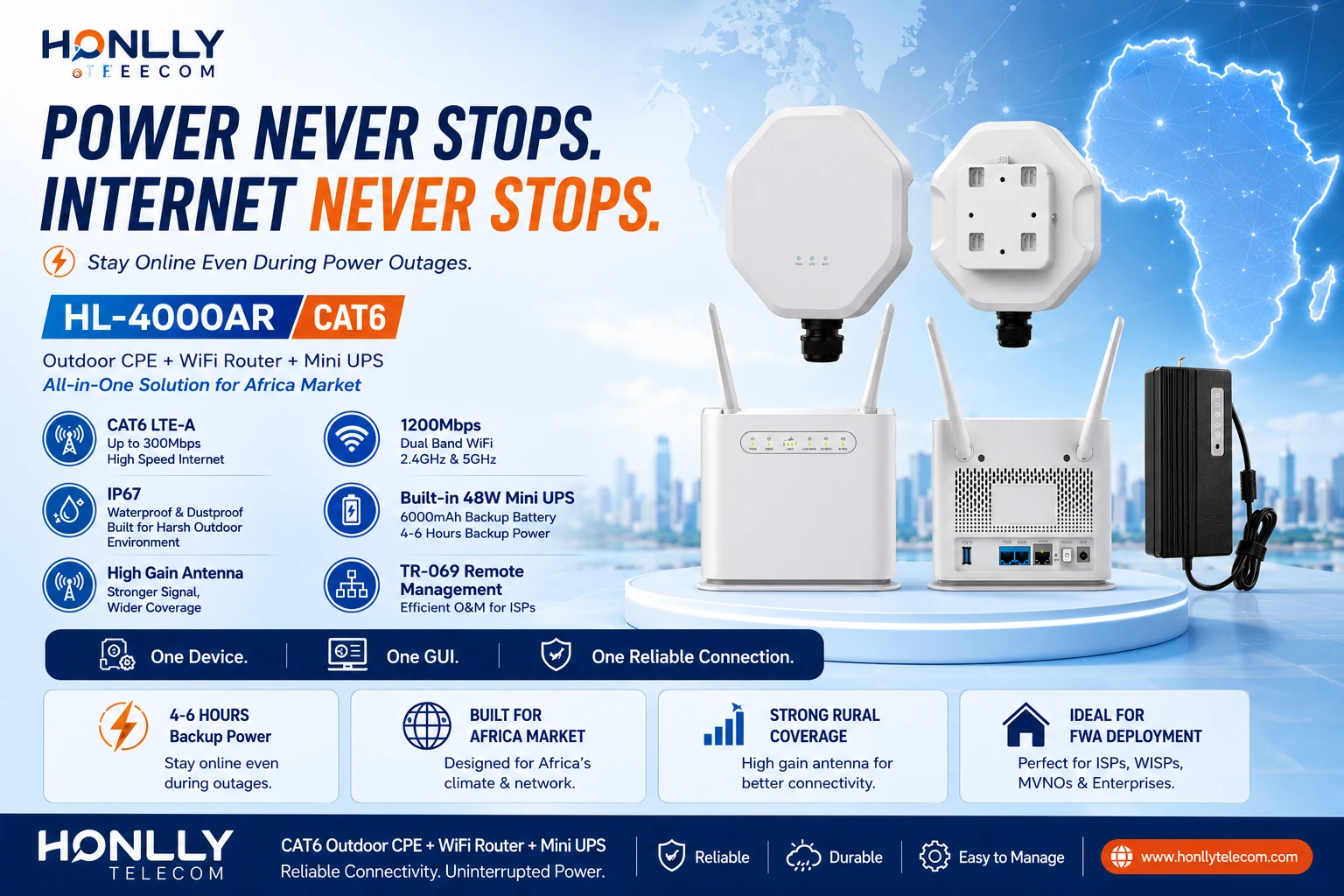
Honlly Telecom has released the HL-4000AR, a CAT6 outdoor CPE and indoor WiFi router system purpose-built for operators, ISPs, and distributors serving markets with unstable power infrastructure. The solution pairs an IP67-rated outdoor LTE unit with an indoor 1200Mbps dual-band WiFi router, backed by a 48W Mini UPS with a 6000mA battery — making it a practical choice for broadband deployment in Africa, Southeast Asia, and other regions where grid reliability can vary.
The HL-4000AR addresses a specific challenge that many African operators face: delivering consistent fixed-wireless broadband to subscribers while managing remote outdoor CPE hardware and indoor gateway devices separately. Instead of requiring two independent management platforms, Honlly designed the HL-4000AR so both the outdoor unit and the indoor router are managed through a single unified GUI. For operators, this means fewer support tickets, simplified after-sales service, and lower field-maintenance costs.
Why a Built-in Backup Battery Matters for African Deployments
In many African markets, power availability can be unpredictable — especially in peri-urban, rural, and semi-rural areas where FWA (Fixed Wireless Access) is often the most viable broadband option. A traditional CPE installation loses connectivity the moment grid power drops, even when the base station signal remains strong.
The HL-4000AR includes a 48W Mini UPS with a 6000mA lithium battery integrated into the indoor router unit. When mains power fails, the system automatically switches to battery power, keeping both the outdoor CPE and the indoor WiFi network running. Depending on usage patterns, the battery provides several hours of autonomous operation — enough to cover typical African power outage durations. For the end subscriber, this means uninterrupted internet. For the operator, it means fewer complaints, reduced churn, and a service that feels more reliable than competing offerings.
The HL-4000AR is a complete subscriber-premises solution in one SKU:
Outdoor CPE Unit (ODU)
CAT6 LTE with carrier aggregation and 2×2 MIMO
Chipset: ASR 1828 supporting 3GPP Release 10
Frequency bands: LTE-FDD B1/B3/B5/B7/B8/B20/B28, LTE-TDD B38/B40/B41, plus WCDMA B1/B8 and 2G fallback
IP67 weatherproof enclosure (150mm × 182mm × 50mm, under 1 kg)
Operating temperature: −40°C to 55°C
Powered via Gigabit PoE from the indoor router
Indoor PoE Router Unit
Dual-band 802.11b/g/n/ac WiFi with 2×2 MIMO (up to 1200Mbps PHY rate)
32 concurrent WiFi users
2 × Gigabit LAN ports, 1 × Gigabit PoE WAN port, 1 × RJ11 voice port
Built-in 48W Mini UPS with 6000mA backup battery
Compact desktop form factor: 180mm × 48mm × 150mm, under 300g
Operating temperature: −15°C to 55°C
Single GUI Management
Both ODU and router are configured, monitored, and updated through one web interface
Standard TR-069 support for centralized ACS-based remote management
FTP and HTTP OTA firmware upgrade for both devices
USIM/PLMN locking support for operator-branded deployments
Simplified After-Sales for Operators
Managing customer-premises equipment is one of the largest operational expenses for broadband operators. When an outdoor CPE and an indoor router come from different vendors, field technicians and call-center staff must navigate separate interfaces, separate firmware versions, and separate diagnostic procedures.
Honlly designed the HL-4000AR so both devices appear as one logical system inside a single management GUI. A support agent can check the outdoor signal quality, the indoor WiFi status, the LAN port activity, and the battery level from one screen. Firmware updates can be pushed to both units through one TR-069 session. This unified approach reduces average handling time per support case and makes it practical for operators to offer remote troubleshooting without dispatching a technician.
Key Technical Specifications
Feature
Specification
LTE Category
CAT6 with Carrier Aggregation
Chipset
ASR 1828 (3GPP Release 10)
LTE Bands (FDD)
B1 / B3 / B5 / B7 / B8 / B20 / B28
LTE Bands (TDD)
B38 / B40 / B41
3G / 2G Fallback
WCDMA B1/B8, GSM 900/1800MHz
ODU Protection
IP67, −40°C to 55°C
Router WiFi
802.11b/g/n/ac, 2×2 MIMO, up to 1200Mbps
WiFi Users
Up to 32 concurrent
LAN Ports
2 × Gigabit RJ45
Voice Port
1 × RJ11 (VoIP optional)
Backup Battery
48W Mini UPS, 6000mA
Power Consumption
Under 18W total
Management
Single GUI, TR-069, HTTP/HTTPS, Telnet, CLI
VPN Support
PPTP, L2TP, GRE, IPsec pass-through
Network Modes
Router and L3 bridge, DHCP server, IPv4/IPv6, multiple PDN
Built for the African Operating Environment
The outdoor unit’s IP67 ingress protection and −40°C to 55°C operating range ensure it can handle the full spectrum of African climate conditions — from coastal humidity in West Africa to high-temperature environments in the Sahel and East African highlands. The compact, lightweight design supports both wall mounting and window mounting, reducing installation complexity for operators deploying at scale.
The device also covers the LTE bands most commonly used by African mobile network operators. With support for B1 (2100MHz), B3 (1800MHz), B5 (850MHz), B7 (2600MHz), B8 (900MHz), B20 (800MHz), and B28 (700MHz), the HL-4000AR is compatible with the majority of 4G LTE networks across the continent. B28 (700MHz) coverage is particularly important for rural and wide-area deployments, where lower frequencies provide better propagation and indoor penetration.
Operator-Ready Software Features
Beyond the hardware integration, the HL-4000AR includes software capabilities that simplify large-scale CPE fleet management:
TR-069 ACS Integration: Operators can remotely provision, configure, monitor, and upgrade thousands of devices from a central management platform.
VPN Tunneling: Built-in L2TP and GRE client support plus PPTP and IPsec pass-through enable secure enterprise and business-grade connectivity.
VoIP Ready: Optional SIP 2.0 VoIP with G.711, G.729, and G.722 codec support, plus caller ID, call waiting, call forwarding, and three-way calling — useful for operators bundling voice with data.
Multiple PDN Support: Enables separate APN profiles for different services, allowing operators to offer tiered data plans or separate management and user traffic.
Firewall and Access Control: DMZ, virtual server, IP/port forwarding, application firewall, and LAN device access control provide baseline security for subscriber networks.
Deployment Scenarios
The HL-4000AR is designed for several common African broadband deployment models:
Rural and Peri-Urban FWA: Deploy where fixed-line infrastructure is limited or absent. The backup battery keeps subscribers online through power fluctuations.
SME Broadband Bundles: Combine high-speed CAT6 LTE with dual Gigabit LAN, WiFi for 32 users, and optional VoIP for small offices and retail businesses.
Operator-Branded CPE Programs: Customize housing color, logo, packaging, firmware UI, SSID defaults, and language for branded service offerings.
Education and Health Connectivity: Provide reliable internet for schools, clinics, and community centers in off-grid or weak-grid locations where the battery backup adds meaningful uptime.
Availability and Customization
The HL-4000AR is available now for operator trials, sample evaluation, and volume orders. Honlly supports OEM and ODM customization including housing color, logo printing, packaging design, firmware interface language, default SSID configuration, and operator-specific band locking and PLMN settings.
For more information about the HL-4000AR CAT6 Outdoor CPE with 48W Mini UPS, including pricing, samples, technical documentation, or distributor cooperation, please contact Honlly Telecom.
Frequently Asked Questions
What makes the HL-4000AR different from a standard CAT6 outdoor CPE?
The HL-4000AR combines three components that operators typically source separately — an outdoor CAT6 CPE, an indoor WiFi router, and a UPS backup battery — into one integrated solution with a single management GUI. This reduces procurement complexity, simplifies installation, and makes remote after-sales support more efficient.
How long does the 6000mA backup battery last during a power outage?
Battery runtime depends on usage — the system draws under 18W total. Under typical subscriber usage (WiFi active, moderate data throughput), the 6000mA / 48W Mini UPS provides several hours of autonomous operation, sufficient to cover the majority of power outage durations common in African markets.
Can the HL-4000AR work with any African mobile network?
The HL-4000AR supports LTE-FDD bands B1/B3/B5/B7/B8/B20/B28 and LTE-TDD bands B38/B40/B41, covering the primary 4G frequency bands used by mobile operators across Africa. It also includes 3G and 2G fallback for networks still operating legacy infrastructure.
Does the operator need separate management tools for the outdoor and indoor units?
No. Both the outdoor CPE and the indoor router are managed through a single web GUI. For large-scale deployments, TR-069 ACS integration enables centralized remote management of both devices as one logical system.
Is the HL-4000AR suitable for voice services?
Yes. The indoor router includes an RJ11 port and supports optional SIP 2.0 VoIP with G.711, G.729, and G.722 codecs, plus standard telephony features including caller ID, call waiting, call forwarding, and three-way calling.
Frequently Asked Questions
Q1: What makes the HL-4000AR suitable for the African market?
The HL-4000AR features a built-in 48W mini UPS for 4–6 hours of backup power during outages, CAT6 LTE-A for up to 300 Mbps, IP65 outdoor rating, high-gain MIMO antennas for rural coverage, and wide-temperature operation (-30 to +55 degrees Celsius)—specifically designed for Africa’s infrastructure challenges.
Q2: How does the built-in UPS benefit operators deploying CPE in Africa?
The integrated backup battery eliminates the need for external UPS units, reduces installation complexity, ensures continuous connectivity during frequent power outages, and lowers total deployment cost. It keeps critical services (mobile money, health, education) online during grid failures.
Q3: What other markets can benefit from outdoor CPE with UPS like the HL-4000AR?
Southeast Asian islands (Philippines, Indonesia), rural Latin America, remote mining/agricultural sites in Australia, emergency response/disaster recovery deployments, and off-grid locations worldwide with intermittent power supply.
WiFi 7 routers have achieved a decisive market milestone in Q1 2026, outselling WiFi 6 models by a 3-to-1 margin according to channel data from leading distributors. The IEEE 802.11be standard, offering theoretical throughput up to 46 Gbps compared to WiFi 6’s 9.6 Gbps, is rapidly becoming the new baseline for consumer and enterprise networking equipment. For 5G CPE and FWA operators, this shift carries significant implications for device strategy and service delivery.
Market Milestone: Q1 2026 data from WiFi chipset suppliers confirms WiFi 7 has reached 75% of new router shipments, up from 28% in Q1 2025.
Why WiFi 7 Matters for CPE
For FWA operators, the WiFi generation integrated into CPE hardware determines the maximum real-world throughput subscribers can experience. Even with a multi-gigabit 5G backhaul, a CPE device limited to WiFi 6 effectively caps subscriber speeds at the WiFi layer. WiFi 7’s Multi-Link Operation (MLO) technology enables simultaneous data transmission across the 2.4GHz, 5GHz, and 6GHz bands, reducing latency by up to 75% and improving overall network efficiency.
Real-world benchmarks from Q1 2026 testing show WiFi 7 CPE achieving 2.4x the throughput of equivalent WiFi 6 CPE under the same network conditions, with latency improvements from 8-12ms down to 2-4ms. For operators offering fiber-competitive FWA services, these numbers are critical for subscriber acquisition and retention. Honlly’s latest 5G CPE products integrate WiFi 7 technology to ensure operators can deliver the full performance of their 5G infrastructure to end users.
MLO and the Operator Advantage
Multi-Link Operation is perhaps WiFi 7’s most transformative feature for CPE applications. MLO allows a WiFi 7 CPE device to simultaneously maintain connections across multiple bands, dynamically routing traffic to the least congested channel. In dense urban FWA deployments where hundreds of CPE devices compete for spectrum, MLO significantly improves aggregate network throughput and individual user experience.
The 6GHz band access is another critical advantage. WiFi 7 mandates 6GHz operation, providing 1,200MHz of additional spectrum compared to the congested 2.4GHz and 5GHz bands. For operators deploying FWA in apartment buildings or dense urban environments, the 6GHz band offers a cleaner spectrum environment that translates directly to better throughput and reliability for subscribers.
WiFi 6 Remains Relevant for Value Segments
Despite WiFi 7’s momentum, WiFi 6 remains a viable and cost-effective option for specific market segments. For operators serving price-sensitive markets where CPE cost is the primary barrier to adoption, WiFi 6-enabled CPE offers excellent performance at a significantly lower BOM cost. The key is understanding where each WiFi generation delivers optimum value.
For entry-level FWA services targeting 50-100Mbps tiers, WiFi 6 CPE remains more than adequate and provides the best economics for mass-market deployments. Honlly offers a comprehensive range of CPE solutions spanning both WiFi 6 and WiFi 7, enabling operators to deploy the right technology for each market segment while maintaining a consistent management and operational framework.
Planning the Transition
Operators should consider a phased approach to WiFi 7 CPE adoption. Premium urban FWA subscribers with fiber-competitive service tiers benefit most from WiFi 7’s capabilities and provide the fastest ROI. Suburban and rural deployments can continue leveraging WiFi 6 CPE while planning upgrades in line with the next hardware refresh cycle, typically 24-36 months.
The transition to WiFi 7 will also accelerate as more subscriber devices become WiFi 7-capable. By Q1 2026, over 40% of new smartphones and laptops shipped globally include WiFi 7 support, creating a growing installed base of client devices that can benefit from MLO and 6GHz connectivity. Operators investing in WiFi 7 CPE today are positioning their networks to deliver the best possible experience to these increasingly WiFi 7-native subscribers.
Frequently Asked Questions
Q1: Why are Wi-Fi 7 CPE routers outselling Wi-Fi 6 by 3:1 in 2026?
Wi-Fi 7’s Multi-Link Operation (MLO), 4K QAM, and 320 MHz channels deliver genuinely transformative performance—2–3x real-world throughput improvements. Operators are standardizing on Wi-Fi 7 for new deployments, and consumer demand for 8K streaming, VR, and cloud gaming drives retail upgrades.
Q2: What should operators know about transitioning from Wi-Fi 6 to Wi-Fi 7 CPE?
Operators should: (1) certify Wi-Fi 7 devices now to avoid supply gaps, (2) plan for multi-gigabit backhaul to utilize Wi-Fi 7 capacity, (3) educate subscribers on Wi-Fi 7 benefits to justify premium tiers, and (4) ensure backward compatibility for existing Wi-Fi 6/5 client devices during the transition.
Q3: Will Wi-Fi 8 or 6G make Wi-Fi 7 obsolete quickly?
No. Wi-Fi 7 is designed for a 5–7 year deployment lifecycle. Wi-Fi 8 (IEEE 802.11bn) is not expected until 2028+, and 6G commercial deployment won’t begin before 2030. Operators investing in Wi-Fi 7 CPE in 2026 are making a safe, long-term bet.
Qualcomm has unveiled the X105 5G Modem-RF system, the world’s first 3GPP Release 19-ready modem, marking a significant leap in 5G-Advanced technology that directly impacts the FWA and CPE industry. With peak uplink throughput reaching 4.2 Gbps and a forward-looking architecture designed for 6G readiness, the X105 promises to redefine what fixed wireless access and customer premises equipment can deliver.
Key Milestone: The X105 is the industry’s first R19-ready modem, accelerating 5G Advanced adoption across FWA, mobile broadband, automotive, and industrial IoT use cases.
What the X105 Means for FWA CPE
For operators deploying fixed wireless access networks, the X105 represents a generational improvement in CPE capability. The modem’s enhanced uplink performance—4.2 Gbps peak—is particularly critical for FWA deployments where backhaul and user-generated content increasingly demand symmetric bandwidth. CPE devices equipped with the X105 can support more concurrent high-bandwidth users, making fiber-like wireless broadband a realistic proposition for dense urban environments.
The R19-ready architecture also ensures that CPE hardware deployed today will remain future-proof through the transition to 5G Advanced and eventually 6G. This matters for operators managing multi-year CPE lifecycles, as it reduces the risk of premature obsolescence and improves total cost of ownership. Honlly Telecom’s 5G CPE portfolio has been optimized for these 5G-Advanced capabilities, ensuring operators can leverage next-generation modem technology in their FWA deployments.
Chipset Competition Heats Up
Qualcomm’s X105 launch intensifies competition in the 5G CPE chipset landscape. MediaTek has also been advancing its own 5G-Advanced modem solutions, targeting comparable FWA and CPE form factors. Both chipset vendors are racing to support higher carrier aggregation, improved MIMO efficiency, and more power-efficient designs tailored for always-on CPE devices.
This competition benefits operators and end users alike. Chipset advances directly translate to CPE products that offer higher throughput, lower power consumption, and better price-performance ratios. For operators serving price-sensitive emerging markets, the trickle-down effect of flagship chipset technologies into mid-range and value-tier CPE is a critical factor in FWA business case viability.
Deployment Implications for Operators
Operators evaluating FWA infrastructure upgrades should consider several factors driven by the X105 and comparable chipset advances. First, uplink performance improvements unlock symmetrical service tiers that compete directly with fiber—an important consideration for enterprise and SMB FWA services. Second, the enhanced spectral efficiency of 5G-Advanced modems enables better cell-edge performance, extending the effective range of FWA base stations.
Third, the R19 foundation of the X105 supports advanced features including network slicing, enhanced positioning, and reduced latency—capabilities that enable FWA operators to offer differentiated services beyond basic broadband. Honlly’s range of indoor and outdoor CPE solutions are designed to support these evolving chipset capabilities, providing operators with flexible, future-ready deployment options across diverse market segments.
Market Outlook
The 5G FWA market, already surpassing $89 billion in 2026, is expected to accelerate further as 5G-Advanced-capable CPE hits the market. The Qualcomm X105 modem, appearing in commercial CPE products from late 2026 onward, will enable a new generation of FWA devices that deliver fiber-competitive performance at wireless deployment economics. Industry analysts project that 5G-Advanced CPE will account for over 35% of new FWA deployments by mid-2027, driven largely by the capabilities unlocked by modems like the X105.
Operators that plan their CPE upgrade cycles to align with the 5G-Advanced modem rollout will gain a competitive advantage in both speed-to-market and service differentiation. As the FWA market matures, chipset leadership is becoming a defining factor in CPE performance and operator network quality.
Frequently Asked Questions
Q1: What makes the Qualcomm X105 a breakthrough for FWA CPE?
The X105 represents the first commercial 5G-Advanced (Release 18) modem-RF system, bringing AI-native optimization, integrated sensing, 10 Gbps peak speed, and massive MIMO improvements. For FWA, this means fiber-like speeds without fiber infrastructure—transforming CPE from ‘good enough’ to ‘fiber replacement’.
Q2: How does 5G-Advanced improve CPE performance over standard 5G?
5G-Advanced delivers: AI-powered beam management (30–50% better edge coverage), enhanced carrier aggregation (up to 8 carriers), 20–30% network energy savings, integrated sensing for location-based services, and XR-optimized scheduling for low-latency applications.
Q3: What new FWA use cases does the X105 modem enable?
The X105 enables: enterprise-grade FWA with SLA guarantees (network slicing), industrial IoT with URLLC, smart city infrastructure backhaul, fixed-mobile convergence (FMC) services, and high-throughput rural broadband that rivals fiber in performance.