
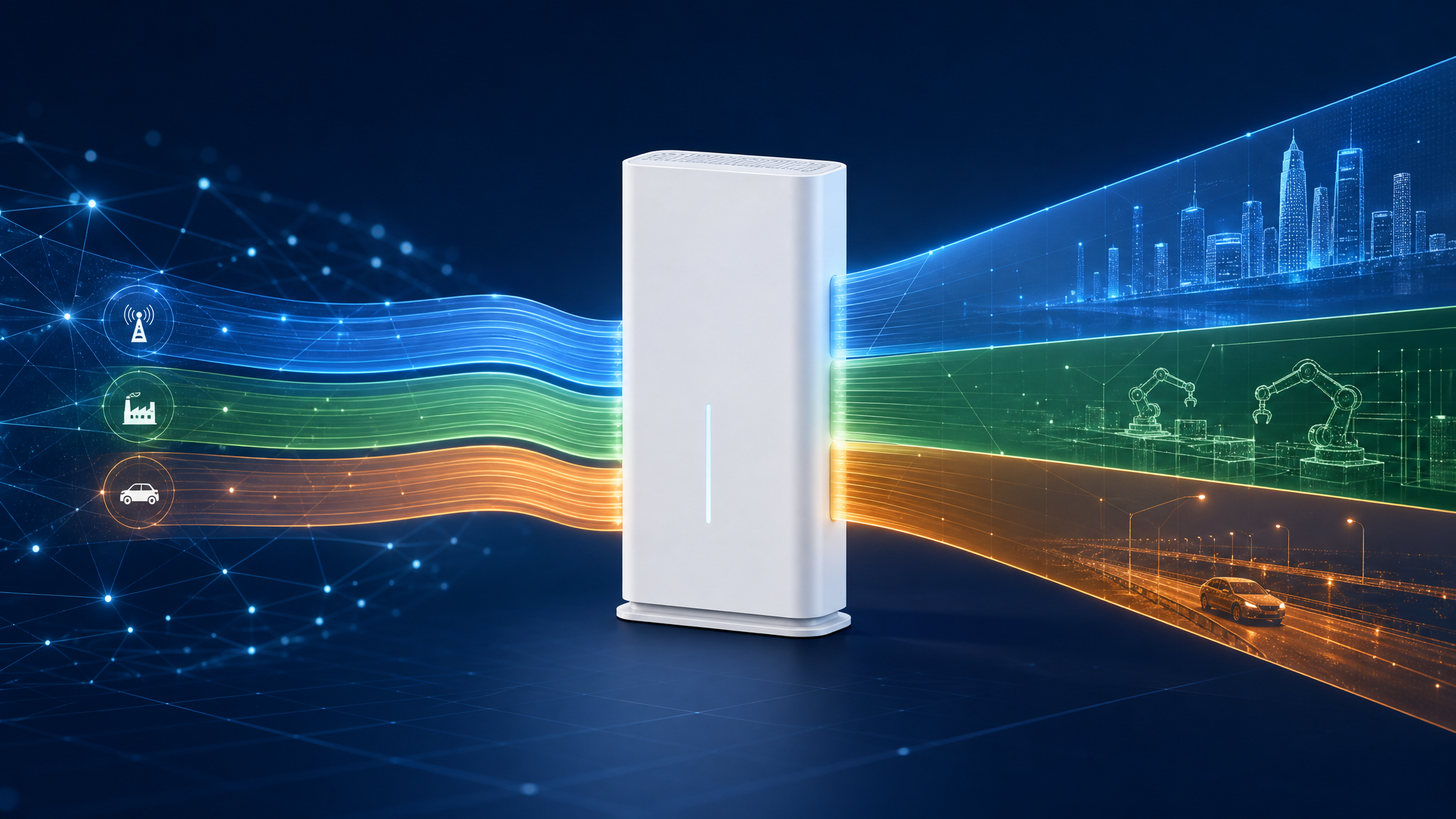
The telecom industry is entering a new phase of network monetization in 2026, and network slicing stands at the center of it. For operators, ISPs, and MVNOs deploying fixed wireless access (FWA) services, the ability to deliver multiple virtualized network services over a single physical CPE device is transforming the economics of last-mile connectivity.
3GPP-defined network slicing — formally introduced in Release 15 and matured through Release 18 — enables operators to partition a single 5G physical network into multiple isolated logical networks. Each slice can be optimized for a distinct service profile: ultra-reliable low-latency communications (URLLC) for industrial IoT, enhanced mobile broadband (eMBB) for residential broadband, or massive machine-type communications (mMTC) for smart metering. What changed in 2026 is that this capability has moved from core network trials into commercial CPE silicon.
URSP: The CPE-Side Enabler of Network Slicing
The critical CPE-side mechanism for network slicing is the UE Route Selection Policy (URSP), standardized in 3GPP TS 23.503. URSP rules, provisioned by the 5G core network to the CPE device, instruct the modem on how to route application traffic to specific Protocol Data Unit (PDU) sessions — each mapped to a different network slice identified by its Single Network Slice Selection Assistance Information (S-NSSAI).
In practical terms, a single 5G CPE deployed at an enterprise branch office can simultaneously:
- Route mission-critical SCADA traffic through a URLLC slice with sub-10ms latency guarantees
- Deliver enterprise internet access through a standard eMBB slice
- Terminate a private enterprise APN through a dedicated slice with enhanced security policies
- Support IoT sensor backhaul through an mMTC slice optimized for low-power devices
This is not speculative. Qualcomm’s Snapdragon X80 and MediaTek’s T830 modem platforms, shipping in 2026 CPE designs, include hardware-accelerated URSP rule processing with support for up to 8 simultaneous PDU sessions across 4 network slices. Huawei’s Balong 5000-series and Samsung’s Exynos Modem 5400 offer comparable slicing capabilities.
Commercial Deployment Patterns in 2026
Several deployment models have emerged across different operator segments:
Tier-1 Operator Multi-Service FWA: Deutsche Telekom and NTT Docomo have launched commercial FWA tiers that use slicing-aware CPE to differentiate service levels. A single outdoor CPE installation can deliver a base 100 Mbps residential broadband slice alongside a premium 500 Mbps business-grade slice with SLA-backed latency, all provisioned and billed separately through the operator’s BSS/OSS.
MVNO Slice-as-a-Service: In the US and European markets, MVNOs are leveraging slicing-capable CPE to offer “network-as-a-service” to enterprise customers. The MVNO leases slice capacity from the host MNO and deploys URSP-configured CPE at customer premises, creating a fully virtualized private network without spectrum ownership or RAN infrastructure.
Private 5G Hybrid Slicing: System integrators serving manufacturing and logistics verticals are deploying CPE that bridges a local private 5G NPN slice with a public MNO slice on the same device. This eliminates the dual-CPE architecture previously required for hybrid private/public deployments.
CPE Procurement Implications for Operators
For operators and ISPs evaluating CPE for slicing-capable networks in 2026, several technical requirements have become non-negotiable:
- URSP rule capacity: The CPE must support a minimum of 8 URSP rules with traffic descriptor matching at IP 5-tuple, Application ID (OSId/OSAppId), and DNN levels. Devices limited to IP-based routing only will not meet operator requirements for application-aware slicing.
- Multi-PDU session concurrency: At least 4 simultaneous PDU sessions, each independently addressable by the CPE’s internal routing table, with per-session QoS flow mapping.
- S-NSSAI configuration interface: Operators need a standardized management interface — TR-369 USP or a vendor MQTT-based API — to push S-NSSAI to DNN mappings to deployed CPE fleets without requiring firmware updates.
- Per-slice throughput enforcement: The CPE must enforce per-slice rate limiting at the IP forwarding layer to prevent one slice from consuming another slice’s guaranteed bandwidth.
- Slice isolation verification: Operators increasingly require CPE that can generate slice-level performance telemetry (latency, jitter, packet loss per S-NSSAI) for SLA compliance reporting.
Market Outlook
ABI Research estimates that slicing-capable 5G CPE will represent approximately 22% of total 5G FWA CPE shipments in 2026, growing to over 50% by 2028. The driver is not technology push but operator business pull: slicing transforms CPE from a cost center into a revenue multiplier, enabling a single customer premises installation to generate multiple recurring revenue streams.
For CPE manufacturers, supporting URSP and multi-slice architectures is no longer optional for Tier-1 and Tier-2 operator RFPs. The procurement language is shifting from “5G NR capable” to “3GPP Release 18 slicing compliant with URSP support verified through GCF/PTCRB certification.”
Frequently Asked Questions
What is network slicing in 5G CPE?
Network slicing in 5G CPE enables a single physical router to connect to multiple virtualized 5G network slices simultaneously, each optimized for different service requirements — such as ultra-low latency for industrial control, high bandwidth for internet access, and massive IoT connectivity for sensor networks.
What is URSP and why does it matter for CPE procurement?
UE Route Selection Policy (URSP) is the 3GPP-standardized mechanism that governs how a 5G CPE routes application traffic to specific network slices. For operators, URSP support in CPE is essential for delivering differentiated, SLA-backed services over a single device — enabling multi-revenue-stream business models from one customer installation.
How many network slices can a 2026 CPE support simultaneously?
Leading 2026 5G CPE platforms based on Qualcomm X80 and MediaTek T830 modems support up to 8 simultaneous PDU sessions across 4 distinct network slices, with per-slice QoS enforcement and isolated throughput management.
Explore Honlly Telecom’s 5G CPE portfolio designed for carrier-grade slicing deployments. Contact our solutions team to discuss URSP-compliant CPE for your network slicing roadmap.