Tag: 5G router supplier

  • Multi-WAN Failover and SD-WAN Integration Architecture for 5G CPE: Building Network Resilience for Enterprise Branch and ISP Deployments

    Multi-WAN Failover and SD-WAN Integration Architecture for 5G CPE: Building Network Resilience for Enterprise Branch and ISP Deployments

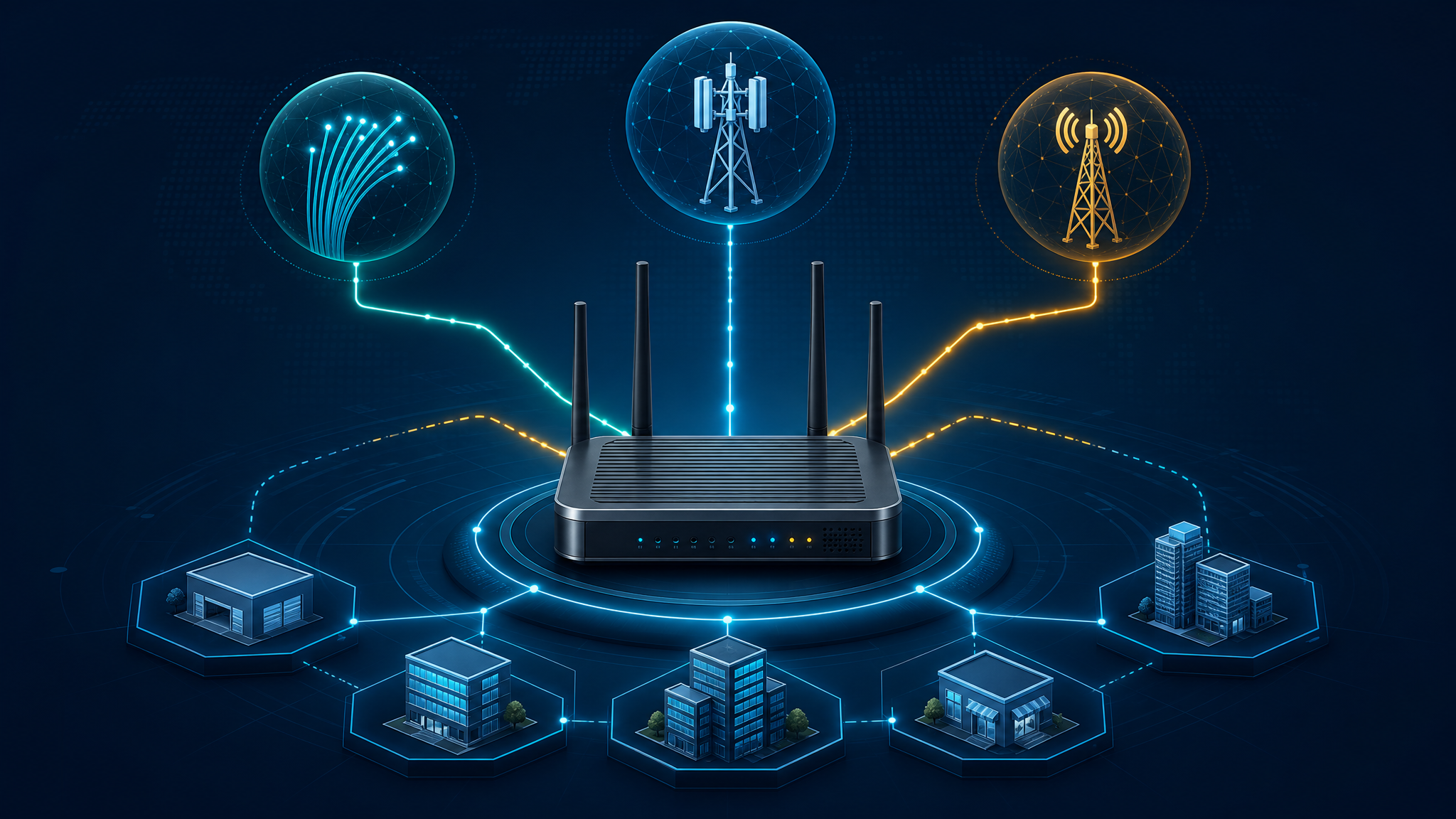
    For ISPs and enterprise network architects deploying 5G fixed wireless access at branch offices, retail locations, and remote sites, network resilience is not optional — it is a contractual SLA obligation. A single WAN link over 5G, however fast, introduces a critical single point of failure. The industry response in 2026 is multi-WAN CPE architectures with integrated SD-WAN intelligence, combining fiber, 5G, and 4G LTE paths into a unified resilience fabric managed at the customer premises.

    The Multi-WAN Imperative for 5G CPE

    Real-world 5G FWA deployments face several availability challenges that multi-WAN architectures directly address:

    • Cell site maintenance windows: Even Tier-1 operators schedule 2-4 maintenance events per cell site annually, each causing 2-6 hours of downtime. A secondary WAN path eliminates customer-facing outages during these windows.
    • 5G mmWave rain fade: Operators deploying 28 GHz and 39 GHz bands report up to 8 dB/km additional attenuation during heavy rainfall, sufficient to drop connections at cell edges. Automatic failover to sub-6 GHz 5G or LTE preserves connectivity.
    • Core network congestion: During peak hours, 5G user-plane throughput can degrade below SLA thresholds. Policy-based traffic steering to a fiber or alternate 5G path maintains critical application performance.
    • Fiber backhaul cuts: In hybrid fiber-plus-5G deployments, construction-related fiber cuts are the most common cause of extended outages. 5G WAN failover provides sub-second recovery.

    Multi-WAN Architecture Models

    Three dominant architectural patterns have emerged in 2026 CPE designs:

    1. Active-Standby with Path Monitoring

    The most widely deployed model for cost-sensitive ISP rollouts. The primary WAN interface (typically 5G NR or fiber) carries all traffic while the secondary interface (LTE or secondary 5G carrier) remains in hot standby. The CPE continuously monitors primary path health using ICMP probes, HTTP reachability checks, or BFD (Bidirectional Forwarding Detection) at configurable intervals as low as 300ms. On failure detection, failover completes within 1-3 seconds, including DHCP lease acquisition on the backup interface.

    Key capability for operators: pre-failover path quality verification. Advanced CPE implementations verify that the backup link has adequate signal quality (RSRP ≥ -110 dBm, SINR ≥ 0 dB) and throughput capacity before initiating failover, preventing flapping between degraded links.

    2. Active-Active Load Balancing with Application Steering

    Enterprise-grade CPE platforms support simultaneous active WAN paths with per-application or per-destination traffic distribution. This model uses policy-based routing (PBR) rules provisioned through the CPE management interface to steer traffic based on:

    • Application identification: Deep packet inspection (DPI) or SNI-based classification assigns VoIP and video conferencing to the lowest-latency path while bulk file transfers and cloud backups use the highest-throughput path.
    • Destination prefix: Traffic destined for specific IP ranges (e.g., AWS Direct Connect endpoints, corporate VPN concentrators) is pinned to specific WAN interfaces.
    • DSCP marking preservation: QoS markings are preserved and mapped to 5G QoS Flow Identifiers (5QI) on the cellular WAN path, ensuring end-to-end traffic class treatment.

    3. SD-WAN Overlay with Tunnel Bonding

    The most sophisticated model integrates an SD-WAN agent directly into the CPE software stack. All WAN interfaces — fiber, 5G NR, LTE, even satellite — terminate into SD-WAN tunnels (IPsec or WireGuard) that connect to an aggregation point (SD-WAN hub, cloud gateway, or carrier SD-WAN edge). The SD-WAN controller manages:

    • Per-packet tunnel bonding: Packet duplication and transmission across multiple WAN paths simultaneously, with the receiver accepting the first-arriving copy. This eliminates failover time entirely for loss-sensitive applications — the failover is packet-level, not session-level.
    • Forward error correction (FEC): Additional parity packets across tunnels enable loss recovery without retransmission, critical for real-time UDP traffic over cellular links.
    • Dynamic path selection: The SD-WAN controller continuously measures per-tunnel latency, jitter, and loss, and dynamically adjusts traffic distribution policies without CPE reboot or session interruption.

    CPE Hardware Requirements for Multi-WAN SD-WAN

    Not all 5G CPE hardware can effectively support multi-WAN and SD-WAN workloads. Operators evaluating CPE for resilient deployments should verify:

    1. CPU headroom: SD-WAN tunnel termination with IPsec encryption at 1 Gbps requires approximately 4 DMIPS per Mbps, or roughly a quad-core ARM Cortex-A55 at 1.8 GHz as a practical minimum. CPE based on low-power IoT-class processors will bottleneck at 150-300 Mbps of encrypted tunnel throughput.
    2. Hardware crypto acceleration: AES-NI or ARM Crypto Extensions support is essential for IPsec throughput above 500 Mbps. Software-only crypto on embedded CPE processors typically caps at 200-400 Mbps.
    3. Multiple independent WAN interfaces: At minimum: one 5G NR modem (3GPP Release 17+), one Gigabit Ethernet WAN port, and optionally a secondary cellular modem or SFP cage for fiber WAN. Avoid designs where the Ethernet port is LAN-only with no WAN routing capability.
    4. RAM and flash: Minimum 512 MB RAM and 256 MB flash for SD-WAN agent, routing table (full BGP feed not required at CPE level; default route plus specific prefixes is sufficient), and DPI signature database.

    Procurement Checklist for Operators

    When issuing RFPs for multi-WAN 5G CPE, operators should include these technical requirements:

    • Support for minimum 2 active WAN interfaces with independent IP addressing and routing tables
    • Path monitoring: ICMP, HTTP(S) GET, and BFD at configurable intervals down to 300ms
    • Failover time: ≤3 seconds from primary path failure to backup path active (measured at TCP session level)
    • Application-aware steering: DPI-based or at minimum DSCP-based with minimum 32 classification rules
    • SD-WAN tunnel support: IPsec IKEv2 and WireGuard with hardware-accelerated crypto, minimum 500 Mbps aggregate tunnel throughput
    • Zero-touch provisioning with pre-staged SD-WAN tunnel configurations via TR-369 USP or vendor ACS
    • Per-interface telemetry export (throughput, latency, jitter, packet loss) to operator NMS via NETCONF/YANG or gNMI

    Frequently Asked Questions

    What is the difference between multi-WAN failover and SD-WAN in 5G CPE?

    Multi-WAN failover provides basic link redundancy — switching traffic to a backup link when the primary fails. SD-WAN adds intelligent traffic steering across multiple active links based on application requirements, real-time path quality measurements, and centralized policy control. SD-WAN enables active-active link utilization, per-packet tunnel bonding, and application-aware routing that basic failover cannot provide.

    What CPU specifications are needed for SD-WAN on 5G CPE?

    For 1 Gbps IPsec SD-WAN tunnel throughput, a quad-core ARM Cortex-A55 at 1.8 GHz with hardware crypto acceleration (ARM Crypto Extensions) is the practical minimum. Software-only crypto on embedded CPE processors typically caps at 200-400 Mbps. Operators should request vendor benchmark data for encrypted tunnel throughput under production workloads.

    How fast should 5G CPE failover be for enterprise deployments?

    Enterprise-grade 5G CPE should achieve failover within 1-3 seconds measured at the TCP session level, including DHCP lease acquisition on the backup interface. BFD-based path monitoring at 300ms intervals enables sub-second failure detection. For real-time applications (VoIP, video conferencing), SD-WAN packet duplication across paths eliminates failover time entirely — the receiver accepts the first-arriving copy.

    Discuss your multi-WAN CPE requirements with Honlly Telecom. Contact our engineering team for SD-WAN-capable 5G CPE specifications and deployment consultation.

  • Multi-WAN and SD-WAN in CPE: Network Resilience for Enterprise and Carrier Deployments

    Multi-WAN and SD-WAN in CPE: Network Resilience for Enterprise and Carrier Deployments

    In a world where business operations depend on always-on connectivity, a single WAN link is a single point of failure. Whether it is a retail chain relying on cloud-based POS systems, a healthcare provider transmitting real-time patient data, or a carrier delivering managed SD-WAN services to enterprise customers — network downtime translates directly into lost revenue, damaged reputation, and, in some cases, regulatory penalties. Multi-WAN and SD-WAN capabilities in CPE devices are no longer optional features. They are table stakes for any serious B2B deployment.

    The concept is straightforward: equip the CPE with two or more WAN interfaces — typically cellular (4G/5G) plus wired (Ethernet/fiber), or dual cellular from different carriers — and use intelligent software to manage traffic across them. But the implementation details matter enormously. The difference between a crude connection failover that drops every VoIP call in progress and a sophisticated SD-WAN implementation that seamlessly shifts traffic with zero perceived interruption is measured in customer satisfaction, SLA compliance, and competitive differentiation.

    Multi-WAN Architectures: Failover, Load Balancing, and Bonding

    Multi-WAN implementations fall into three broad architectural categories, each suited to different deployment scenarios:

    1. Active-Passive Failover

    The simplest and most widely deployed Multi-WAN configuration. The CPE maintains one active WAN connection (typically a wired fiber or DSL link) and one standby connection (typically 5G cellular). The CPE continuously monitors the primary link — using ICMP pings, DNS lookups, or HTTP health checks to external targets — and automatically fails over to the secondary link when the primary is detected as unavailable. Failover times typically range from 10 to 60 seconds depending on detection sensitivity and the CPE’s WAN reconnection logic.

    Active-passive failover is ideal for branch offices, retail locations, and small-to-medium enterprise sites where the cellular link serves purely as insurance against wired broadband outages. The key design consideration is health-check granularity: pinging a single IP address every 30 seconds may miss transient failures, while aggressive sub-second monitoring can trigger unnecessary failovers due to normal network jitter. A well-designed implementation uses multiple health-check targets and configurable thresholds — for example, requiring three consecutive failures across two independent targets before triggering failover.

    2. Active-Active Load Balancing

    In an active-active configuration, the CPE uses both WAN connections simultaneously, distributing traffic across them based on configurable policies. Common load-balancing algorithms include weighted round-robin (assigning a percentage of new sessions to each link), least-connection (sending new sessions to the link with fewer active connections), and bandwidth-proportional (distributing traffic in proportion to each link’s capacity).

    Active-active is most valuable when both WAN links offer comparable performance and the operator wants to maximize aggregate throughput. For example, a CPE with two 5G connections from different carriers can deliver combined download speeds approaching the sum of both links for multi-session traffic. However, active-active introduces complexity: individual TCP sessions are pinned to a single WAN link (you cannot split a single TCP flow across two links without bonding), and applications that depend on consistent source IP addresses — such as banking portals or VPN gateways — may require session persistence rules.

    3. Channel Bonding / Link Aggregation

    The most sophisticated Multi-WAN approach, channel bonding combines multiple physical WAN links into a single logical connection — typically using a VPN tunnel to a bonding server in the cloud or at a data center. The bonding server reassembles packets arriving over different paths, presenting a unified, higher-bandwidth connection to the application layer. Unlike simple load balancing, bonding can aggregate bandwidth for a single application flow.

    Channel bonding requires infrastructure on both ends — the CPE must support a bonding client (such as OpenMPTCProuter or a commercial SD-WAN bonding agent), and the operator must deploy bonding concentrators. For fixed-location deployments with mission-critical bandwidth requirements (broadcast video contribution, large-file transfer for engineering firms, real-time data replication), bonding delivers tangible throughput benefits. However, the per-megabit cost of bonding server infrastructure means it is rarely deployed as a default feature — it is typically an upsell for premium enterprise service tiers.

    SD-WAN in CPE: Application-Aware Routing for the Last Mile

    While Multi-WAN provides the physical path diversity, SD-WAN adds the intelligence layer. A CPE with SD-WAN capabilities goes beyond link-level failover and load balancing to make per-application routing decisions based on real-time network conditions.

    An SD-WAN-capable CPE continuously measures the performance of each WAN link — latency, jitter, packet loss, and available bandwidth — and maintains a dynamic quality score for each path. When an application session is initiated, the SD-WAN engine classifies the traffic (by destination IP, port, protocol, or deep packet inspection) and selects the best available path based on the application’s requirements:

    • VoIP and video conferencing: Routed over the lowest-latency, lowest-jitter path. If that path degrades, the session is seamlessly migrated to the next-best path — modern SD-WAN implementations can achieve sub-second failover with no dropped calls.
    • Bulk file transfers and cloud backups: Routed over the highest-bandwidth path, or load-balanced across multiple paths for maximum throughput.
    • SaaS applications (Office 365, Salesforce, etc.): Routed based on policy — for example, preferring the wired link for cost reasons, with automatic failover to cellular if the wired link is congested.
    • Guest WiFi and non-critical traffic: Confined to the lower-cost or lower-priority link, preserving premium bandwidth for business applications.

    For ISPs and MSPs offering managed SD-WAN services, the CPE becomes the edge enforcement point for the service. The operator’s SD-WAN orchestrator — typically a cloud-based or on-premises controller — pushes policies to the CPE, collects telemetry, and provides the customer with visibility into application performance across all sites. Integration between the CPE and the orchestrator is critical: the CPE must support the orchestrator’s API or protocol (commonly NETCONF/YANG, RESTCONF, or proprietary APIs from vendors like VMware VeloCloud, Fortinet, or Cisco).

    Dual-SIM and Multi-Carrier 5G: The Cellular Advantage

    One of the most practical Multi-WAN configurations for CPE is dual-SIM with multi-carrier support. A CPE equipped with two SIM slots — or an eSIM plus a physical SIM — can connect to two different mobile network operators simultaneously (with dual-modem hardware) or switch between them intelligently (with a single modem).

    The use cases are compelling: a logistics company deploying CPE in delivery vehicles that cross carrier coverage boundaries, a construction site where only one carrier has adequate signal strength at a given location, or a retail chain negotiating better data rates by splitting traffic across two carriers. Dual-SIM CPE with automatic carrier selection based on signal quality, data usage caps, or time-of-day pricing gives operators a powerful tool to offer “always-best-connected” service level agreements.

    Honlly Telecom’s 5G CPE portfolio includes dual-SIM models such as the HL-840M, with firmware support for automatic carrier failover, usage-based SIM switching, and configurable carrier preference policies. For operators building differentiated enterprise services, dual-SIM capability is a high-margin differentiator that competitors relying on single-carrier CPE cannot match.

    Deployment Considerations for ISPs and Operators

    Before rolling out Multi-WAN or SD-WAN CPE to enterprise customers, operators should address several practical considerations:

    1. IP address management. With Multi-WAN, the CPE has multiple public IP addresses — one per WAN link. Outbound sessions may appear to originate from different IPs depending on which link is active. For applications that require a consistent source IP (IP whitelisting for SaaS platforms, site-to-site VPNs), operators must implement source NAT persistence or use a cloud-based SD-WAN gateway that presents a single egress IP.

    2. QoS and bandwidth management. Simply adding a second WAN link without proper QoS policies can create more problems than it solves. If the backup cellular link has lower bandwidth than the primary fiber link, applications that fail over may experience degraded performance. Operators should define per-application bandwidth guarantees and DSCP marking policies that adapt when links change.

    3. SLA definition and monitoring. Multi-WAN enables new SLA tiers — for example, “99.99% uptime with automatic 5G failover” versus “99.9% uptime on single link.” Operators need the monitoring infrastructure (probes, synthetic transactions, customer-facing dashboards) to prove SLA compliance to enterprise customers.

    4. Security across multiple links. Each WAN interface is an attack surface. The CPE’s firewall must enforce consistent security policies across all WAN links, and operators should consider whether SD-WAN traffic should be tunneled through a secure gateway for centralized threat inspection — especially when one of the links is a public cellular network.

    Frequently Asked Questions

    What is Multi-WAN in a CPE device?

    Multi-WAN is a feature in CPE routers that allows the device to connect to two or more wide-area network (WAN) connections simultaneously — for example, a 5G cellular connection plus a fiber or DSL line, or dual 5G connections from different carriers. The CPE can use these connections for automatic failover (switching to the backup if the primary fails), load balancing (distributing traffic across both links), or policy-based routing (sending specific traffic types over specific WAN links). Multi-WAN dramatically improves network uptime for business-critical applications.

    How does SD-WAN differ from basic Multi-WAN failover?

    Basic Multi-WAN failover simply switches all traffic to a backup link when the primary fails — typically with a 10–60 second interruption. SD-WAN adds application-aware intelligence: it continuously monitors the quality of each WAN link (latency, jitter, packet loss) and dynamically routes application traffic over the best-performing path in real time. For example, a VoIP call might be routed over a low-latency fiber link while bulk file transfers use the higher-bandwidth 5G connection — and if either link degrades, traffic is seamlessly shifted with minimal or no perceptible interruption.

    What are the key use cases for Multi-WAN CPE in enterprise deployments?

    Key use cases include: retail branch connectivity (using 5G as backup for wired broadband to keep POS systems online during outages), pop-up locations and temporary sites (using cellular as primary WAN with no fixed-line dependency), SD-WAN hybrid deployments (combining low-cost broadband with 5G for cost-effective multi-path connectivity), in-vehicle and mobile deployments (using dual-carrier 5G for always-on connectivity in transit), and carrier aggregation at the WAN level (bonding two cellular connections for higher aggregate throughput).

    Does Honlly Telecom offer Multi-WAN capable CPE?

    Yes. Honlly Telecom’s 5G CPE portfolio includes models with dual-SIM, Multi-WAN, and SD-WAN capabilities. Our engineering team can customize firmware for operator-specific failover policies, load-balancing algorithms, and integration with third-party SD-WAN orchestrators. Contact our sales team to discuss your specific Multi-WAN requirements.

    Looking for Multi-WAN or SD-WAN capable CPE for your deployment?

    Contact Honlly Telecom for a Custom Solution


  • How to Choose the Right OEM/ODM Partner for 4G/5G CPE and MiFi Devices

    How to Choose the Right OEM/ODM Partner for 4G/5G CPE and MiFi Devices


    Selecting the right OEM or ODM partner for your 4G/5G CPE and MiFi product line is one of the most consequential decisions a telecom equipment buyer can make. The wrong partner can mean delivery delays, certification failures, quality issues, and lost market opportunities. The right partner becomes a strategic asset — accelerating your time-to-market and ensuring product reliability across every unit shipped.

    Key Factors in Selecting an OEM/ODM Partner

    1. Certifications and Regulatory Compliance

    Certifications are the gateway to any market. A competent CPE manufacturer must navigate the regulatory landscape across multiple regions: CE for Europe, FCC for the United States, IC/ISED for Canada, PTCRB/GCF for carrier network approval, RCM for Australia, Anatel for Brazil, and JATE/TELEC for Japan. Ask potential partners to provide their existing certification portfolio. A manufacturer with pre-certified reference designs can save you 3–6 months and tens of thousands in testing costs.

    2. R&D and Engineering Capability

    Wireless CPE is not a commodity. The difference between a device that performs and one that frustrates users comes down to RF engineering — antenna design, thermal management, firmware optimization, and carrier compatibility. Evaluate whether the manufacturer has an in-house R&D team with expertise across chipset platforms (Qualcomm, MediaTek, UNISOC, ASR), antenna design, and embedded Linux/OpenWRT development. Ask about their track record with specific chipsets relevant to your product roadmap.

    3. Customization Depth and Flexibility

    Can the manufacturer adapt their designs to your requirements? Look for these customization capabilities:

    • Industrial design (ID): Custom enclosures, materials, and form factors.
    • Branding: Logo printing, custom packaging, and user manual localization.
    • Firmware: Custom UI/UX, operator-specific TR-069 parameters, and value-added features.
    • Hardware: Port configuration changes, antenna modifications, and component selection.
    • Software integration: ACS platform compatibility, OTA update systems, and cloud management SDKs.

    Visit the factory if possible. A transparent manufacturer will welcome a facility tour and technical deep-dive with their engineering team.

    4. Production Capacity and Quality Control

    Capacity matters — especially as your business scales. Ask about monthly production volume, lead times, and their track record of meeting delivery commitments. Quality systems are equally important: look for ISO 9001 certification, SMT (Surface Mount Technology) production lines, RF testing chambers, and burn-in testing protocols. A well-documented quality management system minimizes defective units reaching your customers.

    5. Supply Chain Resilience

    The component shortages of recent years highlighted how critical supply chain management is. A strong OEM/ODM partner maintains relationships with multiple chipset and component suppliers, holds strategic inventory, and proactively communicates material availability. Ask about their sourcing strategy for key components — 5G modems, Flash memory, power management ICs — and their contingency plans for supply disruptions.

    6. After-Sales Support and Warranty

    Your relationship with a CPE manufacturer doesn’t end at delivery. Evaluate their after-sales infrastructure: warranty terms (standard is 12–24 months), RMA (Return Merchandise Authorization) process efficiency, technical support availability, and firmware update policy. A partner that provides ongoing firmware maintenance ensures your deployed devices remain secure and feature-current throughout their lifecycle.

    Honlly Telecom: Your Strategic OEM/ODM Partner

    Honlly Telecom brings over a decade of experience in 4G/5G CPE, MiFi, and wireless router manufacturing for ISPs, operators, MVNOs, and distributors worldwide. Our Shenzhen-based engineering team handles the full product lifecycle — from concept and industrial design through certification, mass production, and ongoing support.

    We offer:

    • Proven reference designs across Qualcomm, MediaTek, UNISOC, and ASR platforms.
    • Global certifications: CE, FCC, IC, PTCRB, GCF, and regional compliance.
    • Flexible production: MOQs tailored to your project, with pilot-run and scale-up support.
    • Full customization: Branding, firmware, packaging, and industrial design.
    • Dedicated support: Engineering point-of-contact and responsive after-sales service.

    Browse our product portfolio: Honlly Telecom Product Range

    Frequently Asked Questions

    What is the difference between OEM and ODM for CPE devices?

    OEM (Original Equipment Manufacturing) means the manufacturer produces devices based on the buyer’s specifications and branding. ODM (Original Design Manufacturing) means the manufacturer designs and produces the device, and the buyer can rebrand it with minor customizations. For telecom equipment like 4G/5G CPE and MiFi, ODM allows faster time-to-market using proven reference designs, while OEM offers deeper customization for unique requirements.

    Which certifications does a CPE manufacturer need?

    Key certifications depend on target markets: CE (Europe), FCC (United States), IC/ISED (Canada), PTCRB/GCF (carrier network approval), RCM (Australia), Anatel (Brazil), and JATE/TELEC (Japan). A qualified manufacturer should hold or be capable of obtaining the specific certifications your target market requires.

    How long does OEM/ODM CPE development typically take?

    The timeline varies: using an existing ODM platform with cosmetic customizations may take 6-10 weeks. Full OEM development with hardware modifications or new industrial design can take 4-8 months. Key phases include specification definition, hardware design, firmware development, compliance testing, and pilot production.

    What MOQ (Minimum Order Quantity) is typical for OEM CPE orders?

    MOQs vary by product complexity and customization depth. For standard ODM 4G/5G CPE devices, typical MOQs range from 500 to 2,000 units. For fully custom OEM designs, MOQs may start at 3,000-5,000 units due to tooling and R&D investment. Honlly Telecom offers flexible MOQ terms for qualified partners and pilot programs.

    Looking for a reliable OEM/ODM partner for your 4G/5G CPE project?

    Request a Quote from Honlly Telecom Today