
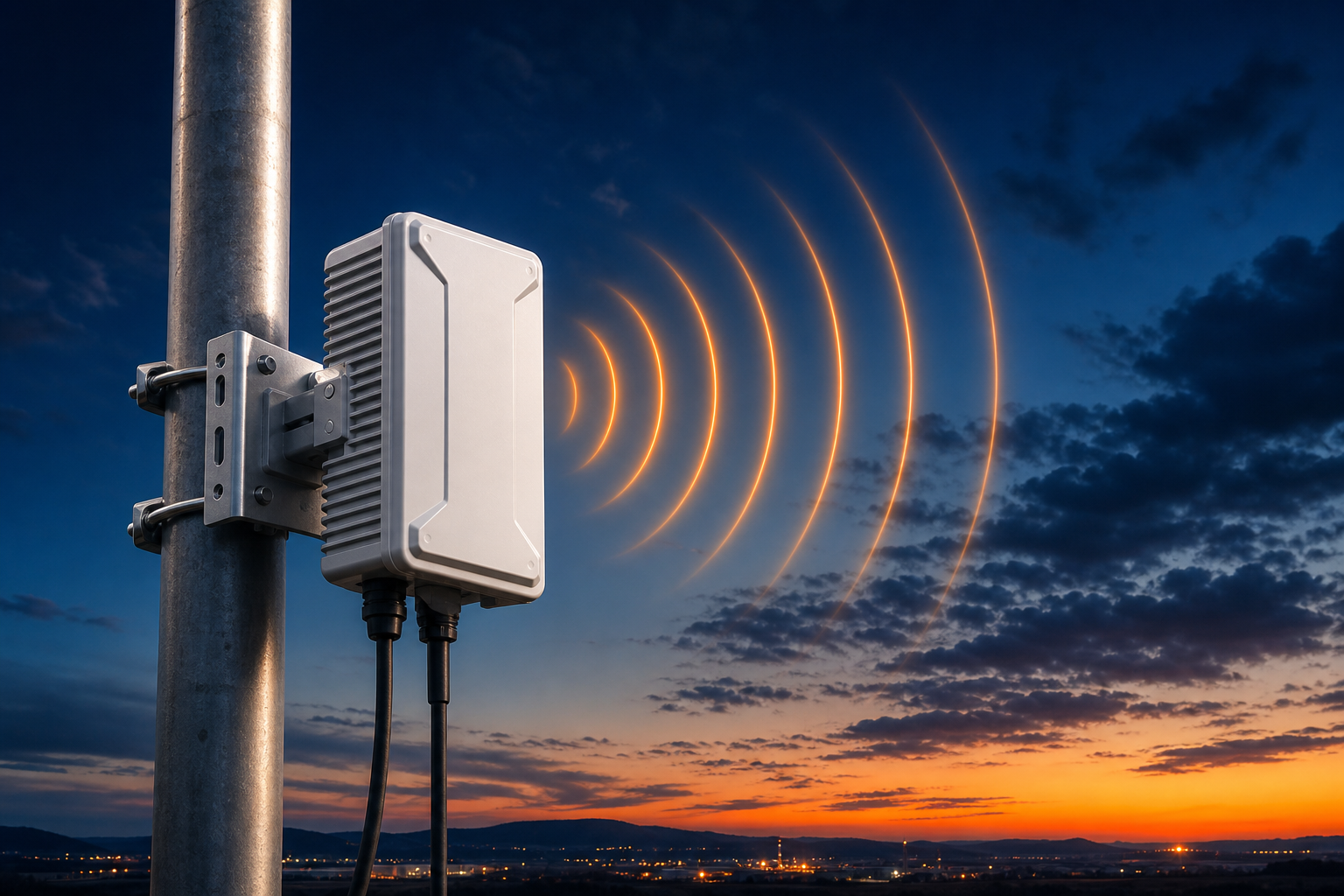
The global outdoor 5G CPE market is experiencing one of its strongest growth phases on record. According to preliminary Q2 2026 data from ABI Research and Dell’Oro Group, outdoor CPE shipments grew approximately 47% year-over-year in the first half of 2026, driven by expanded rural broadband funding programs, accelerated mmWave network rollouts in dense urban corridors, and a growing wave of Wireless Internet Service Provider (WISP) deployments across North America, Europe, and Southeast Asia.
This surge reflects a structural shift in how operators approach last-mile connectivity. Fixed Wireless Access (FWA) is no longer a stopgap technology — it has become the primary broadband delivery mechanism for millions of households and businesses, and outdoor CPE is the critical hardware anchor that determines the quality, reliability, and longevity of those connections.
mmWave and Sub-6GHz Co-Deployment Drives New CPE Requirements
One of the defining trends in 2026 is the increasing prevalence of dual-band outdoor CPE that supports both mmWave (FR2) and Sub-6GHz (FR1) frequencies within a single enclosure. Operators who initially launched FWA services on 3.5 GHz mid-band spectrum are now layering mmWave capacity in high-density zones, requiring CPE that can seamlessly aggregate across both frequency ranges.
This co-deployment model places new demands on outdoor CPE hardware: wider antenna bandwidth coverage (covering n77/n78 through n257/n258/n260), more sophisticated beam management algorithms, and thermal engineering capable of dissipating the additional heat generated by mmWave front-end modules operating in direct sunlight. Manufacturers who invested early in gallium nitride (GaN) power amplifiers and advanced heat-pipe cooling architectures are seeing disproportionate demand from Tier-1 operators.
Site Engineering Becomes the Differentiator
As outdoor CPE hardware specifications converge across vendors, site engineering and installation quality have emerged as the real differentiators in FWA service performance. Operators report that properly engineered installations — accounting for azimuth alignment, Fresnel zone clearance, pole-mount stability, and lightning protection — yield 30–40% higher throughput consistency compared to suboptimal deployments.
Leading operators are now investing in AI-assisted installation tools that use smartphone-based augmented reality to guide field technicians through optimal antenna positioning. Vodafone’s European FWA operations reported a 22% reduction in truck rolls after deploying computer-vision-based alignment verification across their outdoor CPE install base in Q1 2026.
For procurement teams evaluating outdoor CPE, the vendor’s installation support ecosystem — including mobile alignment apps, spectrum analyzers with API integration, and certified installer training programs — should carry as much weight as the hardware specifications themselves.
Regulatory Tailwinds and Rural Broadband Funding
Government broadband subsidy programs continue to fuel outdoor CPE demand. The European Union’s Connecting Europe Broadband Fund allocated an additional €1.2 billion for rural FWA infrastructure in May 2026, while the second phase of the U.S. Broadband Equity, Access, and Deployment (BEAD) program released $6.4 billion in matching funds specifically earmarked for fixed wireless projects in unserved census blocks.
In emerging markets, outdoor CPE is bridging the connectivity gap at an even faster pace. Reliance Jio’s JioAirFiber service in India, which relies heavily on outdoor CPE installations, added 8.2 million subscribers in the first five months of 2026, according to TRAI data. Similar growth trajectories are visible in Indonesia, Nigeria, and Brazil, where national operators are deploying outdoor FWA as the primary vehicle for meeting universal service obligations.
Implications for CPE Procurement in H2 2026
For ISPs, operators, and system integrators planning outdoor CPE procurement in the second half of 2026, several strategic considerations emerge. First, dual-band mmWave+Sub-6GHz capability is transitioning from a premium feature to a baseline requirement for greenfield deployments. Second, vendors with integrated installation tooling and AI-assisted site engineering software will deliver measurably better total cost of ownership.
Third, supply chain diversification remains critical — operators should qualify at least two outdoor CPE vendors per frequency band to mitigate single-source risk, particularly given ongoing silicon allocation constraints in the mmWave RF front-end supply chain. Finally, outdoor CPE with embedded eSIM (eUICC) support is gaining traction as operators seek to streamline logistics and enable remote carrier profile switching across multi-market deployments.
FAQ
What is driving the surge in outdoor 5G CPE shipments in 2026?
The surge is driven by three factors: expanded government broadband subsidy programs (BEAD in the U.S., CEBF in Europe), accelerated mmWave network deployments in urban corridors, and the maturation of FWA as a primary broadband delivery mechanism rather than a secondary option. Outdoor CPE is the critical endpoint hardware enabling these deployments.
What is the difference between mmWave and Sub-6GHz outdoor CPE?
mmWave (FR2) outdoor CPE operates in the 24–52 GHz range and delivers multi-gigabit throughput over shorter distances, ideal for dense urban deployments. Sub-6GHz (FR1) CPE operates below 6 GHz and provides broader coverage with lower throughput, suitable for suburban and rural FWA. Modern dual-band CPE combines both in a single unit for optimal performance across deployment scenarios.
Why is site engineering important for outdoor CPE performance?
Proper outdoor CPE installation — including precise azimuth alignment toward the serving cell tower, ensuring Fresnel zone clearance, secure pole-mounting, and adequate lightning protection — can improve throughput consistency by 30–40% compared to suboptimal installations. AI-assisted installation tools are increasingly used to verify alignment quality.
What should operators look for when procuring outdoor CPE?
Operators should evaluate dual-band capability (mmWave + Sub-6GHz), thermal engineering for outdoor environments, integrated installation tooling (mobile alignment apps, spectrum analyzer integration), eSIM/eUICC support for logistics efficiency, and vendor supply chain diversification to mitigate single-source risk.
How is government funding affecting outdoor CPE adoption?
Government broadband programs are a primary growth driver. The U.S. BEAD program released $6.4 billion for fixed wireless projects, and the EU’s CEBF allocated €1.2 billion for rural FWA. These subsidies make outdoor FWA economically viable for operators serving low-density areas, directly increasing outdoor CPE demand.
Source Outdoor 5G CPE from a Trusted Manufacturer
Honlly Telecom offers a comprehensive portfolio of outdoor 5G CPE solutions — including dual-band mmWave+Sub-6GHz models — with carrier-grade certifications, AI-assisted installation tooling, and flexible OEM/ODM engagement models. Contact our engineering team to discuss your deployment requirements.