
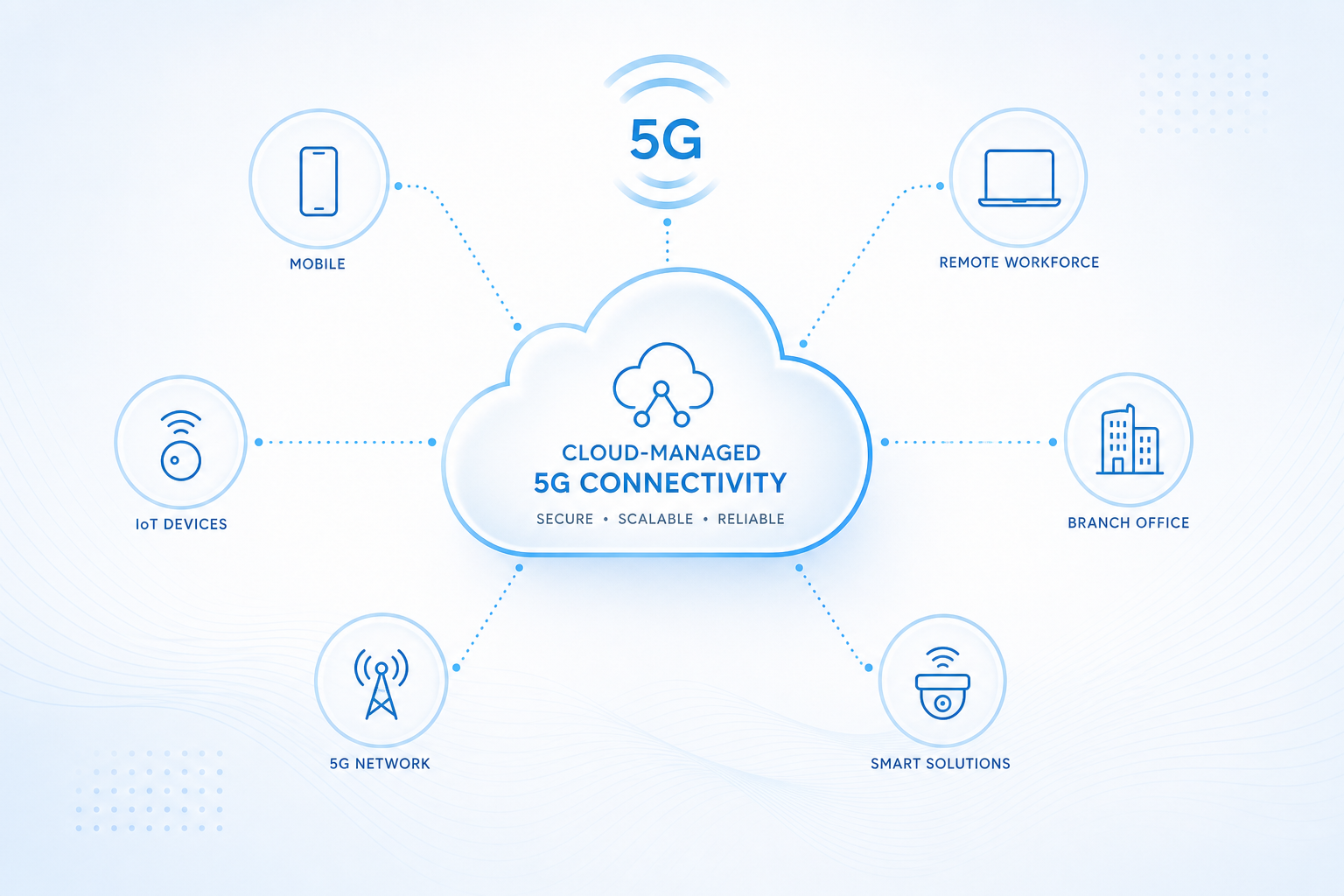
The operational paradigm for managing 5G fixed wireless access (FWA) customer premises equipment (CPE) at carrier scale is undergoing a fundamental transformation. As operator CPE fleets expand from thousands to millions of deployed devices, the legacy TR-069 (CWMP) protocol and on-premises ACS (Auto Configuration Server) architectures that served the DSL and early fiber era are giving way to cloud-native, TR-369 USP (User Services Platform)-based management frameworks. For telecom operators, MVNOs, and wholesale CPE buyers, understanding this evolution is critical for making informed procurement and deployment decisions in 2026 and beyond.
From TR-069 to TR-369 USP: A Generational Shift
The Broadband Forum’s TR-069 protocol (CWMP) has been the workhorse of broadband CPE management for nearly two decades, providing remote configuration, firmware upgrade, and diagnostic capabilities across hundreds of millions of devices. However, TR-069 was designed in an era of single-service DSL connections and presents fundamental limitations for modern multi-service 5G FWA deployments: its XML/SOAP-based messaging is bandwidth-intensive and processing-heavy; its connection model requires the ACS to initiate sessions through NAT traversal; and its data model lacks native support for the complex multi-WAN, network slicing, and IoT gateway functions of modern 5G CPE.
TR-369 USP, standardized by the Broadband Forum in 2020 and now reaching widespread implementation maturity, addresses these limitations with a fundamentally modernized architecture. USP uses a binary-protocol-over-WebSocket or CoAP transport, supports both controller-initiated and agent-initiated messaging, enables bulk data collection through the scalable USP Record mechanism, and provides native IoT device proxy capabilities. Critically, USP is designed for cloud-native deployment—its microservices-friendly architecture aligns with the Kubernetes-orchestrated, horizontally scalable management platforms that Tier-1 operators are now deploying.
Zero-Touch Provisioning: The ZTP Revolution
One of the most transformative operational benefits of modern cloud-managed CPE platforms is zero-touch provisioning (ZTP). In the TR-069 era, CPE onboarding typically required manual intervention: pre-configuration at a staging facility, customer-side technician visits, or phone-based guided setup. With TR-369 USP and cloud-native management, operators can achieve true zero-touch deployment: the CPE boots, connects to any available WAN interface (5G, LTE, Ethernet), discovers its management controller via DHCP options, DNS SRV records, or pre-loaded bootstrap URLs, authenticates using device certificates or IMEI/ICCID-based identity, and automatically downloads its full service configuration—all without human intervention.
For B2B operators deploying CPE at thousands of enterprise customer sites simultaneously, ZTP reduces deployment costs by an estimated 40-60% compared to staged or truck-roll provisioning models. Major CPE chipset vendors including Qualcomm (through its Device Management Framework) and MediaTek (via its Cloud CPE SDK) now provide integrated ZTP bootstrap libraries that simplify USP agent implementation for ODM/OEM manufacturers.
Multi-Tenant Architecture for Wholesale and MVNO Deployments
A critical capability that cloud-managed platforms bring to the B2B CPE ecosystem is true multi-tenancy. In wholesale and MVNO business models—increasingly common in the 5G FWA market—a single CPE hardware SKU may be deployed across multiple service provider tenants, each requiring isolated management visibility, distinct configuration profiles, and tenant-specific firmware branches. Cloud-native USP controllers implement tenant isolation at the platform layer, enabling a single management infrastructure to serve multiple operator customers while maintaining strict data and configuration separation.
This multi-tenant architecture also simplifies the CPE supply chain: wholesale buyers can procure a single, cloud-manageable CPE model and assign devices to downstream operator tenants through software configuration alone—eliminating the need for per-operator hardware variants and reducing inventory complexity.
Security Architecture for Cloud-Managed CPE
The shift to cloud-based CPE management introduces heightened security requirements. Modern TR-369 USP implementations mandate mutual TLS (mTLS) authentication between the CPE agent and the USP controller, with X.509 device certificates provisioned at manufacturing time or during initial bootstrap. The USP protocol also defines end-to-end message security, role-based access control (RBAC) for multi-tenant controller access, and secure software module management for verified firmware updates.
For procurement teams evaluating cloud-managed CPE solutions, security certification is paramount. Key certifications to look for include Broadband Forum BBF.369 USP certification, GSMA NESAS (Network Equipment Security Assurance Scheme) compliance for 5G devices, and relevant regional security certifications such as EUCC (EU) and FIPS 140-3 (North America).
Procurement Considerations for 2026-2027
When selecting cloud-manageable 5G CPE for carrier-grade deployments, B2B buyers should evaluate the following criteria:
- USP protocol compliance: Full TR-369 USP 1.2+ support with USP Record, USP Bulk Data Collection, and USP Firmware Management modules.
- Controller ecosystem compatibility: Certification with leading USP controller platforms including Axiros AXESS, Friendly Technologies, AOUSD, and open-source solutions like OB-USP-Agent.
- ZTP maturity: Support for DHCP Option 43/60, DNS-based discovery (RFC 6763), and pre-loaded bootstrap URL mechanisms with secure device identity provisioning.
- Multi-WAN management: Ability to manage 5G NR, LTE, Ethernet WAN, and Wi-Fi backhaul interfaces through a unified USP data model.
- Analytics and telemetry: Support for streaming telemetry (gNMI/gRPC alongside USP) and integration with operator big-data platforms for AI-driven predictive maintenance.
- Firmware lifecycle: A/B partition firmware architecture with USP-managed secure OTA updates and automated rollback capabilities.
The transition from TR-069 to TR-369 USP represents more than a protocol upgrade—it is a strategic platform shift that enables operators to manage exponentially larger CPE fleets with lower operational overhead, faster service velocity, and richer customer experience analytics. For B2B buyers, selecting cloud-native, USP-compliant CPE today is an investment in operational scalability that will pay dividends through the 5G-Advanced and 6G eras ahead.