
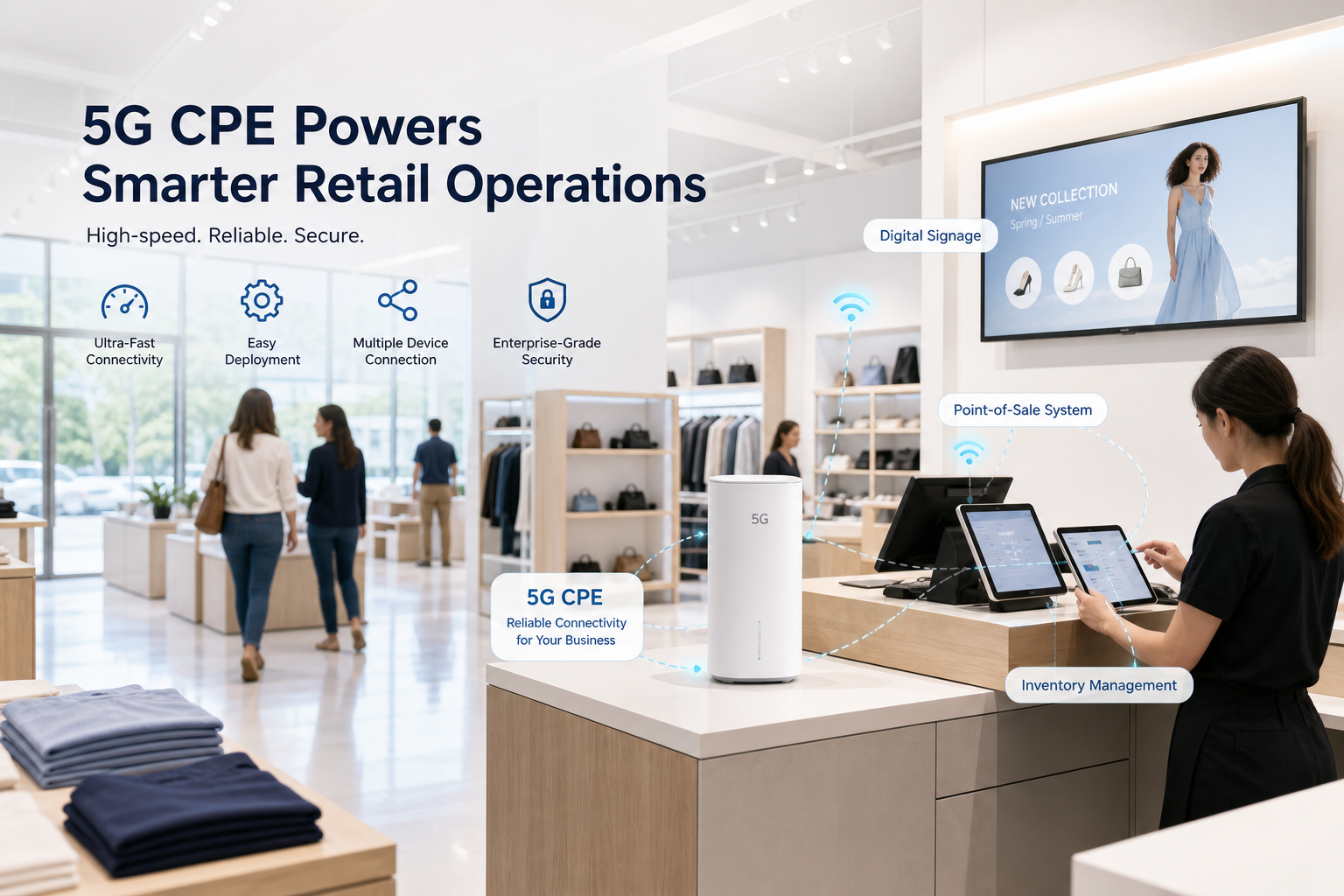
Retail chains and multi-site small-to-medium businesses represent one of the largest addressable markets for 5G fixed wireless access, yet the specific technical requirements of distributed retail environments are frequently underserved by generic enterprise CPE platforms. A national quick-service restaurant chain operating 2,000 locations, or a regional pharmacy network with 150 branches, faces connectivity challenges that differ fundamentally from single-site enterprise deployments: mass deployment logistics, centralized configuration management, payment card industry compliance, and the need for consistent customer-facing Wi-Fi performance across every location. This technical buyer’s guide examines the CPE architecture, security, and management requirements that B2B procurement teams should specify when sourcing 5G CPE for retail and multi-site SMB deployments.
The Multi-Site Connectivity Challenge
Retail chains face a unique combination of operational requirements that consumer-grade broadband and basic enterprise routers cannot satisfy simultaneously. The typical retail location must support point-of-sale (POS) transaction processing requiring sub-2-second authorization latency with 99.99% uptime, PCI-DSS compliant network segmentation that isolates payment traffic from guest Wi-Fi and back-office operations, digital signage and in-store media requiring sustained 15–50 Mbps per display, and inventory management systems that synchronize multi-gigabyte databases across hundreds of locations during overnight batch windows. Simultaneously, customer-facing guest Wi-Fi — increasingly expected as a baseline amenity — must deliver satisfactory throughput to dozens of concurrent users without compromising the security or performance of business-critical transaction traffic.
Traditional wired solutions — MPLS, business fiber, or carrier Ethernet — deliver the required reliability but at a per-site cost of $200–500 monthly for circuits that may take 60–90 days to provision. For chains opening 50–200 new locations annually, this provisioning timeline creates a direct revenue gap: each new store operates for weeks or months on consumer-grade broadband failover links that cannot support PCI-compliant transaction processing at scale. 5G FWA CPE, provisioned in hours rather than months and operating at $50–120 monthly per site, addresses this deployment velocity gap while delivering throughput that meets or exceeds typical retail requirements (50–150 Mbps per location).
PCI-DSS Compliance: The Non-Negotiable Requirement
Any CPE handling, transmitting, or providing network transport for payment card data must operate within a PCI-DSS compliant network architecture. The Payment Card Industry Data Security Standard version 4.0.1, effective since 2025, imposes specific requirements that directly influence CPE selection for retail deployments.
Network Segmentation (Requirement 1): The CDE (Cardholder Data Environment) must be logically separated from all other networks. 5G CPE deployed in retail must support at minimum three distinct network segments: a CDE VLAN for POS terminals and payment gateways, a corporate VLAN for back-office systems and inventory management, and a guest VLAN for customer Wi-Fi. Each VLAN requires independent DHCP, firewall policy, and QoS configuration. Enterprise-grade CPE platforms with hardware-accelerated VLAN tagging (802.1Q) and per-VLAN stateful firewall rules satisfy this requirement without additional network appliances.
Encryption of Cardholder Data in Transit (Requirement 4): All payment data traversing the CPE’s WAN interface must be encrypted using strong cryptography. While POS systems typically implement application-layer encryption (TLS 1.2+), PCI-DSS also requires network-layer protection for the CDE VLAN. CPE platforms with hardware-accelerated IPsec (supporting IKEv2 with AES-256-GCM) can establish encrypted tunnels directly from each retail location to the central payment processing gateway, providing defense-in-depth encryption that satisfies both PCI-DSS and general network security best practices.
Access Control and Monitoring (Requirements 7, 10): Administrative access to the CPE must be restricted to authorized personnel with unique credentials, and all access events must be logged. CPE deployed in retail environments should support TACACS+ or RADIUS integration for administrative authentication, with syslog forwarding (TLS-encrypted) to a centralized SIEM platform. Role-based access control (RBAC) with at minimum three tiers — full administrator, network operator, and read-only auditor — ensures compliance with separation of duties requirements.
Vulnerability Management (Requirement 6): CPE firmware must be regularly updated to address known vulnerabilities, and the update mechanism must be secure and auditable. Retail CPE platforms should support signed OTA firmware updates with automatic rollback protection, scheduled maintenance windows configurable per location, and a centralized dashboard that provides compliance reporting on firmware versions across the entire fleet.
SD-WAN Integration for Retail Networks
The emergence of SD-WAN has transformed how retail chains architect their wide-area connectivity. Rather than backhauling all traffic through a central data center — a model that adds 30–80ms of latency for cloud-hosted POS and inventory applications — SD-WAN enables intelligent traffic steering at each retail location. 5G CPE serving as the primary or secondary WAN termination point must integrate seamlessly with the organization’s SD-WAN overlay.
Key SD-WAN integration requirements for retail CPE include:
Dual-WAN with Application-Aware Routing: The CPE should support simultaneous 5G primary and wired/LTE secondary WAN connections, with policy-based routing that steers latency-sensitive POS transactions over the lowest-latency path while directing bulk data (inventory sync, digital signage content updates) over the highest-throughput or lowest-cost link. Application identification should extend to Layer 7 — recognizing specific cloud POS platforms, video streaming services, and SaaS applications — rather than relying solely on port-based classification.
Forward Error Correction and Packet Duplication: For retail locations in fringe 5G coverage areas where packet loss may degrade POS transaction reliability, the CPE should support FEC (Forward Error Correction) and selective packet duplication on critical traffic flows. These techniques add 5–15% bandwidth overhead but reduce effective packet loss by 2–3 orders of magnitude — a trade-off well worth making for payment traffic where a single dropped packet can trigger a transaction timeout and lost sale.
Zero-Touch Provisioning at Scale: When deploying CPE across hundreds or thousands of retail locations, manual configuration is operationally and economically infeasible. The CPE platform must support zero-touch provisioning (ZTP) that automatically downloads configuration templates, security policies, and SD-WAN overlay credentials upon first connection — typically via TR-069/TR-369 USP, DHCP options, or a cloud-based device onboarding service. The ZTP workflow should support staging-site pre-configuration for bulk deployments, where CPE units are provisioned at a central warehouse and shipped to individual locations ready to operate upon power-up.
Customer-Facing Wi-Fi: Performance Without Compromise
Retail guest Wi-Fi is no longer optional — it influences foot traffic, dwell time, and brand perception. 5G CPE with integrated Wi-Fi 6 (802.11ax) or Wi-Fi 6E capability can serve double duty as the primary internet gateway and the guest Wi-Fi access point for smaller retail locations (under 3,000 square feet), eliminating the need for a separate AP and reducing per-site hardware cost by $150–250.
The guest Wi-Fi configuration must enforce strict isolation from corporate and CDE VLANs — a requirement that integrated Wi-Fi CPE satisfies more cleanly than separate devices, as the isolation is enforced at the CPE’s internal switch fabric rather than relying on upstream switch or router ACLs that can be misconfigured. Captive portal support with customizable branding, social media login integration, and usage analytics provides marketing value beyond basic connectivity.
For shared-tenancy environments — shopping malls, strip centers, and multi-tenant retail buildings — the CPE should additionally support GRE or VXLAN tunneling to a central wireless LAN controller, enabling consistent SSID, security policy, and captive portal experience across locations without per-site configuration complexity.
Centralized Fleet Management: The Operational Imperative
For retail IT teams managing hundreds or thousands of locations, centralized visibility and control is the difference between proactive network management and reactive firefighting. The CPE management platform must provide:
- Real-Time Dashboard: Fleet-wide status view with at-a-glance health indicators — online/offline status, WAN throughput, latency, packet loss, connected client count, and Wi-Fi channel utilization — organized by region, store type, or custom tags. Proactive alerting on threshold violations (throughput below SLA minimum, latency above 100ms, CDE VLAN connectivity loss) should trigger automated notifications via email, SMS, or ITSM integration.
- Bulk Configuration Management: The ability to push configuration changes to groups of CPE devices simultaneously — updating firewall rules across all East Coast locations, modifying guest Wi-Fi captive portal branding across all locations, or rotating IPsec pre-shared keys on a defined schedule — without per-device manual intervention.
- Compliance Reporting and Audit Trails: Automated generation of PCI-DSS compliance reports showing CDE VLAN segmentation configuration, firmware version consistency, administrative access logs, and encryption status across the CPE fleet. Integration with GRC (Governance, Risk, and Compliance) platforms via API enables audit-ready documentation with minimal manual effort.
- Predictive Analytics and Anomaly Detection: Machine learning models that analyze historical performance data to predict link degradation, identify sites experiencing coverage changes (due to tower maintenance or new construction obstruction), and flag CPE units with early signs of hardware failure — enabling proactive maintenance before end-users report service degradation.
Procurement Checklist for Retail 5G CPE
B2B buyers should evaluate candidate CPE platforms against the following retail-specific criteria:
- PCI-DSS Alignment: Hardware-accelerated VLAN segmentation (minimum 4 simultaneous VLANs), per-VLAN stateful firewall, hardware IPsec (IKEv2 + AES-256-GCM), RADIUS/TACACS+ admin authentication, signed OTA firmware updates, syslog forwarding with TLS encryption.
- SD-WAN Integration: Dual-WAN with application-aware routing (Layer 7 DPI), FEC and packet duplication for link remediation, zero-touch provisioning (TR-069/TR-369), integration with leading SD-WAN platforms (Cisco, Fortinet, VMware, Aruba).
- Wi-Fi Capability: Wi-Fi 6 (802.11ax) minimum, 4×4 MU-MIMO, VLAN-to-SSID mapping, captive portal with customizable branding, client isolation, minimum 64 concurrent clients.
- Centralized Management: Cloud-based fleet management with real-time dashboard, bulk configuration, compliance reporting, API integration for ITSM/GRC platforms, role-based access control.
- Physical and Environmental: Compact form factor suitable for retail back-office or under-counter installation, Kensington lock slot or equivalent physical security, operating temperature 0°C to +45°C, fanless design for silent operation on retail floor.
- Carrier Flexibility: Multi-carrier SIM support (dual-SIM with automatic failover), eSIM capability for remote carrier provisioning, support for all major 5G bands in the deployment region.
Conclusion
5G FWA CPE designed for retail and multi-site SMB deployments must address a complex intersection of requirements spanning payment security compliance, distributed network management, customer experience, and operational scalability. Generic enterprise CPE — while technically capable — often lacks the retail-specific features (PCI-DSS compliance tooling, captive portal integration, bulk fleet management) that transform a capable device into a retail-ready connectivity platform. B2B buyers who specify these requirements in procurement RFPs position their organizations to capture the deployment speed, cost efficiency, and customer experience benefits of 5G FWA while maintaining the security and compliance posture essential for retail operations.
This technical buyer’s guide was prepared by the Honlly Telecom solutions engineering team. For detailed specifications of Honlly’s retail-optimized 5G CPE platforms or to discuss your multi-site deployment requirements, contact our enterprise sales team at sales@xmhonlly.com.