
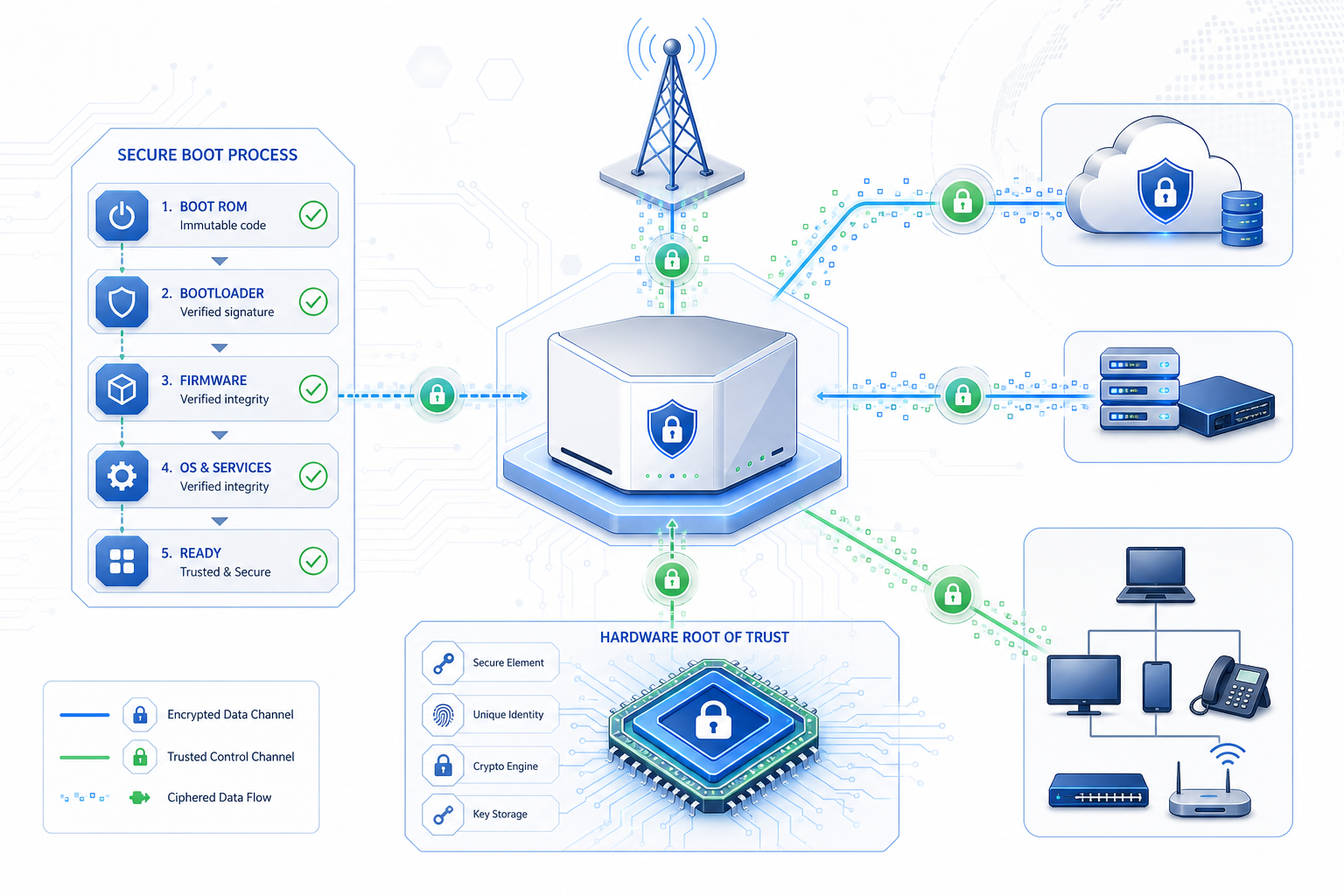
As 5G fixed wireless access matures from a consumer broadband play into a carrier-grade enterprise connectivity platform, the security requirements placed on customer premises equipment have escalated dramatically. A 5G CPE deployed at a bank branch, a utility substation, or a government office is no longer a simple modem—it is a network edge device that sits at the boundary between the carrier’s trusted domain and the enterprise LAN, processing sensitive traffic and maintaining persistent connectivity to the mobile core. This article provides a technical framework for evaluating Zero Trust security architectures in 5G CPE, covering the hardware root of trust, secure boot chains, firmware attestation, and cryptographic lifecycle management that procurement teams should require in carrier-grade FWA gateways.
Why Zero Trust for 5G CPE?
The traditional perimeter-based security model—where devices inside the carrier network are implicitly trusted—falls apart in modern FWA deployments. CPE devices are physically accessible to end users and third-party technicians, connected to untrusted LAN environments, and exposed to internet-originating threats on their WAN interfaces. A compromised CPE becomes a vector for lateral movement into the mobile core, a platform for DDoS amplification, or a surveillance point for traffic interception.
Zero Trust architecture addresses this by eliminating implicit trust at every layer. Every software component is verified before execution. Every communication session is authenticated and encrypted independently. Every configuration change is authorized against policy. For 5G CPE, Zero Trust is not a single feature but a system-level design philosophy that spans silicon, firmware, operating system, and application layers.
Hardware Root of Trust: The Silicon Foundation
The hardware root of trust (HRoT) is the immutable foundation upon which all other security properties depend. In a Zero Trust CPE, the HRoT is typically implemented as a dedicated security processor or a trusted execution environment (TEE) within the main SoC that operates independently of the application processor and maintains its own isolated memory space.
The HRoT stores device-unique cryptographic keys provisioned during silicon manufacturing—often using physically unclonable function (PUF) technology that derives keys from sub-micron variations in the silicon itself, making extraction physically infeasible. These keys never leave the HRoT boundary and are used exclusively for internal cryptographic operations: signing measurements, unwrapping protected blobs, and establishing device identity.
For CPE procurement, the minimum HRoT specification should include: compliance with GlobalPlatform TEE Protection Profile or equivalent, PUF-based or OTP-fused unique device key storage, a certified true random number generator (TRNG) for nonce and key generation, and physical tamper resistance meeting FIPS 140-3 Level 2 or higher. Devices that rely solely on software-based key storage or unprotected non-volatile memory for device identity should be disqualified from carrier-grade deployments.
Secure Boot: Measured and Verified Execution
Secure boot ensures that only authenticated software executes on the CPE from the moment power is applied. The process follows a chain of trust: the HRoT (immutable boot ROM) verifies the first-stage bootloader signature; the first-stage bootloader verifies the second-stage bootloader; the bootloader verifies the operating system kernel; and the kernel verifies each application and service before launch.
Critically, enterprise-grade CPE should implement measured boot alongside verified boot. Where verified boot makes a binary allow/deny decision at each stage, measured boot records cryptographic hashes of every loaded component into Platform Configuration Registers (PCRs) within a Trusted Platform Module (TPM 2.0). These measurements can be remotely attested by the network operator to prove that the CPE is running an authorized software stack before granting network access.
The TPM 2.0 integration requirements for carrier CPE should include: discrete or firmware TPM compliant with TCG PC Client Specification, support for SHA-256 and SHA-384 PCR banks, monotonic counters for replay protection, and NV storage for operator-provisioned policies. Integrated SoC-level TPM implementations (fTPM) are acceptable when backed by a TEE that isolates TPM operations from the rich OS, but discrete TPM (dTPM) provides stronger physical attack resistance.
Firmware Attestation: Proving Integrity to the Network
Remote attestation closes the Zero Trust loop by enabling the mobile network operator to cryptographically verify the CPE’s software state before allowing it to attach to the network. The process typically follows the IETF RATS (Remote ATtestation procedureS) architecture, which standardizes the roles of attester (the CPE), verifier (the operator’s attestation service), and relying party (the network access control function).
At network attachment time, the CPE generates a signed attestation report containing its PCR values, device identity certificate, and a fresh nonce provided by the verifier to prevent replay attacks. The verifier compares the PCR values against a reference database of known-good measurements for each authorized firmware version. If the measurements match, the verifier issues an attestation result that the network access control function uses to grant differentiated access—full network access for attested devices, restricted access for devices running unrecognized but unmodified firmware, and no access for devices with tampered software.
Procurement teams should specify support for: IETF RATS architecture with TPM-based attestation, X.509 device identity certificates (IEEE 802.1AR DevID) with PKI-based certificate lifecycle management, and operator-customizable reference measurement policies. The attestation client should support both network-attach-time and periodic runtime attestation to detect post-attach compromises.
Transport Layer Security and Cryptographic Agility
All traffic between the CPE and the 5G core traverses encrypted tunnels—IPsec for user plane traffic in most FWA architectures, complemented by TLS 1.3 for management plane communications (TR-069/TR-369, NETCONF, or proprietary ACS protocols). Zero Trust principles demand that these tunnels are established with mutual authentication bound to the device’s hardware identity, not just pre-shared keys that can be extracted from compromised firmware images.
Cryptographic agility is equally important. As quantum computing threats mature, CPE platforms must support crypto-agile architectures that allow algorithms to be swapped without hardware replacement. NIST’s Post-Quantum Cryptography (PQC) standardization process completed its first round of algorithm selections in 2024, and CPE platforms shipping in 2026 should include hardware acceleration for CRYSTALS-Kyber (key encapsulation) and CRYSTALS-Dilithium (digital signatures) in addition to classical algorithms.
Runtime Protection and Secure Updates
Beyond the boot chain, Zero Trust CPE must maintain security during continuous operation. Key runtime requirements include: signed and encrypted over-the-air (OTA) firmware updates with rollback protection (anti-downgrade enforced by TPM monotonic counters), secure storage for operator credentials and enterprise VLAN configurations with hardware-binding that prevents extraction if the flash chip is physically removed, runtime integrity monitoring that detects unauthorized code modification or configuration tampering, and a hardware-enforced secure debug interface that requires cryptographic authentication before JTAG or UART access is granted.
Evaluation Framework for Procurement
The following checklist provides a structured framework for evaluating Zero Trust security capabilities in 5G CPE:
- Hardware Root of Trust: PUF-based or OTP-fused unique device keys, certified TRNG, tamper-resistant key storage (FIPS 140-3 Level 2+)
- Secure Boot Chain: Immutable boot ROM, staged verification from bootloader through application launch, measured boot with TPM 2.0 PCR logging
- TPM Integration: TPM 2.0 (dTPM preferred, fTPM with TEE backup acceptable), SHA-256/384 PCR banks, NV storage for operator policies
- Remote Attestation: IETF RATS-compliant attestation client, IEEE 802.1AR DevID certificates, customizable reference measurements, periodic runtime attestation
- Mutual Authentication: Hardware-bound device identity for IPsec/TLS, PKI-based certificate management, crypto-agile architecture with PQC readiness
- OTA Updates: Signed and encrypted firmware images, hardware-enforced rollback protection, atomic update with fallback partition
- Runtime Defense: Secure credential storage with hardware binding, runtime integrity monitoring, authenticated debug interface
Conclusion
Zero Trust security is no longer optional for carrier-grade 5G CPE. As FWA deployments expand into enterprise verticals with stringent compliance requirements—finance, healthcare, energy, government—the security architecture of the CPE becomes a critical factor in both technical evaluation and regulatory compliance. Procurement teams that specify hardware-anchored Zero Trust capabilities today will avoid costly retrofit programs and security incidents as threat actors increasingly target the network edge.
This guide is part of Honlly Telecom’s Technical Buyer’s Guide series. For detailed security specifications of Honlly’s 5G CPE platforms or to schedule a technical deep-dive with our security architecture team, please contact our enterprise solutions group.