
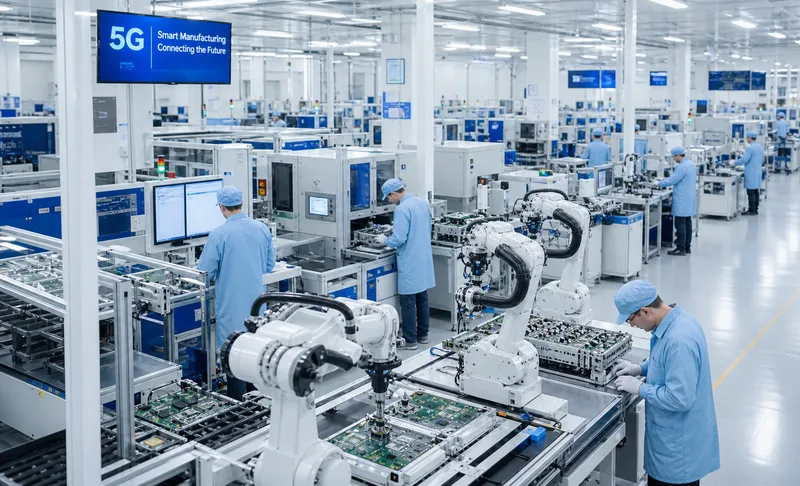
The global 5G CPE supply chain is undergoing a structural transformation in 2026 as telecom operators, system integrators, and enterprise procurement teams pivot from single-source dependency toward diversified, multi-region manufacturing strategies. This shift, driven by geopolitical realignments, component shortages, and the accelerating pace of 5G-Advanced deployments, is reshaping how B2B buyers evaluate and select CPE vendors for large-scale FWA, private network, and enterprise connectivity projects.
The End of Single-Source Dependence
For much of the 5G rollout cycle from 2020 through 2025, Tier 1 operators relied heavily on a concentrated pool of CPE manufacturers, often sourcing entire product lines from one or two primary ODMs. This model delivered economies of scale and simplified qualification workflows but created significant concentration risk. When component shortages hit the semiconductor supply chain in 2023-2024, operators with single-source strategies faced lead-time extensions of 20 to 40 weeks, delaying network expansion targets and impacting subscriber acquisition timelines.
By mid-2026, procurement teams across the telecom sector have formalized multi-source mandates. A recent industry survey of 150 global operators indicates that 73% now require at least two qualified manufacturing sources for each CPE SKU, up from 34% in 2023. This diversification extends beyond component-level dual-sourcing to encompass full-device manufacturing partnerships spanning multiple geographic regions, including manufacturing hubs in Southeast Asia, South Asia, and Latin America.
Geopolitical Drivers and Trade Policy Realignment
Trade policy continues to be a primary catalyst for supply chain restructuring. Tariff regimes in key markets, particularly North America and the European Union, have incentivized operators to source CPE from manufacturing bases in countries with favorable trade agreements. Vietnam, India, Mexico, and Thailand have emerged as strategic alternatives to traditional manufacturing centers, each offering distinct advantages in labor cost, logistics infrastructure, and bilateral trade access.
For B2B procurement managers, the calculus now extends beyond per-unit cost to include total landed cost analysis incorporating tariff exposure, shipping logistics, inventory carrying costs, and supply continuity guarantees. The most sophisticated buyers are employing scenario-modeling frameworks that evaluate vendor resilience across multiple disruption vectors: geopolitical, climatic, logistical, and regulatory.
The Rise of Regional Manufacturing Partnerships
A notable trend in 2026 is the emergence of regional CPE manufacturing partnerships. Rather than relying on a single global ODM, operators are engaging regional manufacturers for localized production runs serving specific markets. This approach reduces shipping lead times from 8-12 weeks to 2-4 weeks for regional fulfillment, dramatically improving responsiveness to demand fluctuations and reducing carbon footprint through shorter logistics chains.
In the Asia-Pacific region, several CPE manufacturers have established dedicated production lines for regional operators, offering SKU-level customization including localized firmware, regulatory certifications, and packaging. This regionalization strategy also addresses growing data sovereignty requirements, as some national regulators now mandate that telecom equipment firmware be developed, tested, or flashed within domestic borders.
Component-Level Resilience Strategies
Beyond finished-device sourcing, component-level resilience has become a boardroom priority. The 5G CPE bill of materials typically includes specialized components—5G modem chipsets, RF front-end modules, power amplifiers, and antenna arrays—that have historically been concentrated among a small number of semiconductor suppliers. Forward-thinking procurement teams are now qualifying alternative chipsets at the design stage, ensuring socket-level compatibility with multiple modem platforms to prevent single-vendor lock-in.
This design-for-resilience approach is particularly relevant for the emerging 5G RedCap and 5G-Advanced CPE categories, where second-source chipset availability is improving. Qualcomm, MediaTek, UNISOC, and several emerging Chinese semiconductor firms now offer competing modem platforms across the performance spectrum, giving CPE ODMs and their operator customers genuine multi-source optionality at the silicon level.
Inventory Strategy: From Just-in-Time to Just-in-Case
The era of lean, just-in-time inventory for CPE procurement is giving way to strategic buffer-stock models. Leading operators now maintain 8 to 16 weeks of safety stock for high-volume CPE SKUs, up from the 2 to 4 weeks that was standard pre-2023. While this carries higher working capital requirements, operators have determined that the cost of stockouts—measured in delayed revenue, competitor churn, and brand damage—far exceeds the carrying cost of strategic inventory reserves.
Advanced demand forecasting powered by machine learning is helping procurement teams optimize this balance. By analyzing subscriber acquisition patterns, seasonal demand cycles, network expansion timelines, and competitive dynamics, operators can dynamically adjust safety-stock targets at the SKU level, minimizing both stockout risk and excess inventory exposure.
Implications for CPE Vendor Selection in 2026-2027
For procurement decision-makers evaluating CPE partners, the 2026 vendor selection criteria have expanded well beyond technical specifications and unit pricing. RFPs now routinely weight supply chain resilience factors at 20-30% of total evaluation scores, alongside traditional technical and commercial criteria. Key evaluation dimensions include multi-factory manufacturing capability, geographic diversity of production sites, silicon-level multi-source qualification, logistics redundancy, and demonstrated supply continuity during prior disruption events.
CPE manufacturers that have invested in distributed manufacturing, qualified alternative component sources, and built regional fulfillment capabilities are gaining competitive advantage in operator RFPs. Those relying on single-factory, single-region production models face increasing disqualification risk, particularly for large-scale operator tenders exceeding 100,000 units annually.
Honlly Telecom’s Multi-Source Manufacturing Footprint
Honlly Telecom has proactively built a diversified manufacturing infrastructure aligned with the industry’s evolving procurement requirements. With production facilities in Shenzhen (China), strategic partnerships in Southeast Asia, and component-level multi-source qualification across leading 5G modem platforms, Honlly offers B2B customers the supply continuity assurances that modern procurement frameworks demand.
The company’s 5G CPE product lines—spanning indoor FWA gateways, outdoor CPE units, industrial-grade routers, and portable MiFi devices—are manufactured with socket-level chipset flexibility and multi-region fulfillment capability. For operators and enterprises building resilient 5G deployment pipelines, Honlly provides a procurement partner structured for the realities of the 2026-2030 supply chain landscape.
For more information on Honlly Telecom’s 5G CPE manufacturing capabilities and supply chain resilience framework, contact the B2B sales team or visit the product page.