
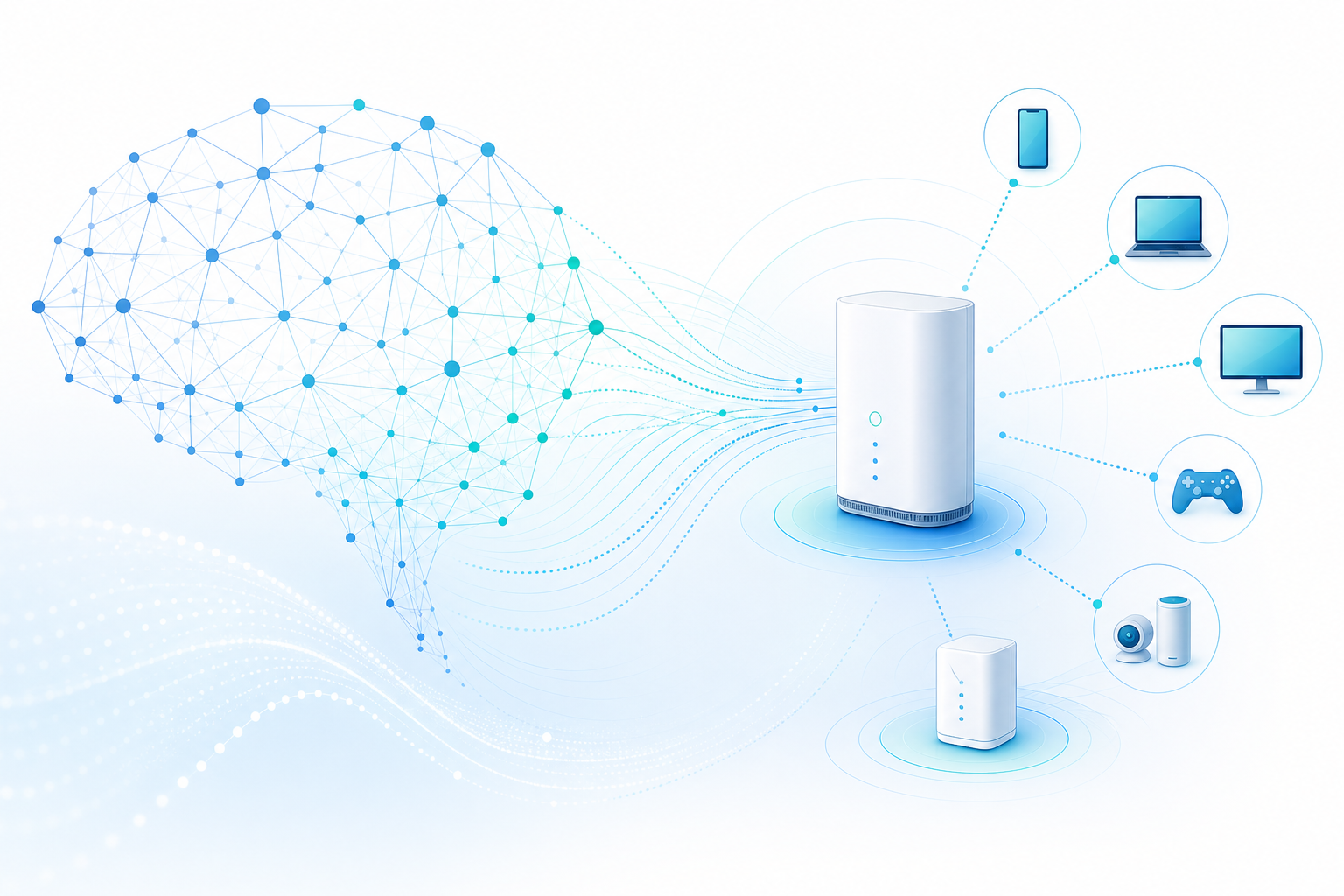
The telecom industry is witnessing a paradigm shift in how customer premises equipment (CPE) is managed at scale. After years of lab trials and proof-of-concept deployments, AI-native CPE management solutions are entering commercial service in 2026, bringing machine learning (ML)-driven automation to routine RF optimization, interference mitigation, and predictive maintenance workflows. For ISPs and mobile network operators managing tens of thousands of 5G fixed wireless access (FWA) endpoints, this transition from reactive troubleshooting to proactive intelligence marks one of the most significant operational efficiency gains since the introduction of TR-069 auto-configuration servers two decades ago.
The commercial availability of AI-native CPE management coincides with the global FWA subscriber base surpassing 200 million connections in mid-2026. As operators scale their deployments, the operational burden of manual CPE configuration, spectrum re-planning, and fault diagnosis becomes unsustainable. AI-driven platforms are emerging as the answer, leveraging telemetry data from deployed CPE fleets to automate optimization tasks that previously required field engineer visits.
The Shift from Reactive to Predictive CPE Management
Traditional CPE management architectures rely on periodic polling via TR-069 or TR-369 (USP) protocols. While effective for bulk configuration and firmware updates, these frameworks operate on fixed intervals and lack the ability to anticipate degradation before it impacts subscriber experience. In a 5G FWA network where each CPE serves as a primary broadband connection for a household or enterprise branch, even brief periods of degraded performance translate directly into support tickets and churn risk.
AI-native platforms invert this model. Instead of waiting for threshold breaches, they continuously ingest real-time metrics—RSRP, RSRQ, SINR, BLER, MCS index, and throughput per bearer—from every CPE in the fleet. Transformer-based time-series models then detect subtle pattern shifts that precede observable faults by hours or even days. The result is a predictive maintenance capability that allows operators to remediate issues before subscribers notice them.
Major CPE silicon vendors, including Qualcomm and MediaTek, have begun exposing ML inference APIs on their 5G modem platforms, enabling on-device anomaly detection that feeds into cloud-based fleet intelligence. This edge-cloud hybrid architecture reduces backhaul overhead while maintaining centralized visibility across the entire subscriber base.
ML-Driven RF Optimization: Beyond Static Configuration
Perhaps the most transformative application of AI in CPE management is autonomous RF optimization. In dense urban FWA deployments, where dozens of CPE devices operate within overlapping coverage footprints, static antenna configuration and fixed channel assignment lead to persistent co-channel interference and suboptimal spectral efficiency.
Reinforcement learning (RL) models trained on field data can now dynamically adjust CPE parameters—antenna beam steering, carrier aggregation band selection, MIMO layer mapping, and power control—in response to real-time RF conditions. Field trials conducted by Tier-1 operators in Southeast Asia and the Middle East have demonstrated 18–27% throughput improvements in high-interference environments when ML-driven optimization replaced manual configuration.
The commercial availability of these capabilities in 2026 is being accelerated by the maturation of O-RAN Alliance specifications, which define standardized interfaces for RAN Intelligent Controller (RIC) integration. Non-real-time RIC (Non-RT RIC) platforms can now ingest CPE-level telemetry and push optimization policies through the rApps framework, creating a vendor-agnostic AI management layer that works across multi-supplier CPE deployments.
Predictive Fault Detection and Self-Healing Networks
Beyond RF optimization, AI-native platforms are proving their value in fault management. CPE hardware failures—antenna degradation, PA burnout, thermal throttling, memory leaks—often present early warning signs in telemetry data long before they cause a complete outage. ML classifiers trained on historical failure data can identify these precursors with over 90% accuracy, enabling proactive CPE replacement or remote reconfiguration.
Self-healing capabilities represent the next maturity stage. When an AI platform detects a degrading CPE, it can automatically attempt remediation—switching to an alternative serving cell, reducing MIMO layers to compensate for antenna path loss, or throttling throughput to manage thermal headroom—before escalating to a truck roll. For operators, each avoided field visit represents an estimated $150–$300 in operational savings, making the ROI case for AI-native management compelling even at moderate fleet sizes.
What This Means for ISP Procurement in 2026–2027
As AI-native management enters commercial service, CPE procurement criteria are evolving. Forward-looking ISPs and operators are now evaluating CPE platforms not just on RF performance and cost, but on their telemetry richness and AI integration readiness. Key procurement considerations include:
- Telemetry granularity: Does the CPE expose per-bearer metrics, per-antenna-path RSSI, and modem temperature at sub-second intervals?
- On-device ML capability: Does the platform support edge inference via Qualcomm AI Engine, MediaTek APU, or equivalent NPU hardware?
- Standards alignment: Is the CPE compatible with O-RAN O1 and A1 interfaces for RIC integration?
- Vendor API openness: Does the manufacturer provide RESTful or gRPC APIs for telemetry streaming and configuration push?
- Fleet scalability: Can the AI platform handle 100,000+ devices with sub-second latency for critical remediation events?
Distributors and system integrators serving the ISP market should anticipate growing demand for AI-ready CPE and build their 2026–2027 product portfolios accordingly. The operational cost savings alone justify a premium of 8–12% over conventional CPE, and the subscriber experience improvements translate into measurable reductions in churn.
Honlly’s AI-Ready CPE Portfolio
Honlly Telecom’s 5G FWA CPE product line—including the HL-810Z, HL-820Z, and the newly launched HL-850Z WiFi 7 platform—is engineered for AI-native fleet management. All current-generation devices support high-granularity telemetry export via TR-369 USP, with O-RAN O1 interface compatibility currently in field validation. Honlly’s engineering team works closely with operator partners to customize telemetry schemas and integrate CPE data pipelines into their chosen AI/ML operations platforms.
For ISP procurement teams evaluating AI-ready CPE for 2026–2027 deployment cycles, Honlly offers evaluation units, technical documentation, and integration support. Contact the Honlly sales engineering team to schedule a technical consultation and discuss your AI-native FWA roadmap.